Mahatma Gandhi National Rural Employment Guarantee Act
Introduction
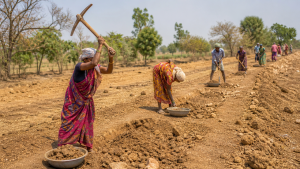
MGNREGA is India’s flagship rural employment law and a key part of the country’s social security framework. It gives rural households a legal right to demand wage employment and places the responsibility on the state to provide work or unemployment allowance within the prescribed time.
Implemented by the Ministry of Rural Development, the Act shifted rural welfare from a relief-based approach to a rights-based, demand-driven system. It also aims to create productive village assets, improve livelihoods, and strengthen local self-government.
Origin and Objectives
- Enactment: The Mahatma Gandhi National Rural Employment Guarantee Act was notified on September 5, 2005.
- Phased rollout: Phase I covered 200 districts from February 2, 2006; Phase II extended the scheme to 130 more districts in 2007–08; Phase III brought the remaining rural districts under the Act from April 1, 2008.
- Renaming: The law was originally known as NREGA and was renamed MGNREGA on October 2, 2009.
- Employment guarantee: It guarantees 100 days of wage employment in a financial year to every rural household whose adult members volunteer for unskilled manual work.
- Asset creation: The Act supports durable community assets and natural resource management in villages.
- Social goals: It seeks to reduce distress migration and promote inclusion, especially for women, Scheduled Castes and Scheduled Tribes.
- Local governance: Panchayati Raj Institutions play a central role in planning and execution.
Core Legal Provisions
- Right to apply: Adult members of a rural household may submit oral or written applications to the local Gram Panchayat.
- Job Card: The Gram Panchayat issues a free Job Card with photographs of all registered adult members within 15 days of application.
- Time-bound work: Employment must be offered within 15 days of submitting a written request for work.
- Unemployment allowance: If work is not provided within 15 days, the state government must pay unemployment allowance.
- Allowance rate: The allowance is one-fourth of the minimum wage for the first 30 days and one-half of the wage for the remaining period.
- Worksite distance: Work sites should normally be within 5 km of the applicant’s village.
- Extra wage: If work is allotted beyond 5 km, workers receive an additional 10% wage allowance for transport and living expenses.
- Equal wages: Men and women are paid equal wages for the same work.
- Women’s participation: At least one-third of the total beneficiaries must be women.
- Worksite facilities: Basic amenities such as safe drinking water, shade, first-aid kits and crèche facilities for small children are mandatory.
Financial Structure and Permissible Works
- Central funding: The Central Government bears 100% of the cost of unskilled manual labour wages.
- Material cost: The Centre bears 75% of the material cost, including wages for skilled and semi-skilled workers.
- State share: State Governments bear 25% of the material cost, the full unemployment allowance, and administrative costs of the State Council.
- Labour-material ratio: At the district level, a 60:40 ratio must be maintained between labour cost and material cost.
- Permissible works: The scheme focuses on water conservation, watershed management, soil health enhancement, micro-irrigation canals, afforestation and rural connectivity roads.
- Contractors and machinery: Engagement of commercial contractors and heavy power machinery is prohibited to maximise manual employment.
Governance, Transparency and Technology
- Gram Sabha role: Gram Sabhas conduct compulsory social audits of completed projects within their jurisdiction at least once every six months.
- Ombudsman: District-level Ombudsmen handle grievances, order investigations and recommend corrective action against administrative lapses.
- NMMS: The National Mobile Monitoring System enables digital attendance tracking at worksites through geo-tagged photographs taken twice a day.
- ABPS: Aadhaar-Based Payment System links worker bank accounts for Direct Benefit Transfer of wages and reduces leakages.
- GeoMGNREGA: GeoMGNREGA uses GIS and space technology to geo-tag assets before, during and after construction.
Important Administrative Features
| Parameter | Statutory provision |
| Legal mandate | 100 days of guaranteed unskilled manual employment per rural household per year |
| Nodal ministry | Ministry of Rural Development, Government of India |
| Target group | Adult members of rural households willing to do manual work |
| Job Card | Issued free of cost by Gram Panchayat within 15 days |
| Women participation | Minimum 33% of total workforce |
| Distance limit | Within 5 km radius; 10% extra wage if work is beyond 5 km |
| Wage payment cycle | Weekly or within a maximum of 15 days from work completion |
| Unemployment allowance | Payable by State Government if work is not provided within 15 days |
| Material to labour ratio | 60% labour and 40% material |
| Audit requirement | Mandatory social audit by Gram Sabha every six months |
Key Facts for Quick Revision
- Rollout milestones: The Act started with 200 districts in February 2006, expanded to 130 more districts in 2007–08, and covered the remaining rural districts from April 1, 2008.
- Renaming date: The scheme became MGNREGA on October 2, 2009.
- Gram Panchayat role: Gram Panchayats execute at least 50% of approved works by value.
- Project shelf: The shelf of projects is recommended by the Gram Sabha and approved by local bodies.
- Wage fixation: Wage rates are notified state-wise under Section 6(1) of the Act and linked to the Consumer Price Index for Agricultural Labourers (CPI-AL).
- Core principle: The Act is demand-driven, not supply-driven, and gives a legal right to employment.
- Worker rights: The law combines guaranteed work, unemployment allowance, equal wages and minimum workplace facilities.
Key Prelims Takeaways
- MGNREGA: A legal guarantee of 100 days of wage employment to rural households.
- Nodal ministry: Ministry of Rural Development.
- Job Card: Issued free by the Gram Panchayat within 15 days.
- Employment timeline: Work must be provided within 15 days of demand.
- Women quota: At least 33% of beneficiaries must be women.
- Wage and distance rule: Equal wages apply; work beyond 5 km gets an extra 10% allowance.
- Transparency: Social audit, NMMS, ABPS and GeoMGNREGA are key oversight tools.
Current General Studies comprises current-affairs-based, General Studies-rich study material on policies, laws, institutions, economy, science, environment, governance, international relations, and other varied but important topics for UPSC and State PSC Prelims examinations.
Fortnightly PDF compilations: Available here
Originally written on
May 2, 2026
and last modified on
September 5, 2026.
| Related | |
|---|---|