Key Marine Wildlife Conservation Laws and Schemes
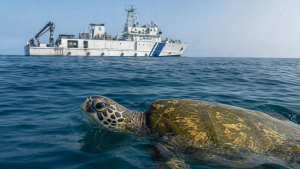
India’s marine wildlife protection framework combines constitutional duties, environmental regulation, wildlife law, and conservation programmes. It is designed to safeguard coastal habitats, endangered marine species, and fisheries across territorial waters and the Exclusive Economic Zone (EEZ).
Constitutional and Statutory Jurisdiction
- Article 48A: Directs the State to protect and improve the environment and to safeguard forests and wildlife.
- Article 51A(g): Makes it a fundamental duty of citizens to protect and improve the natural environment, including forests, lakes, rivers, and wildlife.
- Seventh Schedule: Wildlife protection is under Entry 17B of the Concurrent List. Territorial fisheries fall under Entry 21 of the State List, while maritime zones beyond territorial limits fall under Entry 57 of the Union List.
- CRZ Notification, 2019: Issued under the Environment (Protection) Act, 1986, it restricts development and waste disposal in Ecologically Sensitive Areas, including mangroves, seagrasses, sand dunes, and coral reefs.
Wild Life (Protection) Amendment Act and CITES Alignment
- Wild Life (Protection) Amendment Act, 2022: Came into force on 1 April 2023 and aligns domestic law with the Convention on International Trade in Endangered Species of Wild Fauna and Flora (CITES).
- Schedule restructuring: The principal Act’s schedules were reduced from six to four. Schedule I covers highest-level protected species, Schedule II lesser-protected species, Schedule III specified plants, and Schedule IV CITES-regulated specimens.
- Section 49M rules: Rules notified on 28 February 2024 require persons possessing live CITES-listed specimens to register them with the State Chief Wild Life Warden through the PARIVESH 2.0 portal.
- Coast Guard powers: The 2022 amendment formally empowers the Indian Coast Guard to conduct entry, search, arrest, and detention for offences under the Act in marine areas.
Marine Schemes, Reserves and Institutions
- Integrated Development of Wildlife Habitats (IDWH): This Centrally Sponsored Scheme prioritises monitoring and population assessments of critical species, including five marine turtles, the humpback whale, and the dugong.
- Dugong Conservation Reserve: About 450 sq km in Palk Bay has been designated to protect dugongs and their seagrass habitats.
- Marine Protected Areas: India has notified 130 MPAs across coastal states and islands.
- Important Coastal and Marine Biodiversity Areas: The government has prioritised 106 coastal and marine sites as ICMBAs.
- CMLRE, Kochi: The Centre for Marine Living Resources and Ecology under the Ministry of Earth Sciences functions as a national repository and institutional mechanism for marine living resources and biodiversity assessments under the Deep Ocean Mission.
- Tamil Nadu Marine Resource Foundation: Established in June 2025 with an initial seed fund of Rs 50 crore for mangrove conservation and sustainable modern fishing.
| Provision/Institution | Key point |
| Article 48A | State’s duty to protect and improve the environment |
| Article 51A(g) | Citizen’s duty to protect the natural environment |
| CRZ Notification, 2019 | Protects ecologically sensitive coastal areas |
| Wild Life (Protection) Amendment Act, 2022 | Aligns Indian law with CITES and restructures schedules |
| PARIVESH 2.0 | Portal for registration of live CITES specimens |
Judicial Interpretations and Jurisdictional Rulings
- Fishing rights in the EEZ: The Supreme Court held that Tamil Nadu can regulate or ban purse seine fishing within its territorial waters up to 12 nautical miles, but cannot block access to fishing in the EEZ by delaying verification of Access Pass applications under the Union’s Sustainable Harnessing of Fisheries in the EEZ Rules, 2025.
- NGT and coastal aquaculture: The Madras High Court quashed an NGT Southern Zone order on shrimp hatcheries, holding that the Coastal Aquaculture Authority Act, 2005 is not listed in Schedule I of the NGT Act, 2010, and therefore lies outside the tribunal’s jurisdiction.
- Suo motu review: The High Court initiated suo motu proceedings under Article 226 to examine the environmental impact of coastal aquaculture units.
- Great Nicobar project: The NGT declined to interfere with the 2022 environmental clearance for the Great Nicobar Island trans-shipment port and township project, noting its strategic importance and the presence of safeguards despite possible effects on leatherback turtle nesting sites.
- Sea turtle conservation: The Calcutta High Court directed State and Union Territory coordination committees to prepare and implement state-specific SOPs for sea turtle conservation.
Key Prelims Takeaways
- Territorial division: Territorial fisheries are a State List subject, while EEZ-related maritime zones fall under the Union List.
- Wildlife law update: The 2022 amendment to the Wild Life (Protection) Act became operational from 1 April 2023.
- New schedule structure: The Act now has four schedules, with CITES specimens placed in Schedule IV.
- Registration requirement: Live CITES-listed specimens must be registered on PARIVESH 2.0 under Section 49M rules.
- Dugong habitat: The Dugong Conservation Reserve in Palk Bay covers about 450 sq km.
- Marine protection network: India has 130 MPAs and 106 prioritised ICMBAs.
- Institutional role: CMLRE in Kochi is a key marine biodiversity assessment body under the Deep Ocean Mission.
Current General Studies comprises current-affairs-based, General Studies-rich study material on policies, laws, institutions, economy, science, environment, governance, international relations, and other varied but important topics for UPSC and State PSC Prelims examinations.
Fortnightly PDF compilations: Available here
Originally written on
March 26, 2026
and last modified on
September 5, 2026.
| Related | |
|---|---|