LPG Reforms: Key Changes and Impacts
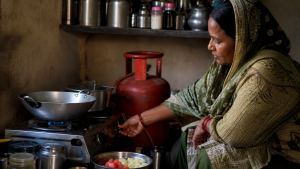
India’s LPG reform drive focuses on better targeting of subsidies, tighter beneficiary verification, and a gradual shift towards cleaner household energy. The policy mix aims to reduce leakage, protect genuine users, and support expansion of piped natural gas in urban areas.
PMUY: Expansion and Subsidy Support
- Launch and objective: Pradhan Mantri Ujjwala Yojana (PMUY) was launched in May 2016 to provide deposit-free LPG connections to women from below-poverty-line households.
- Clean cooking push: The scheme was designed to reduce dependence on solid biomass fuels and expand access to clean cooking energy in rural India.
- Targeted subsidy: Eligible PMUY beneficiaries receive a subsidy of ₹300 per 14.2 kg cylinder.
- Refill limit: The annual subsidized refill limit has been capped at up to 9 refills per financial year, down from the earlier ceiling of 12.
- Budget provision: The central government allocated ₹12,000 crore for targeted PMUY subsidies in FY 2025–26.
- Coverage: PMUY has benefited over 10.33 crore households, with total connections released reaching about 10.55 crore as of September 2, 2026, close to the target of 10.6 crore connections.
Targeted Subsidy Rationalization
- Objective: The subsidy system is being tightened to ensure that public funds reach only eligible households.
- Income exclusion: LPG subsidy is permanently terminated for households where the annual taxable income of either the consumer or the spouse exceeds ₹10 lakh.
- Rationale: This measure is intended to conserve fiscal resources and focus support on vulnerable consumers.
- Leakage control: The reforms are meant to reduce ghost beneficiaries, multiple registrations, and other forms of misuse.
- Stable domestic pricing: Domestic 14.2 kg LPG cylinders are kept relatively stable to protect household consumers from market volatility.
KYC Verification and DBT Control
- Biometric e-KYC: Aadhaar-based biometric e-KYC has been made mandatory for LPG consumers.
- Deadline: August 31, 2026 was set as the final date for completion of e-KYC verification.
- DBT impact: Failure to complete e-KYC leads to a freeze on Direct Benefit Transfer (DBT) payments under the PAHAL scheme.
- PAHAL linkage: Subsidy is transferred directly into Aadhaar-linked bank accounts through DBT.
- One Household, One Connection: Oil Marketing Companies cross-check LPG and PNG databases to detect duplicate connections at the same address.
- Verification goal: The exercise is aimed at ensuring that only genuine beneficiaries receive subsidy support.
Push for Piped Natural Gas
- Incentive scheme: The Incentive Scheme for Promotion of Domestic PNG Connections was implemented on September 1, 2026.
- APM gas support: City Gas Distribution (CGD) companies receive domestic gas under the Administered Price Mechanism (APM).
- Additional allocation: CGD companies get an additional 200 standard cubic meters (SCM) of lower-priced APM gas for every incremental billed household connection.
- Purpose: The scheme is designed to reduce dependence on imported Liquefied Natural Gas (LNG) and encourage household pipeline expansion.
- Investment impact: It is expected to shorten the capital expenditure payback period for pipeline rollout from 10 years to around 3 years.
- Current base: India currently has about 1.74 crore operational domestic PNG connections.
- Rollout structure: The incentive scheme is being implemented in two six-month tranches to accelerate domestic pipeline infrastructure in urban areas.
Support to Oil Marketing Companies
- Compensation package: The central government approved ₹30,000 crore in compensation to public sector Oil Marketing Companies.
- Beneficiaries: The support applies to Indian Oil Corporation Limited (IOCL), Bharat Petroleum Corporation Limited (BPCL), and Hindustan Petroleum Corporation Limited (HPCL).
- Reason: The compensation addresses under-recoveries suffered by these companies on domestic LPG supply sold below actual market cost.
- Commercial vs domestic cylinders: Commercial 19 kg cylinder prices vary with international market conditions, while domestic cylinder prices are comparatively more stable.
Key Prelims Takeaways
- PMUY: A scheme launched in May 2016 to provide deposit-free LPG connections to eligible women, especially in BPL households.
- PMUY subsidy: ₹300 per 14.2 kg cylinder for eligible beneficiaries, with up to 9 subsidized refills per financial year.
- PAHAL: Pratyaksh Hanstantrit Labh, the DBT mechanism for transferring LPG subsidy directly into bank accounts.
- e-KYC: Aadhaar-based biometric verification made mandatory to prevent duplicate and fake LPG beneficiaries.
- APM gas: Administered Price Mechanism gas is domestically produced natural gas supplied at controlled prices, below imported LNG-linked rates.
- One Household, One Connection: The verification rule used by OMCs to eliminate duplicate LPG/PNG connections at the same address.
- Under-recoveries: Revenue loss faced by OMCs when domestic LPG is sold below its market-linked cost.
Current General Studies comprises current-affairs-based, General Studies-rich study material on policies, laws, institutions, economy, science, environment, governance, international relations, and other varied but important topics for UPSC and State PSC Prelims examinations.
Fortnightly PDF compilations: Available here
Originally written on
February 28, 2026
and last modified on
September 5, 2026.
| Related | |
|---|---|