Mission Sagar
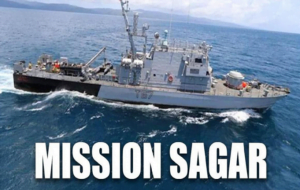
Mission Sagar, launched on May 10, 2020, is a major maritime outreach and Humanitarian Assistance and Disaster Relief (HADR) initiative by the Ministry of External Affairs and the Indian Navy. Functioning as the operational arm of the overarching SAGAR doctrine (“Security and Growth for All in the Region”) introduced in 2015, the mission delivers essential food, medical equipment, and liquid oxygen to nations across the Indian Ocean Region (IOR) during crises like the COVID-19 pandemic and climate disasters. The deployment covers littoral partners across East Africa, the Western Indian Ocean, South Asia, and Southeast Asia.
Strategic Mandate and Institutional Framework
The primary purpose of Mission Sagar centers on positioning India as the primary security provider and first responder in the Indian Ocean Region. Executed in close coordination between the Ministry of External Affairs, Ministry of Defence, and the Indian Navy, the operations align with broader foreign policy frameworks.
Strategic Convergence
-
SAGAR Policy: Translates the broader regional maritime security vision into actionable disaster relief, medical support, and capacity-building deployments.
-
Neighborhood First: Strengthens diplomatic ties with immediate maritime neighbours through non-kinetic, high-impact relief exercises.
-
Act East Policy: Extends India’s naval assistance reach to Southeast Asian nations including Vietnam, Cambodia, and Indonesia.
-
Counter-Balance Mechanism: Reinforces bilateral goodwill to offset growing external naval footprints and infrastructure dominance across critical Sea Lines of Communication (SLOCs).
Phase-wise Deployment and Operational Matrix
The Indian Navy executed multiple deployments under Mission Sagar using naval landing craft, frigates, and amphibious platforms. Each phase targeted specific maritime partners with specialized consignments ranging from food grains to mobile oxygen plants.
| Deployment Phase | Timeframe | Naval Asset | Destination Countries | Relief Consignment |
| Mission Sagar I | May–June 2020 | INS Kesari | Maldives, Mauritius, Seychelles, Madagascar, Comoros | 580 MT food, essential medicines, Medical Assistance Teams |
| Mission Sagar II | Oct–Nov 2020 | INS Airavat | Sudan, South Sudan, Djibouti, Eritrea | 270 MT food aid |
| Mission Sagar III | December 2020 | INS Kiltan | Vietnam, Cambodia | 15 MT HADR stores per country for flood relief |
| Mission Sagar IV | March 2021 | INS Jalashwa | Comoros, Madagascar | 1,000 MT rice to Comoros, 1,000 MT food aid to Madagascar |
| Mission Sagar V | August 2021 | INS Airavat | Indonesia | 100 MT Liquid Medical Oxygen (LMO), 300 oxygen concentrators |
| Mission Sagar VI | August 2021 | INS Shakti | Sri Lanka | 100 MT Liquid Medical Oxygen, 5 ISO containers |
| Mission Sagar VII | September 2021 | INS Savitri | Bangladesh | 2 Mobile Oxygen Plants |
| Mission Sagar VIII | December 2021 | INS Kesari | Mozambique | 500 MT food aid, 2 Fast Interceptor Craft |
| Mission Sagar IX | April 2022 | INS Gharial | Sri Lanka | 760 kg critical medicines and medical supplies |
Diplomatic and Security Significance
The deployment of amphibious warfare ships (Landing Ship Tanks) like INS Kesari, INS Airavat, and INS Jalashwa highlighted the versatility of amphibious assets for civilian relief operations.
Institutional Impact
-
Maritime Domain Awareness (MDA): Continuous naval movements improved operational familiarity across critical chokepoints including the Bab-el-Mandeb, Mozambique Channel, and the Malacca Strait.
-
Indian Ocean Commission (IOC): Engagement with island states (Mauritius, Seychelles, Comoros, Madagascar, Réunion) supported India’s entry as an Observer State to the IOC in March 2020.
-
Disaster Management Leadership: Solidified the Indian Navy’s reputation as a reliable maritime security guarantor across South Asia and East Africa.
Key Facts for Quick Revision
-
Launch Date: May 10, 2020.
-
Parent Doctrine: SAGAR (Security and Growth for All in the Region), announced in 2015.
-
Nodal Agencies: Indian Navy, Ministry of External Affairs, and Ministry of Defence.
-
First Deployment Vessel: INS Kesari (covered 7,500 nautical miles over 55 days in Phase I).
-
Total Aid Coverage: Over 15 friendly foreign countries, 3,000+ MT food grains, 300+ MT Liquid Medical Oxygen, and 900+ oxygen concentrators.
-
Geographic Span: From Red Sea littoral states (Eritrea, Djibouti) to Southeast Asian states (Indonesia, Vietnam).
-
Strategic Chokepoints Covered: Bab-el-Mandeb, Mozambique Channel, Palk Strait, and Malacca Strait.
-
Defense Capability Transfer: Delivered two Fast Interceptor Craft to Mozambique under Phase VIII to enhance coastal policing capability.
| Related | |
|---|---|