India’s Agricultural Trade Policy and Export Promotion Schemes
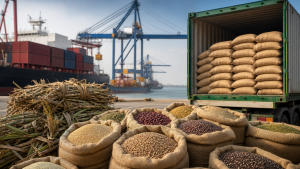
India’s agricultural trade policy seeks a balance between food security at home and stronger competitiveness abroad. It uses export promotion schemes, quality controls, and trade regulations to support farm incomes while safeguarding domestic supply.
The policy framework is shaped by the Ministry of Commerce and Industry through the DGFT, APEDA and related agencies. It covers incentives for exports, infrastructure support, and temporary restrictions or relaxations depending on market and supply conditions.
Overview of Agricultural Export Performance
- Record exports: India’s agricultural exports rose 2.8% year-on-year from USD 51.12 billion in FY 2024-25 to USD 52.55 billion in FY 2025-26.
- Leading commodity: Rice remained the largest agricultural export commodity in FY 2025-26, valued at USD 11.5 billion.
- Other major items: Marine products stood at USD 8.4 billion and spices at USD 4.3 billion.
- Export strategy: High-value items such as processed foods, organic products and fresh fruits are being prioritised to improve farmer incomes.
The Export Promotion Mission (EPM)
- Launch and scope: The Export Promotion Mission (EPM), approved in November 2025, is a flagship central-sector scheme for FY 2025-26 to FY 2030-31.
- Budgetary outlay: It has an outlay of ₹25,060 crore over six years.
- Implementing agency: The mission is implemented by the Directorate General of Foreign Trade (DGFT).
- Purpose: It consolidates fragmented export support measures into a single framework.
- Earlier schemes merged: The mission brings together support such as the Interest Equalisation Scheme and the Market Access Initiative.
- Two sub-schemes: Niryat Protsahan focuses on financial credit support, while Niryat Disha focuses on quality standards, regulatory compliance and logistics.
- Policy integration: The Union Budget 2026-27 proposed converging the Remission of Duties and Taxes on Exported Products (RoDTEP) scheme into the EPM framework for a single administrative window.
RoDTEP and APEDA Infrastructure Support
- RoDTEP extension: The RoDTEP scheme has been extended from April 1, 2026 to September 30, 2026.
- Coverage: The extension applies under Appendix 4R for Domestic Tariff Area exports and Appendix 4RE for Advance Authorisation, EOU and SEZ exports.
- Temporary rate cut: Agricultural and processed food products under ITC HS Chapters 01 to 24 were excluded from a temporary 50% RoDTEP rebate cut introduced in February 2026, which was later withdrawn.
- APEDA scheme: The Agriculture and Processed Foods Export Promotion Scheme supports export-grade post-harvest and cold chain infrastructure.
- Funding support: Under the 15th Finance Commission cycle (FY 2021-22 to FY 2025-26), it provides up to 40% financial assistance, capped at ₹200 lakhs.
Regulatory Framework for Grain Exports
- Wheat exports: DGFT Notifications No. 34/2026-27 and No. 35/2026-27 changed the export policy of wheat and specified wheat flour products from “Prohibited” to “Free”.
- Products covered: The change applies to durum wheat, maida, semolina and wholemeal atta.
- Earlier ban: This effectively lifted the May 2022 export ban.
- Non-basmati rice: The Minimum Export Price (MEP) of USD 490 per tonne under HS Code 1006 30 90 was removed in October 2024, shifting the export policy to “Free”.
- Inspection relaxation: DGFT Notification No. 07/2026-27 dated April 10, 2026 relaxed the requirement of a Certificate of Inspection from the Export Inspection Council (EIC) or Export Inspection Agency (EIA) for rice exports to non-EU European countries until October 1, 2026.
- Exceptions: The relaxation does not apply to the European Union, the United Kingdom, Iceland, Liechtenstein, Norway and Switzerland, where the Certificate of Inspection remains mandatory.
- RCAC validity: On August 24, 2026, APEDA extended the validity of Registration-cum-Allocation Certificates (RCACs) for Basmati and non-Basmati rice exports by 45 days beyond the original 45-day validity.
Institutional and Legal Backdrop
- DGFT role: The DGFT issues export policy notifications and manages trade-related regulation under the Ministry of Commerce and Industry.
- APEDA role: APEDA supports promotion, infrastructure and compliance for agricultural and processed food exports.
- EIC/EIA function: The Export Inspection Council and Export Inspection Agencies handle quality control and inspection for specified export consignments.
- Legal basis: The EIC is the nodal authority under the Export (Quality Control and Inspection) Act, 1963.
- Policy balance: Export liberalisation is used selectively, while restrictions and quality requirements continue where domestic supply or market access concerns exist.
Key Prelims Takeaways
- Export value: India’s agricultural exports reached USD 52.55 billion in FY 2025-26.
- Top export: Rice remained the largest agricultural export item at USD 11.5 billion.
- EPM: A central-sector scheme approved in November 2025, with a ₹25,060 crore outlay for FY 2025-26 to FY 2030-31.
- Two pillars of EPM: Niryat Protsahan for credit support and Niryat Disha for compliance, logistics and standards.
- RoDTEP: Extended till September 30, 2026, with convergence proposed under the EPM framework.
- APEDA support: Up to 40% assistance, capped at ₹200 lakhs, is available for export infrastructure under the 15th Finance Commission cycle.
- Rice and wheat policy: Non-basmati rice MEP was removed in October 2024, and wheat and specified wheat flour products were moved from “Prohibited” to “Free” in 2026.
Current General Studies comprises current-affairs-based, General Studies-rich study material on policies, laws, institutions, economy, science, environment, governance, international relations, and other varied but important topics for UPSC and State PSC Prelims examinations.
Fortnightly PDF compilations: Available here
Originally written on
April 23, 2026
and last modified on
September 5, 2026.
| Related | |
|---|---|