Indus Waters Treaty: Provisions and River Allocations
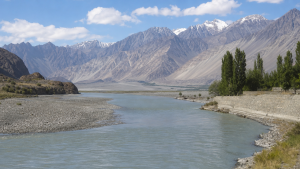
The Indus Waters Treaty is a bilateral water-sharing agreement between India and Pakistan governing the transboundary Indus River system. Signed in 1960 with World Bank mediation, it allocates river usage rights and provides a framework for technical cooperation and dispute settlement.
Historical Background and Treaty Signing
- Signing date: The treaty was signed on September 19, 1960, in Karachi by Indian Prime Minister Jawaharlal Nehru and Pakistani President Ayub Khan.
- Mediator: The World Bank facilitated the negotiations.
- Effective date: The agreement entered into force retroactively from April 1, 1960.
- Treaty status: It governs a transboundary basin and cannot be unilaterally altered, terminated, or replaced.
- Article XII(4): Any modification or termination requires a new treaty concluded and ratified by both governments.
Division and Allocation of the Rivers
The treaty divides the six rivers of the Indus basin into two categories: the Eastern Rivers and the Western Rivers. This division determines the primary rights of use and development for each country.
| River Group | Rivers Included | Mean Annual Flow Volume | Allocation Rights and Restrictions |
| Eastern Rivers | Sutlej, Beas, and Ravi | ~33 million acre-feet (about 20% of total basin flow) | Exclusive usage rights allocated to India for all purposes. |
| Western Rivers | Indus, Jhelum, and Chenab | ~135 million acre-feet (about 80% of total basin flow) | Allocated primarily to Pakistan, with limited rights for India. |
- Eastern Rivers: India has unrestricted control over the Sutlej, Beas, and Ravi.
- Usage rights: India may build storage dams, divert water, and use the full flow of the Eastern Rivers.
- Western Rivers: The Indus, Jhelum, and Chenab are allocated primarily to Pakistan.
- India’s limited rights: India may use waters of the Western Rivers before they cross into Pakistan, subject to treaty conditions.
Permissible Indian Rights on Western Rivers
- Domestic and municipal use: India may withdraw water for domestic, municipal, and non-consumptive industrial applications.
- Agricultural use: The treaty permits irrigation for a maximum area of 13.4 lakh acres across Jammu & Kashmir and Ladakh.
- Hydroelectric power: India can construct run-of-the-river hydroelectric projects on the Indus, Jhelum, and Chenab.
- No live storage: Such projects must be built without live storage, so they cannot hold back or materially alter downstream flow to Pakistan.
- Non-consumptive rights: India’s rights on the Western Rivers are limited and clearly defined, especially for power generation and local use.
Three-Tier Dispute Resolution under Article IX
Article IX provides a structured three-tier mechanism to handle technical and legal differences and avoid diplomatic deadlock.
- Permanent Indus Commission: High-level commissioners from both countries meet at least once a year to exchange data, inspect sites, and address initial technical issues.
- Neutral Expert: Appointed by the World Bank to decide technical differences, especially those relating to the design, construction, and operation of run-of-the-river hydroelectric projects.
- Court of Arbitration: A seven-member panel for broader legal disputes on treaty interpretation that cannot be settled through the earlier stages.
Exam fact: The treaty’s dispute system moves from the Permanent Indus Commission to a Neutral Expert and then to a Court of Arbitration.
Key Prelims Takeaways
- Signed in: Karachi, on September 19, 1960.
- Key signatories: Jawaharlal Nehru and Ayub Khan.
- Mediator: World Bank.
- Eastern Rivers: Sutlej, Beas, and Ravi are allocated to India.
- Western Rivers: Indus, Jhelum, and Chenab are allocated primarily to Pakistan.
- India’s irrigation cap: 13.4 lakh acres in Jammu & Kashmir and Ladakh on the Western Rivers.
- Hydel rule: Run-of-the-river plants are allowed, but live storage is not.
- Non-unilateral change: The treaty cannot be ended or modified by one side alone.
- Article XII(4): Any change requires a mutually agreed and ratified new treaty.
- Contested projects: Kishanganga Hydro-Electric Project and Ratle Hydro-Electric Project.
Current General Studies comprises current-affairs-based, General Studies-rich study material on policies, laws, institutions, economy, science, environment, governance, international relations, and other varied but important topics for UPSC and State PSC Prelims examinations.
Fortnightly PDF compilations: Available here
Originally written on
February 24, 2026
and last modified on
September 5, 2026.
| Related | |
|---|---|