Important River Rejuvenation Projects in India
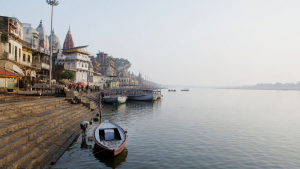
India has launched several national, regional, and city-level river rejuvenation initiatives to curb pollution, improve sewage treatment, restore river ecology, and support sustainable urban water management.
National River Conservation Frameworks
This section details the primary national programs driving river cleanup and ecological restoration across India.
Namami Gange Programme
- Approval: The Union Government approved the programme in June 2014 with an initial budget of ₹20,000 crore.
- Implementing agency: The National Mission for Clean Ganga (NMCG), an autonomous society under the Ministry of Jal Shakti, implements the project.
- Extension: The initiative has been extended to March 2026.
- Focus: It aims at pollution abatement and conservation of the national river Ganga.
- Key pillars: Sewage treatment infrastructure, riverfront development, river surface cleaning, biodiversity conservation, and public awareness.
- Capacity creation: By June 2026, the programme created a cumulative sewage treatment capacity of 4,263 MLD (Million Litres per Day).
- Monitoring: NMCG introduced the Ganga Pulse Public Portal for real-time monitoring of sewage treatment plant operations.
- Funding: The World Bank provides external loan assistance for these conservation activities.
Exam fact: Namami Gange is the flagship river conservation programme for the Ganga basin.
National River Conservation Plan (NRCP)
- Launch: Launched in 1995, it is a Centrally Sponsored Scheme aimed at preventing river pollution.
- Purpose: It supplements state efforts by providing financial and technical assistance for polluted river stretches.
- Coverage: The plan excludes the Ganga basin and its tributaries, which are covered under Namami Gange.
- Funding pattern: 60:40 for general states and 90:10 for Himalayan and North-Eastern states.
- Implementing body: The National River Conservation Directorate (NRCD), under the Ministry of Jal Shakti, executes the plan.
- Recent inclusion: In August 2025, the central government initiated steps to include the Pampa River of Kerala under the NRCP.
- Coverage: The plan has covered polluted stretches of more than 34 rivers across 16 states.
Forestry Interventions for 13 Major Rivers
- Project reports: The Ministry of Environment, Forest and Climate Change (MoEFCC) released detailed project reports in March 2022 to rejuvenate 13 major rivers.
- Funding agency: The National Afforestation and Eco-development Board under MoEFCC funds the project.
- Prepared by: The Indian Council of Forestry Research and Education (ICFRE), Dehradun prepared the project reports.
- Objective: The programme focuses on planting native trees, grasses, and shrubs to increase green cover and prevent soil erosion.
- Landscape models: It covers natural, agricultural, and urban landscapes.
- Carbon sink target: These interventions aim to sequester 50.21 million tonnes of carbon dioxide equivalent after 10 years.
Important: The forestry-based rejuvenation model is designed to support river health through catchment treatment and carbon sequestration.
| Geographic Category | Selected Rivers |
| Himalayan Rivers | Jhelum, Chenab, Ravi, Beas, Sutlej, Yamuna, Brahmaputra |
| Peninsular Rivers | Narmada, Godavari, Mahanadi, Krishna, Cauvery |
| Inland Drained River | Luni |
Noteworthy Regional River Rejuvenation Projects
This section covers specific state-level and river-specific cleanup projects across India.
Project Devika (Jammu & Kashmir)
- First in North India: This is North India’s first river rejuvenation project, initiated in February 2019.
- Model: It is modelled on the Namami Gange programme and included under the National River Conservation Plan.
- Cost sharing: The total allocation exceeds ₹190 crore, shared in a 90:10 ratio between the Centre and the Union Territory.
- River details: The Devika River originates from the Suddha Mahadev temple in Udhampur district and merges with the Ravi River in Pakistan.
- Local name: Devika is locally called the Gupt Ganga and is spiritually regarded as the sister of the Ganga.
- Core works: The project focuses on liquid waste management through three Sewage Treatment Plants of 8 MLD, 4 MLD, and 1.6 MLD capacity.
- Other components: Solid waste management, cremation ghats, solar power setups, and bio-fencing.
Yamuna Action Plan (YAP)
- Launch: Launched in 1993, it is a bilateral project between the Government of India and the Government of Japan.
- Funding: The Japan International Cooperation Agency (JICA) provides financial assistance.
- Phases: The project has been executed in three phases: YAP-I (1993-2003), YAP-II (2004-2011), and YAP-III (currently active).
- Coverage: YAP-I and YAP-II covered critical towns in Haryana, Uttar Pradesh, and Delhi.
- Current focus: YAP-III targets the 22-km stretch in Delhi, which is responsible for about 80% of the river’s pollution.
- Major works: Building a 124 MGD wastewater treatment plant at Okhla and upgrading facilities at Kondli and Rithala.
Nadanthai Vaazhi Cauvery Project (Tamil Nadu)
- Approval: The Central Water Commission approved this ₹11,250 crore project in June 2024.
- Objective: It is designed on the lines of the Namami Gange Programme to conserve and rejuvenate the Cauvery river basin and its tributaries.
- Pollution control: The initiative targets industrial effluents and untreated sewage entering the Cauvery River.
- CETPs: It includes 10 common effluent treatment plants for textile units in Erode and Namakkal.
- STPs: The project features 65 sewage treatment plants with a combined capacity of 209.30 MLD.
- Riverfront development: Planned at Mettur, Karur, and Bhavani Kooduthurai.
Mula-Mutha River Rejuvenation Project (Pune)
- Implementing bodies: The Pune Municipal Corporation (PMC) and the Pune Metropolitan Region Development Authority (PMRDA) manage this urban waterfront project.
- Cost: The project has an estimated cost of ₹4,727 crore.
- Coverage: It targets a 44-km stretch comprising the Mula, Mutha, and Mula-Mutha rivers in Pune.
- Flood protection: The plan focuses on resilient green embankments to reduce flood risks and protect low-lying areas.
- Sewage diversion: It aims to divert untreated industrial and domestic sewage to wastewater treatment plants.
- Ecological restoration: The project includes planting local species of trees, shrubs, and grasses to revive riparian biodiversity.
Sabarmati Riverfront Development Project (Ahmedabad)
- SPV: The Ahmedabad Municipal Corporation set up the Sabarmati River Front Development Corporation Limited in 1997 to manage this project.
- Timeline: Groundbreaking began in 2005, Phase 1 opened to the public in 2012, and Phase 2 was approved in 2020.
- Land reclamation: The project reclaimed 204.91 hectares of riverbed land by narrowing and channeling the river to a constant width of 263 meters.
- Sewage control: It diverted municipal sewage into interceptor sewers, preventing untreated waste from entering the river.
- Public amenities: The development includes an 11.5-km continuous double-level public promenade, parks, sports complexes, and a traditional market.
- Water management: It uses water from the Narmada Canal to maintain stable water levels year-round for recreational purposes.
Recent Context
On 12 August 2026, Telangana Chief Minister A. Revanth Reddy and Lieutenant General C. Rajesh Pushkar met in Hyderabad, where the Indian Army agreed to establish youth training centres at district headquarters across Telangana.
The initiative is intended to prepare local youth for military recruitment drives and improve coordination during disasters, including rescue, evacuation, and rehabilitation in flood-affected areas.
Rare Facts for Prelims
- Ganga Pulse Public Portal: It is used for monitoring sewage treatment plant operations in real time under the Namami Gange framework.
- Devika River: It is popularly known as Gupt Ganga in Jammu and Kashmir.
- YAP-III focus: The 22-km Delhi stretch of the Yamuna contributes nearly 80% of the river’s pollution load.
- Sabarmati design: The riverfront project reduced the river width to a constant 263 meters for planned urban development.
- Carbon sink target: The forestry intervention project aims to sequester 50.21 million tonnes of CO2 equivalent in 10 years.
- NRCP funding: Himalayan and North-Eastern states receive a 90:10 funding pattern under the scheme.
| Related | |
|---|---|