Generations of Computers: Key Technologies and Milestones
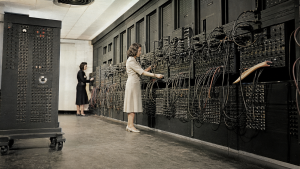
Computer technology has evolved in distinct generations, each marked by a major shift in the core electronic component, storage method, and programming style. These phases show how computers became smaller, faster, more reliable, and more accessible over time.
First Generation: Vacuum Tubes
- Core technology: Vacuum tubes were used for switching and amplification in circuits.
- Primary storage: Magnetic drums served as internal storage for data and instructions.
- Programming: Machine language was used exclusively, so instructions had to be written in binary code.
- Examples: ENIAC and UNIVAC are the best-known systems of this era.
- Physical traits: These machines occupied entire rooms, consumed huge amounts of electricity, and produced excessive heat.
- Limitation: Continuous cooling was required because of heat generation.
ENIAC contained over 17,000 vacuum tubes and weighed approximately 30 tons.
Second Generation: Transistors
- Core technology: The transistor replaced the vacuum tube, making computers smaller, faster, and more reliable.
- Memory: Magnetic core memory became the standard main storage technology.
- Programming languages: Assembly language and early high-level languages such as FORTRAN and COBOL developed during this period.
- Use: Computing became commercially more viable for businesses and government agencies.
- Result: These systems were better suited for administrative and commercial tasks.
John Bardeen, Walter Brattain, and William Shockley invented the transistor at Bell Labs in 1947 and later received the Nobel Prize.
Third Generation: Integrated Circuits
- Core technology: Multiple transistors were integrated onto tiny silicon chips called integrated circuits.
- Storage and control: Semiconductor RAM and operating systems improved processing and resource management.
- Software: Operating systems helped execute multiple programs and coordinate peripheral devices.
- Input/output: Keyboards and monitors replaced punched cards and printouts as standard interfaces.
- Impact: Miniaturization reduced size and manufacturing costs, widening access across industries.
- Example: IBM System/360 is a representative system of this generation.
Jack Kilby and Robert Noyce independently developed the first integrated circuit in the late 1950s.
Fourth Generation: Microprocessors
- Core technology: The microprocessor placed the entire central processing unit on a single silicon chip.
- Advancement: Large-scale integration and very-large-scale integration greatly increased computational power and memory capacity.
- Use: Personal computers emerged as consumer products and spread to homes, schools, and offices.
- Interface: Graphical user interfaces replaced command-line prompts and made computing easier to use.
- Examples: Apple II and IBM PC are major examples.
- Milestone: The Intel 4004, released in 1971, was the first commercially available microprocessor on a single chip.
Fifth Generation: Artificial Intelligence
- Core focus: Artificial intelligence, neural networks, and parallel processing define this generation.
- Capability: Systems are designed to handle complex cognitive tasks.
- Functions: Natural language processing enables computers to understand human speech and interpret visual data.
- Applications: Voice recognition and expert systems are key features of intelligent hardware.
- Processing approach: Advanced microprocessors use ultra-large-scale integration and quantum computing principles.
- Examples: Modern supercomputers represent this phase in practice.
Generations at a Glance
| Generation | Core Technology | Primary Memory | Programming Language | Representative Systems |
| First | Vacuum tubes | Magnetic drums | Machine language | ENIAC, UNIVAC |
| Second | Transistors | Magnetic core memory | Assembly, FORTRAN, COBOL | IBM 1401, CDC 1604 |
| Third | Integrated circuits | Semiconductor RAM | High-level languages | IBM System/360 |
| Fourth | Microprocessors, VLSI | Semiconductor RAM | C, C++, advanced software | Apple II, IBM PC |
| Fifth | ULSI, artificial intelligence | Optical and quantum storage | Python, Java, AI frameworks | Modern supercomputers |
Key Prelims Takeaways
- First generation: Vacuum tubes, magnetic drums, and machine language.
- Second generation: Transistors replaced vacuum tubes and enabled better reliability.
- Third generation: Integrated circuits and operating systems marked major progress.
- Fourth generation: Microprocessors, VLSI, and personal computers became central features.
- Fifth generation: AI, neural networks, parallel processing, and natural language processing are key themes.
- ENIAC: Known for over 17,000 vacuum tubes and a weight of about 30 tons.
- Intel 4004: Released in 1971 as the first commercially available microprocessor on a single chip.
Current General Studies comprises current-affairs-based, General Studies-rich study material on policies, laws, institutions, economy, science, environment, governance, international relations, and other varied but important topics for UPSC and State PSC Prelims examinations.
Fortnightly PDF compilations: Available here
Originally written on
June 7, 2026
and last modified on
September 6, 2026.
| Related | |
|---|---|