Major Himalayan Glacial Lakes and GLOF Risks
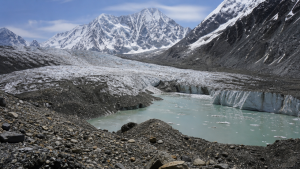
Glacial lake outburst floods (GLOFs) are sudden, high-velocity floods caused when natural dams holding glacial lakes fail. In the Himalayas, warming temperatures, unstable moraines, avalanches, rainfall, and earthquakes make such lakes a serious disaster risk.
Understanding Glacial Lake Outburst Floods (GLOFs)
Glacial lakes form when glaciers melt and retreat due to warming temperatures. The meltwater accumulates in depressions left behind by the ice. These lakes are often dammed by loose rocks, soil, and ice, known as moraines.
A Glacial Lake Outburst Flood (GLOF) occurs when these natural dams fail. The sudden release of a large volume of water leads to rapid and destructive flooding downstream.
Primary Triggers and Causes of GLOFs
- Ice or Rock Avalanches: Large chunks of ice or rock fall into the lake, creating displacement waves that overtop and breach the dam.
- Heavy Rainfall: Intense rain adds sudden volume to the lake and destabilizes the weak moraine boundary.
- Earthquakes: Seismic activity can crack or collapse unstable moraine dams.
- Rapid Melting: Warming temperatures accelerate glacier melt and fill the lake beyond its holding capacity.
- Elevation-Dependent Warming: High mountain altitudes warm faster than lower altitudes, speeding up glacier retreat and lake growth.
Types of Glacial Lakes
- Moraine-Dammed Lakes: These form behind unstable walls of loose rock and soil left by retreating glaciers. They are highly vulnerable to sudden collapse.
- Ice-Dammed Lakes: These form when a glacier blocks a valley stream. They can drain rapidly if the ice dam floats, melts, or breaks.
- Glacial Erosion Lakes: These form in bedrock depressions carved by glaciers. They are generally more stable because bedrock dams do not breach easily.
Distribution of High-Risk Glacial Lakes in India
The National Disaster Management Authority (NDMA) identified 190 high-risk glacial lakes across the Himalayan region. These lakes pose severe threats to downstream infrastructure and communities.
| State / Union Territory | Number of High-Risk Lakes | Key Examples |
| Himachal Pradesh | 48 | Gepang Gath, Samudra Tapu |
| Sikkim | 40 | South Lhonak Lake |
| Ladakh | 35 | Gya Lake |
| Arunachal Pradesh | 28 | Lakes in Mago Chu Basin |
| Jammu & Kashmir | 26 | – |
| Uttarakhand | 13 | Chorabari Lake, Vasudhara Tal |
Key Glacial Lakes and Their Vulnerabilities
- South Lhonak Lake (Sikkim): A rapidly growing moraine-dammed lake at an altitude of over 5,200 metres. It has a history of sudden volume expansion.
- Gepang Gath (Himachal Pradesh): Located in the Lahaul and Spiti district, this moraine-dammed lake has expanded continuously over recent decades.
- Samudra Tapu (Himachal Pradesh): One of the largest glacial lakes in the Chandra basin, consisting of multiple interconnected water bodies with high breach potential.
- Gya Lake (Ladakh): A remote lake that experienced a GLOF in recent years due to moraine failure.
- Mago Chu Basin Lakes (Arunachal Pradesh): Multiple lakes in this basin are expanding due to rising high-altitude temperatures.
Transboundary GLOF Risks to India
- China and Nepal Borders: Hundreds of glacial lakes lie in the Tibetan Plateau and Nepal Himalayas.
- Koshi, Gandak, and Ghaghara Basins: Flash floods from breached lakes in Nepal can flow into Bihar and Uttar Pradesh.
- Yarlung Tsangpo (Brahmaputra): Landslide or glacial lakes in Tibet can pose direct threats to Arunachal Pradesh and Assam.
- Imja Tsho and Tsho Rolpa: These critical glacial lakes in Nepal are closely watched because of their river connections with India.
Major Historical GLOF Events in India
- Chorabari Lake Outburst (Kedarnath, 2013): Heavy rainfall and rapid snowmelt caused the lake to breach, devastating the Kedarnath valley in Uttarakhand.
- South Lhonak Lake Outburst (Sikkim, 2023): A rockfall triggered a massive wave, destroying the Chungthang dam on the Teesta River and causing casualties downstream.
- Gya Lake Outburst (Ladakh, 2014): A sudden discharge flooded the village of Gya, highlighting the risk of unmonitored lakes.
- Rishiganga Disaster (Uttarakhand, 2021): A massive rock and ice avalanche in Chamoli triggered a flash flood that destroyed two major power projects.
Policy Framework and Mitigation Measures
- NDMA Guidelines (2020): These provide a framework for pre-disaster preparedness, emergency response, and post-disaster recovery.
- National GLOF Risk Mitigation Programme (NGRMP): Approved with an outlay of Rs. 150 crore, it targets risk reduction in Arunachal Pradesh, Himachal Pradesh, Sikkim, and Uttarakhand.
- Satellite Monitoring: The Central Water Commission monitors over 900 glacial lakes, while ISRO’s National Remote Sensing Centre maintains a Glacial Lake Atlas.
- Engineering Interventions: Teams reduce lake volume by constructing outlet channels or using controlled pumping.
- Early Warning Systems (EWS): Automated weather and water-level monitoring stations are being installed near high-risk lakes to alert downstream settlements in real time.
GLOF risk is a key climate change adaptation issue because Himalayan ecosystems are fragile and downstream populations depend heavily on mountain water systems.
Recent Context
Recent Himalayan flood events have renewed attention on transboundary GLOF risks, especially in Nepal-Tibet border regions. These incidents underline the need for stronger disaster risk reduction, monitoring, and early warning cooperation.
Rare Facts for Prelims
- Moraines: These are made of unsorted debris deposited directly by glaciers and can behave like weak natural dams.
- Outburst waves: A rockfall into a glacial lake can generate a surge larger than the original impact itself.
- Remote sensing: Satellite imagery is often the only practical way to track lake growth in high-altitude, inaccessible terrain.
- Bedrock lakes: Glacial lakes held by solid rock are usually less vulnerable than moraine-dammed lakes.
- Chandra basin: It is one of the important glacier-fed basins in Himachal Pradesh with several high-risk lakes.
- Elevation-dependent warming: Mountain regions can warm faster than surrounding lowlands, making them especially sensitive to glacier retreat.
| Related | |
|---|---|