Major 20th-Century Art Movements and Styles
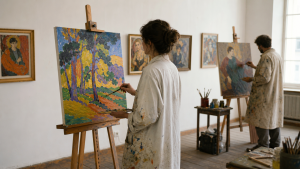
The 20th century brought major shifts in visual art, as artists moved from realism to abstraction, emotion, technology, and mass culture. These movements changed how art was made, seen, and understood.
Fauvism and Expressionism
Fauvism (1905–1910)
Fauvism was the first avant-garde movement of the 20th century. The name came from French critic Louis Vauxcelles, who called the artists les fauves or “the wild beasts” during an exhibition.
- Bright colors: The movement relied on bold, non-naturalistic colors applied directly from the paint tube.
- Flat composition: Artists abandoned traditional perspective and used flat planes of vibrant color.
- Main artists: Henri Matisse and André Derain were leading figures.
- Key works: Woman with a Hat by Henri Matisse and Charing Cross Bridge by André Derain.
Expressionism (1905–1933)
Expressionism originated in Germany and emphasized subjective emotional experience over objective reality.
- Distortion: Artists used distorted forms, jagged lines, and harsh colors to express anxiety, isolation, and psychological stress.
- Major groups: The movement developed through Die Brücke (The Bridge) in Dresden and Der Blaue Reiter (The Blue Rider) in Munich.
- Die Brücke: Artists such as Ernst Ludwig Kirchner sought to build a bridge between traditional art and modern expression.
- Der Blaue Reiter: Led by Wassily Kandinsky, this group explored spiritual values in color and form, leading toward pure abstraction.
- Important works: The Scream by Edvard Munch was a major inspiration, and Composition VII by Wassily Kandinsky is a key example.
Cubism and Futurism
Cubism (1907–1914)
Cubism was one of the most influential modern art movements, pioneered by Pablo Picasso and Georges Braque in Paris.
- Perspective rejected: The style rejected traditional single-point perspective.
- Multiple viewpoints: Subjects were broken into geometric shapes and shown from several angles at once.
- Two phases: Cubism developed as Analytical Cubism and Synthetic Cubism.
- Analytical Cubism: From 1907 to 1912, it used monochrome tones like grey and brown to dissect forms.
- Synthetic Cubism: From 1912 to 1914, it introduced brighter colors and collage elements such as newspaper clippings and oilcloth.
- Key artworks: Les Demoiselles d’Avignon by Pablo Picasso and Violin and Palette by Georges Braque.
Futurism (1909–1944)
Futurism was an Italian artistic and social movement that celebrated the machine age and modern life.
- Founder: Filippo Tommaso Marinetti launched the movement with the Futurist Manifesto in 1909.
- Themes: Artists focused on speed, industrialization, technology, youth, and movement.
- Style: Dynamic lines and fragmented shapes created a sense of constant motion.
- Key figures: Umberto Boccioni, Giacomo Balla, and Gino Severini.
- Representative works: Unique Forms of Continuity in Space by Umberto Boccioni and Dynamism of a Dog on a Leash by Giacomo Balla.
Dadaism and Surrealism
Dadaism (1916–1924)
Dadaism was an international anti-art movement that emerged in Zurich during World War I as a protest against bourgeois values and the rationality that led to conflict.
- Anti-art stance: Dadaists rejected logic, aesthetics, and traditional artistic rules.
- Methods: They used satire, nonsense, collage, and performance art.
- Ready-mades: Everyday manufactured objects were treated as art when selected by an artist.
- Key proponents: Marcel Duchamp, Tristan Tzara, and Hannah Höch.
- Representative works: Fountain and L.H.O.O.Q. by Marcel Duchamp.
Surrealism (1924–1966)
Surrealism grew out of Dadaism. French writer André Breton officially launched it in Paris with the Surrealist Manifesto.
- Unconscious mind: The movement sought to unlock the creative power of the unconscious.
- Freudian influence: It drew heavily from Sigmund Freud’s psychoanalytic ideas on dreams, desire, and irrationality.
- Automatism: Artists used automatic drawing and writing, often pairing unrelated objects in dreamlike settings.
- Prominent artists: Salvador Dalí, René Magritte, Max Ernst, and Joan Miró.
- Key works: The Persistence of Memory by Salvador Dalí and The Treachery of Images by René Magritte.
Abstract Expressionism and Pop Art
Abstract Expressionism (1940s–1950s)
Abstract Expressionism was the first American art movement to gain global influence and made New York City the new center of the art world.
- Style: It featured large-scale canvases, non-representational imagery, and physical intensity.
- Two strands: The movement included Action Painting and Color Field Painting.
- Action Painting: Artists like Jackson Pollock and Willem de Kooning used energetic gestures, dripping, and splashing paint.
- Color Field Painting: Artists such as Mark Rothko and Barnett Newman used large areas of saturated color to evoke spiritual and contemplative emotions.
- Key works: Autumn Rhythm (Number 30) by Jackson Pollock and No. 61 (Rust and Blue) by Mark Rothko.
Pop Art (1950s–1970s)
Pop Art emerged in the United Kingdom and the United States, challenging elitist art traditions by drawing from mass culture.
- Sources: Artists used advertisements, comic books, product packaging, and Hollywood imagery.
- Techniques: The style used screen printing, bold outlines, and bright primary colors.
- Leading artists: Andy Warhol, Roy Lichtenstein, and Richard Hamilton.
- Famous works: Campbell’s Soup Cans by Andy Warhol and Whaam! by Roy Lichtenstein.
Minimalism and Conceptual Art
Minimalism (1960s–1970s)
Minimalism developed in New York as a reaction against the emotional intensity of Abstract Expressionism and the commercial nature of Pop Art.
- Simplicity: Artists reduced art to its essential physical properties.
- Features: The style used geometric shapes, repetition, industrial materials, and little or no narrative.
- Viewer focus: Minimalist art avoided personal expression and emphasized space and material.
- Key figures: Donald Judd, Dan Flavin, and Agnes Martin.
- Important works: Untitled by Donald Judd and Diagonal of May 25, 1916 by Dan Flavin.
Conceptual Art (1960s–1970s)
Conceptual Art placed the idea behind a work above its material form or visual appeal.
- Core idea: The planning and execution of an idea was treated as the real artwork.
- Media: Artists used text, instructions, photography, and performance.
- Key artists: Sol LeWitt, Joseph Kosuth, and Yoko Ono.
- Famous work: One and Three Chairs by Joseph Kosuth.
Summary of Key 20th Century Art Movements
| Movement | Approximate Period | Primary Origins | Core Aesthetic Feature | Leading Artist | Representative Artwork |
| Fauvism | 1905–1910 | France | Bright, wild, non-naturalistic colors | Henri Matisse | Woman with a Hat |
| Expressionism | 1905–1933 | Germany | Distorted forms for emotional expression | Ernst Ludwig Kirchner | Street, Berlin |
| Cubism | 1907–1914 | France | Multiple viewpoints, geometric abstraction | Pablo Picasso | Les Demoiselles d’Avignon |
| Futurism | 1909–1944 | Italy | Celebration of speed, technology, and machinery | Umberto Boccioni | Unique Forms of Continuity in Space |
| Dadaism | 1916–1924 | Switzerland | Anti-art, absurdity, ready-mades | Marcel Duchamp | Fountain |
| Surrealism | 1924–1966 | France | Unconscious mind, dreams, unexpected pairings | Salvador Dalí | The Persistence of Memory |
| Abstract Expressionism | 1940s–1950s | United States | Action painting, color fields, non-representational | Jackson Pollock | Autumn Rhythm (Number 30) |
| Pop Art | 1950s–1970s | UK & US | Mass culture, consumer products, advertising | Andy Warhol | Campbell’s Soup Cans |
| Minimalism | 1960s–1970s | United States | Extreme simplification, industrial materials | Donald Judd | Untitled |
| Conceptual Art | 1960s–1970s | US & Europe | Idea prioritized over the physical object | Joseph Kosuth | One and Three Chairs |
Key Facts and Exam-Oriented Trivia
- Coining of Fauvism: Louis Vauxcelles coined the term “Fauves” in 1905 during the Salon d’Automne in Paris.
- First pure abstraction: Wassily Kandinsky is widely credited with creating one of the first purely abstract paintings in 1910.
- The Armory Show: The 1913 International Exhibition of Modern Art in New York introduced European modern art to the American public.
- Duchamp’s urinal: Fountain (1917) was a porcelain urinal signed “R. Mutt” and rejected by the Society of Independent Artists.
- Freudian link to Surrealism: Sigmund Freud’s The Interpretation of Dreams (1899) influenced André Breton’s Surrealist Manifesto (1924).
- Early Pop Art: Richard Hamilton’s 1956 collage, Just what is it that makes today’s homes so different, so appealing?, is considered an early Pop Art work.
- Bauhaus influence: Founded by Walter Gropius in Germany in 1919, the Bauhaus school unified art, craft, and technology.
Rare Facts for Prelims
- Vauxcelles and Cubism: Louis Vauxcelles also helped popularize the term “Cubism” after viewing works by Georges Braque.
- First Futurist manifesto: Marinetti’s manifesto first appeared in the French newspaper Le Figaro in 1909.
- Hannah Höch’s role: She was one of the earliest major women artists associated with photomontage in Dada.
- Automatism beyond painting: Surrealist automatism was also used in poetry and writing, not only visual art.
- Color Field link: Barnett Newman’s large vertical color bands were often called “zips.”
- Minimalist materials: Dan Flavin became known for using commercially available fluorescent light tubes as sculpture.
| Related | |
|---|---|