Butterfly Diversity in India
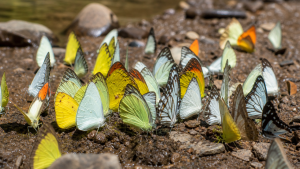
India supports exceptional butterfly diversity, with over 1,500 species spread across forests, hills, grasslands, and wetlands. These insects are important pollinators and reliable indicators of ecosystem health because they respond quickly to habitat and climate changes.
Overview of Butterfly Wealth in India
India is home to a vast and diverse range of butterfly species. The country forms a major part of the Indomalayan biogeographical zone. According to records compiled by the Zoological Survey of India (ZSI), India has 13,703 species of Lepidoptera, which includes butterflies and moths. Of these, 1,417 species are butterflies. This wealth of species accounts for approximately 8.25% of the total known Lepidoptera species globally.
These insects serve critical ecological roles. They act as essential pollinators for flowering plants. They are also vital components of the food chain, serving as prey for birds, reptiles, and spiders. Since butterflies are highly sensitive to temperature, humidity, and land-use changes, they serve as excellent bio-indicators of environmental health.
Key Butterfly Families in India
Indian butterflies belong to six primary families. Each family possesses distinct morphological features and ecological habits.
- Papilionidae (Swallowtails): These are large, brightly colored butterflies. Many species in this family feature tail-like extensions on their hindwings. Key examples include the Common Rose, the Paris Peacock, and the Southern Birdwing.
- Pieridae (Whites and Yellows): These are medium-sized butterflies, predominantly yellow, white, or orange. They are often seen mud-puddling in large groups on damp ground. Examples include the Common Grass Yellow and the Common Emigrant.
- Nymphalidae (Brush-footed Butterflies): This is the largest family of butterflies in India. Their front legs are reduced and short, resembling brushes, which makes them walk on only four legs. Examples include the Blue Pansy, the Great Eggfly, and the Orange Oakleaf.
- Lycaenidae (Blues, Coppers, and Hairstreaks): These are small butterflies with iridescent blue or copper wing surfaces. Many species form symbiotic relationships with ants. The tiny Grass Jewel is a classic example.
- Hesperiidae (Skippers): These species have stout bodies and fly with rapid, darting movements. Their antennae have hooked tips. Examples include the Indian Awl and the Giant Redeye.
- Riodinidae (Metalmarks): This is a small family characterized by metallic spots or markings on their wings. An example is the Plum Judy.
| Family Name | Common Name | Key Characteristics | Famous Indian Examples |
| Papilionidae | Swallowtails | Large size, tails on hindwings, vivid patterns | Blue Mormon, Common Rose |
| Pieridae | Whites and Yellows | Medium size, white/yellow wings, high mobility | Common Grass Yellow, Jezebel |
| Nymphalidae | Brush-footed | Reduced front legs, mimicry, cryptic coloration | Orange Oakleaf, Tamil Yeoman |
| Lycaenidae | Blues & Coppers | Small, delicate, iridescent colors, ant associations | Grass Jewel, Common Silverline |
| Hesperiidae | Skippers | Moth-like stout bodies, hooked antennae, rapid flight | Indian Awl, Banana Skipper |
| Riodinidae | Metalmarks | Metallic markings on wings, unique resting postures | Plum Judy, Punchinello |
Geographic Diversity and Hotspots
Butterfly distribution in India corresponds to different climatic zones, topographic features, and forest types. Three major biodiversity hotspots host a large portion of this diversity:
- Northeast India: This region is the most species-rich area in the country. Arunachal Pradesh alone holds 745 species, which is over 54% of the total butterfly species in India. This richness is driven by altitude variation and heavy rainfall.
- The Western Ghats: This mountainous range running along the western coast of India supports high levels of endemism. It is home to approximately 37 endemic butterfly species, including the Malabar Tree Nymph and the Sahyadri Birdwing.
- The Himalayas: This zone features distinct Palearctic elements. High-altitude regions support specialized species such as the Golden Birdwing and the Kaiser-i-Hind.
Official State Butterflies of India
Several Indian states have designated official state butterflies. This administrative measure helps direct conservation funds and resources toward protecting local ecosystems and raises public awareness. Maharashtra was the first state to declare a state butterfly in 2015.
| State | State Butterfly (Common Name) | Scientific Name | Key Feature |
| Maharashtra | Blue Mormon | Papilio polymnestor | Large, velvet-black swallowtail with bright blue markings. |
| Uttarakhand | Common Peacock | Papilio bianor | Iridescent green-blue wings, inhabits Himalayan forests. |
| Karnataka | Sahyadri Birdwing (Southern Birdwing) | Troides minos | Large black and yellow wings, endemic to the Western Ghats. |
| Kerala | Malabar Banded Peacock | Papilio buddha | Dazzling greenish-blue band on a black background, Western Ghats endemic. |
| Tamil Nadu | Tamil Yeoman | Cirrochroa thais | Tawny-colored wings with dark borders, endemic to Western Ghats. |
| Arunachal Pradesh | Kaiser-i-Hind | Teinopalpus imperialis | Bright green iridescence, stays high in forest canopies. |
| Goa | Malabar Tree Nymph | Idea malabarica | Large, translucent white wings with black spots, paper-like flight. |
| Sikkim | Blue Duke | Bassarona durga | Deep blue and white wings, symbolizes Himalayan skies and snow. |
Largest and Smallest Butterflies of India
There is a vast difference in size among Indian butterfly species.
The Golden Birdwing (Troides aeacus)
- Status: This Himalayan species is the largest butterfly in India.
- Measurement: The female Golden Birdwing features a wingspan of 194 mm. The male of the species is much smaller, with a wingspan of 106 mm.
- Record History: In 2020, researchers updated the measurements, which ended the 88-year-old record of the Southern Birdwing (Troides minos, 190 mm wingspan) as the largest.
- Habitat: It is found in Northern and Northeastern India, including states like Uttarakhand and Meghalaya.
The Grass Jewel (Freyeria trochylus)
- Status: This is the smallest butterfly in India.
- Measurement: It features a wingspan of only 15 mm.
- Family: It belongs to the Lycaenidae (Blues) family.
- Habitat: This tiny butterfly is found throughout the plains of India, feeding on low-growing herbaceous plants.
Legal Protection and Conservation Framework
Butterflies face multiple threats in India. These include habitat loss due to urbanization, deforestation, pesticide use, and illegal trade for aesthetic collections. To address these threats, the Indian government implements legal safeguards.
The Wildlife (Protection) Act, 1972
- Schedule Restructuring: Under the original Wildlife (Protection) Act, 1972, protected species were divided into six schedules. The Wildlife (Protection) Amendment Act, 2022, which came into force on April 1, 2023, rationalized these into four schedules.
- Schedule I Protection: This schedule includes endangered animal species that receive the highest level of absolute protection. Species listed under Schedule I cannot be hunted, captured, or traded. Violations lead to the most severe penal fines and imprisonment. Several rare butterflies, such as the Kaiser-i-Hind (Teinopalpus imperialis) and the Malabar Banded Peacock (Papilio buddha), are listed here.
- Schedule II Protection: This schedule covers animal species requiring high protection but with slightly lesser penal provisions than Schedule I.
- Schedule IV: This is a new schedule introduced in the 2022 amendment to regulate international trade in endangered species under the Convention on International Trade in Endangered Species of Wild Fauna and Flora (CITES).
Key Conservation Initiatives
- Butterfly Parks and Conservatories: Various state forest departments have established dedicated open-air butterfly parks to protect host and nectar plants. Notable examples include the Butterfly Park at Bannerghatta National Park in Karnataka and the open-air conservatory in the Buxa Tiger Reserve in West Bengal.
- Citizen Science Initiatives: Digital platforms allow amateur naturalists to upload photographic observations, helping scientists track migration patterns and species distribution.
Recent Context
The fourth annual Butterfly & Biodiversity Trail was held from July 28 to July 31, 2026, across Assam and Arunachal Pradesh. It documented over 260 butterfly species, including 165 species around Dehing Patkai National Park, reinforcing the importance of forest health monitoring and species conservation.
Rare Facts for Prelims
- Butterflies are diurnal: Most butterflies are active during the day, unlike moths, which are generally nocturnal.
- Ant association: Many Lycaenidae larvae secrete sugary substances that attract ants, which in turn offer protection.
- Mud-puddling: Male butterflies often gather on wet soil to absorb sodium and other minerals.
- Endemism hotspot: The Western Ghats are especially important because many butterfly species found there occur nowhere else.
- Record holder change: The Golden Birdwing overtook the Southern Birdwing as India’s largest butterfly only after revised measurements in 2020.
- High-canopy species: The Kaiser-i-Hind is typically seen in high forest canopies, making it difficult to observe in the wild.
| Related | |
|---|---|