
Major Natural Gas Reserves and Fields
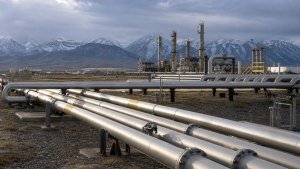
Natural gas is a naturally occurring hydrocarbon gas mixture made mainly of methane. It is formed over millions of years from organic matter and is widely used as a transition fuel because it burns cleaner than coal and oil.
Geographic Distribution of Natural Gas Reserves
The global distribution of natural gas reserves is highly uneven, with a few countries controlling most of the supply.
- Concentration of Reserves: More than half of the world’s proven natural gas reserves are concentrated in Russia, Iran, and Qatar.
- Regional Dominance: The Middle East and Eurasia hold the largest shares of conventional gas reserves.
- Geopolitics and Supply Chains: This concentration makes importing countries dependent on key pipelines and LNG shipping routes.
Top Countries by Proven Natural Gas Reserves
Proven reserves are the quantities of gas that geological and engineering data show can be recovered under existing economic and operating conditions.
| Rank | Country | Proven Natural Gas Reserves (Trillion Cubic Feet – Tcf) | Share of Global Total (%) |
| 1 | Russia | 1,320.5 | ~22.4% |
| 2 | Iran | 1,133.6 | ~15.9% |
| 3 | Qatar | 871.1 | ~13.0% |
| 4 | Turkmenistan | 480.3 | ~6.3% |
| 5 | United States | 445.6 | ~5.3% |
| 6 | China | 296.6 | ~3.3% |
| 7 | Venezuela | 221.1 | ~2.8% |
| 8 | Saudi Arabia | 212.6 | ~2.6% |
| 9 | United Arab Emirates | 209.7 | ~2.5% |
| 10 | Nigeria | 193.3 | ~2.3% |
Russia
Russia has the world’s largest stockpile of natural gas. Most reserves are in the West Siberian Basin, especially around the Yamal Peninsula. Gazprom manages the bulk of these resources.
Iran
Iran has the second-largest natural gas reserves and about 145 hydrocarbon fields. However, sanctions and infrastructure limitations have restricted large-scale exports.
Qatar
Qatar is the third-largest holder of gas reserves and a major exporter of Liquefied Natural Gas (LNG). The Ras Laffan facility is central to its gas export system.
Turkmenistan
Turkmenistan’s reserves are concentrated in the Galkynysh field. Being landlocked, it depends heavily on pipelines, especially exports to China through the Central Asia-China pipeline.
United States
The United States ranks fifth in reserves but is the world’s largest producer of natural gas. Hydraulic fracturing and horizontal drilling unlocked vast shale gas deposits.
Major Natural Gas Fields in the World
Gas fields are classified by size. Supergiant fields contain more than 30 Tcf of recoverable gas, while giant fields hold between 3 and 30 Tcf.
| Field Name | Country / Location | Estimated Recoverable Reserves (Tcf) | Key Characteristics |
| South Pars / North Dome | Iran & Qatar (Persian Gulf) | ~1,230 to 1,800 | The largest gas field in the world; offshore field shared by two nations. |
| Urengoy | Russia (Siberia) | ~222 | The largest onshore gas field in the world; located near the Arctic Circle. |
| Yamburg | Russia (Siberia) | ~138 | Located in the West Siberia Basin, north of the Arctic Circle. |
| Bovanenkovo | Russia (Yamal Peninsula) | ~140 | A key field driving Russia’s Arctic gas development. |
| Hassi R’Mel | Algeria | ~123 | The largest gas field in Africa; located in the Sahara Desert. |
| Shtokman | Russia (Barents Sea) | ~110 | A massive offshore field in the harsh Arctic environment. |
| Galkynysh | Turkmenistan | ~98 to 200 | A supergiant onshore field discovered in 2006. |
| Zapolyarnoye | Russia (Siberia) | ~95 | One of the most productive fields in the West Siberian Basin. |
| Hugoton | United States | ~70 to 81 | A major conventional gas field extending across Kansas, Oklahoma, and Texas. |
| Groningen | Netherlands | ~73 | The largest gas field in Europe; production was phased out due to induced earthquakes. |
South Pars / North Dome Field
This offshore supergiant field in the Persian Gulf covers about 9,700 square kilometers. Iran controls the northern part, called South Pars, and Qatar controls the southern part, known as North Dome. It contains nearly 19% of the world’s known natural gas reserves.
Urengoy Gas Field
Discovered in 1966 in northern West Siberia, Urengoy is the world’s largest onshore gas field. Production began in 1978 and it supplies gas for European pipeline exports.
Galkynysh Gas Field
Located in Mary Province, Turkmenistan, Galkynysh is one of the largest onshore gas discoveries of the 21st century. It is a sour gas field requiring special processing to remove hydrogen sulphide before transport.
Hassi R’Mel Gas Field
Located about 550 kilometers south of Algiers, Hassi R’Mel was discovered in 1956. It is the hub of Algeria’s gas pipeline network and links supply to Europe through undersea Mediterranean pipelines.
Types of Natural Gas Reservoirs
Natural gas occurs in different geological formations, which affect extraction methods and costs.
- Associated Gas: Gas found in contact with or dissolved in crude oil and produced along with oil.
- Non-Associated Gas: Gas found in reservoirs without large amounts of crude oil; many major fields are of this type.
- Shale Gas: An unconventional resource trapped in shale rock and extracted using hydraulic fracturing and horizontal drilling.
- Coalbed Methane (CBM): Gas adsorbed in coal seams, usually extracted by pumping out water to reduce pressure.
Global Production vs. Reserves
There is a major difference between holding large reserves and producing gas at scale.
- The United States: It leads global production, accounting for over 25% of annual output.
- Russia: It is the second-largest producer, with production tied to state-led pipeline infrastructure.
- Qatar: It focuses on LNG exports and uses specialized transport fleets for global shipping.
- Iran: Despite huge reserves, domestic demand and limited LNG infrastructure restrict exports.
Natural Gas Reserves and Fields in India
India has relatively modest gas reserves compared to global giants, but it is moving toward a gas-based economy.
- Total Reserves: India has about 40 Tcf of proven natural gas reserves, or roughly 0.5% of the global share.
- Krishna-Godavari (KG) Basin: A major deepwater gas basin on India’s east coast; the KG-D6 block was the country’s first deepwater development project.
- Mumbai High: An offshore field in the Arabian Sea and India’s historic major source of crude oil and associated natural gas.
- Methane Hydrates: Large deposits are found in the KG Basin and near Andaman and Mahanadi coasts.
- Coal Bed Methane (CBM): Commercial CBM blocks operate mainly in Sohagpur, Madhya Pradesh, and Raniganj, West Bengal.
Recent Context
Iran announced a major natural gas discovery in Fars Province on August 23, 2026. The field contains over 7.5 Tcf of gas, with about 5.7 Tcf commercially extractable, and is classified as sweet gas.
Rare Facts for Prelims
- Gas conversion: 1 cubic foot is approximately equal to 0.0283 cubic metres.
- GECF: The Gas Exporting Countries Forum was established in 2001 and is headquartered in Doha, Qatar.
- Iran’s reserve size: Iran holds nearly 34 trillion cubic metres of proven natural gas reserves, second only to Russia.
- Pazan field: The October 2025 Pazan discovery in Iran’s Zagros Basin contains 10 Tcf of gas and 200 million barrels of crude oil.
- Sweet gas: Sweet natural gas has low hydrogen sulphide content and requires less treatment than sour gas.
- Gas condensate: It is a liquid hydrocarbon that condenses from natural gas when pressure and temperature change during production.
| Related | |
|---|---|



S.S.Bisht
August 24, 2026 at 10:02 amVery valuable iinomations.