Types of Networks: LAN, WAN, MAN, PAN, Internet
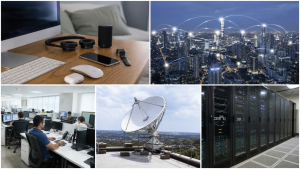
Computer networks connect two or more independent devices to exchange data, share hardware, and support communication protocols. They are commonly classified by geographic reach, ownership, transmission speed, and media used.
The main types include PAN, LAN, MAN, WAN, and the Internet, along with related network forms such as Intranet, Extranet, CAN, SAN, and VPN.
Personal Area Network (PAN)
A Personal Area Network (PAN) works within an individual’s immediate space, usually up to 10 meters. It is designed for short-range communication among personal devices.
- Wireless PAN (WPAN): Uses Bluetooth (IEEE 802.15.1), Zigbee (IEEE 802.15.4), Ultra-Wideband (UWB), and Near Field Communication (NFC).
- Wired PAN: Connects peripherals through USB and FireWire (IEEE 1394).
- Features: Low power consumption, moderate data rates, and simple device-to-device communication.
- Common devices: Smartwatches, smartphones, wireless headsets, and personal laptops.
- Body Area Network (BAN): A specialized PAN used for medical sensors attached to or implanted in the human body.
Local Area Network (LAN)
A Local Area Network (LAN) connects devices within a limited area such as a room, home, office building, laboratory, or school. It is usually owned and administered by a single individual or private organization.
- Wired LAN: Uses Ethernet (IEEE 802.3) over twisted-pair copper cables or optical fiber.
- Wireless LAN (WLAN/Wi-Fi): Uses IEEE 802.11 protocols.
- Speed: Typically ranges from 100 Mbps to 10 Gbps and higher.
- Advantages: High speed, low latency, and minimal transmission errors.
- VLAN: A Virtual LAN under IEEE 802.1Q divides one physical switch network into multiple logical networks to improve security and reduce broadcast domains.
Metropolitan Area Network (MAN)
A Metropolitan Area Network (MAN) covers a larger area than a LAN but smaller than a WAN, usually a town, city, or municipal district. It generally spans about 5 km to 50 km.
- Typical use: Municipal cable television networks, smart city surveillance systems, and fiber-optic backbones linking municipal offices.
- Technologies: Fiber Distributed Data Interface (FDDI), Distributed Queue Dual Bus (DQDB under IEEE 802.6), and Metro Ethernet.
- Ownership: May belong to a consortium of users, a telecom service provider, or a municipal government authority.
- Role: Useful for connecting multiple LANs across a city or large institutional area.
Wide Area Network (WAN) and the Internet
A Wide Area Network (WAN) extends across cities, states, countries, or continents. It uses public, leased, or shared communication links and usually has higher delay than LANs or MANs because of long transmission distances.
- Media: Submarine optical fiber cables, microwave links, communication satellites, and telephone systems.
- Technologies: MPLS, ATM, Frame Relay, and Software-Defined WAN (SD-WAN).
- Ownership: Usually shared among multiple telecom service providers, network operators, and national carriers.
- Characteristics: Long propagation delay and varied transmission error rates.
The Internet is a global public system of interconnected computer networks that uses the TCP/IP protocol suite. It has no single owner and functions as a distributed worldwide network.
- Intranet: A private network restricted to internal employees of an organization.
- Extranet: A secure extension of an intranet that allows controlled access to suppliers, vendors, partners, or customers.
- Campus Area Network (CAN): Links multiple LANs across a defined educational or industrial facility.
- Storage Area Network (SAN): A high-speed network providing block-level access to consolidated storage using Fibre Channel or iSCSI.
- VPN: Creates an encrypted point-to-point tunnel over a public network using IPsec, SSL/TLS, or WireGuard.
Network Topologies and Transmission Media
Network performance also depends on the physical layout of devices and the medium used to carry data.
- Bus Topology: Devices share a single backbone cable terminated at both ends; a break in the cable can disable the whole line.
- Star Topology: Each node connects to a central hub or switch; failure of one cable does not affect the others.
- Ring Topology: Devices form a closed loop, and data travels in one direction using token passing.
- Mesh Topology: Each node has a dedicated point-to-point connection with every other node.
- Full Mesh: Requires n(n-1)/2 links for n nodes and offers high fault tolerance.
- Tree Topology: A hierarchy of multiple star networks connected through a central root hub.
- Twisted Pair Cable: Pairs of insulated copper wires twisted together to reduce electromagnetic interference.
- Coaxial Cable: Carries signals through a central conductor with shielding around it.
- Optical Fiber: Uses light signals for high-speed, low-loss communication over long distances.
- Unguided Media: Includes wireless transmission such as radio waves and microwaves.
Key Prelims Takeaways
- PAN: Short-range network for personal devices, usually within 10 meters.
- LAN: Covers a small local area and usually delivers the highest speed among common network types.
- MAN: Bridges the gap between LAN and WAN, often over a city or municipality.
- WAN: Connects faraway locations using leased, public, or shared communication links.
- Internet: A global network based on TCP/IP with no single owner.
- VLAN: Creates logical separation within a physical LAN for better control and security.
- VPN: Provides encrypted communication over public networks.
| Related | |
|---|---|