Pioneers and Institutions in Early Computing
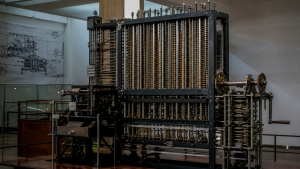
Early computing moved from mechanical calculation to programmable automation through a series of landmark inventions and theoretical breakthroughs. From punched cards and logic algebra to vacuum tubes, transistors and integrated circuits, each step made machines faster, smaller and more capable.
Mechanical Era and Theoretical Foundations
- Charles Babbage: Designed the Difference Engine and the Analytical Engine in the nineteenth century, laying the blueprint for automatic digital calculation.
- Analytical Engine: Introduced the idea of a store for memory and a mill for arithmetic operations, making Babbage the pioneer of computing hardware.
- Joseph Marie Jacquard: Used replaceable punched cards in 1801 to control loom patterns, an early mechanical model for machine programming and data storage.
- Ada Lovelace: Wrote the first published algorithm intended for implementation on Babbage’s Analytical Engine, often regarded as the first program concept.
- George Boole: Developed Boolean algebra in the mid-nineteenth century, creating the mathematical base for binary logic and digital circuit design.
- Herman Hollerith: Invented an electromechanical tabulating machine that used punched cards to process data for the United States Census.
Electronic Computing and Early Machines
- ENIAC: The Electronic Numerical Integrator and Computer was built by John Mauchly and J. Presper Eckert in 1946 as the first programmable, electronic general-purpose digital computer.
- Atanasoff-Berry Computer: Built in 1939, it is recognized as the first automatic electronic digital computer, though it was not general-purpose programmable.
- UNIVAC I: Became the first commercially produced computer for business and government applications.
- Bletchley Park: Housed the Colombe computer, an early electronic digital machine used to crack encrypted enemy communications during the Second World War.
- Alan Turing: Formalized the ideas of algorithmic computation and theoretical machines, while also contributing to cryptanalysis during the mid-twentieth century.
- John von Neumann: Introduced the stored-program architecture, in which data and program instructions share the same memory space.
Hardware Innovations and Commercialization
- Transistor: Invented at Bell Labs in 1947 by John Bardeen, Walter Brattain and William Shockley, replacing bulky vacuum tubes and enabling circuit miniaturization.
- Integrated circuit: Developed in 1958 by Jack Kilby and Robert Noyce, combining multiple transistors onto a single semiconductor chip.
- Grace Hopper: Developed the first compiler concepts and contributed to early high-level programming languages such as COBOL.
- Intel 4004: Introduced in 1971, it marked the debut of the first commercial microprocessor.
Comparative Overview of Early Computing Milestones
| Innovation or Machine | Year | Key Inventor or Architect | Primary Function |
| Jacquard Loom | 1801 | Joseph Marie Jacquard | Automated complex weaving using punched cards |
| Analytical Engine | 1834 | Charles Babbage | Proposed general-purpose mechanical computation |
| Hollerith Tabulator | 1887 | Herman Hollerith | Mechanized census data processing via punched cards |
| ENIAC | 1946 | John Mauchly and J. Presper Eckert | High-speed electronic digital calculation |
| Transistor | 1947 | John Bardeen, Walter Brattain, William Shockley | Controlled electrical current flow without vacuum tubes |
| Integrated Circuit | 1958 | Jack Kilby and Robert Noyce | Consolidated electronic circuits onto a single silicon chip |
Why These Developments Matter
- From mechanical to electronic: Computing evolved from gears, cards and levers to circuits, chips and programmable systems.
- From calculation to logic: Boolean algebra and stored-program ideas made modern software and digital hardware possible.
- From special-purpose to general-purpose: Machines like ENIAC and later stored-program computers broadened computing applications.
- From vacuum tubes to chips: Transistors and integrated circuits drastically reduced size, heat and cost.
- From tabulation to processing: Punched-card systems marked the shift toward mechanized data handling and automation.
Key Prelims Takeaways
- Charles Babbage is associated with the Difference Engine and Analytical Engine.
- Ada Lovelace wrote the first published algorithm for a machine.
- George Boole laid the foundation of binary logic through Boolean algebra.
- Herman Hollerith used punched cards for census tabulation.
- ENIAC is remembered as the first programmable electronic general-purpose digital computer.
- Stored-program architecture is linked to John von Neumann.
- Transistor, integrated circuit and microprocessor are key milestones in the miniaturization of computing.
Current General Studies comprises current-affairs-based, General Studies-rich study material on policies, laws, institutions, economy, science, environment, governance, international relations, and other varied but important topics for UPSC and State PSC Prelims examinations.
Fortnightly PDF compilations: Available here
Originally written on
May 28, 2026
and last modified on
September 6, 2026.
| Related | |
|---|---|