Important Military Test Ranges in India
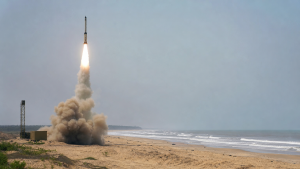
India’s military test ranges are specialized facilities used to evaluate missiles, aircraft, artillery, explosives, and electronic warfare systems before induction into service. These ranges provide secure airspace, isolated land areas, and controlled conditions for safe trials and telemetry collection.
Missile and Rocket Testing Ranges
Integrated Test Range (ITR), Chandipur
The Integrated Test Range is a DRDO facility in Balasore district, Odisha. Established in 1982, it is India’s primary site for missile testing and has two major launch complexes.
- Launch Complex-III (LC-III), Chandipur-on-Sea: This coastal facility is used mainly for short-range tactical missiles, surface-to-air systems, and multi-barrel rocket launchers. The beach is known for its low-tide phenomenon, when the sea recedes by up to 5 kilometres, exposing a hard sand bed that helps recover missile parts and debris. Weapons tested here include the Prithvi missile, Akash system, and Pinaka rocket system.
- Launch Complex-IV (LC-IV), Dr. APJ Abdul Kalam Island: Formerly Wheeler Island, it was renamed in 2015. Located about 10 kilometres off the Odisha coast in the Bay of Bengal, it is the main site for strategic weapon trials. It has advanced tracking and telemetry systems for long-range tests. Weapons tested here include the Agni series, K-series submarine-launched ballistic missiles such as K-15 Sagarika and K-4, and interceptor missiles for India’s Ballistic Missile Defence shield.
Proof and Experimental Establishment (PXE), Chandipur
The Proof and Experimental Establishment is a DRDO armament laboratory in Balasore, Odisha. Established in 1895 and brought into the DRDO network in 1958, it evaluates conventional military hardware.
- Primary function: Developmental, evaluation, and proof trials for medium and large-caliber weapons.
- Testing scope: Artillery guns, mortars, infantry combat vehicle guns, rocket systems, naval gun mounts, proximity fuzes, Arjun tank armaments, and armored vehicle turrets.
- Technical support: It works closely with the nearby Integrated Test Range for assessment and recovery of test munitions.
Aeronautical and Unmanned Systems Testing
Aeronautical Test Range (ATR), Challakere
The Aeronautical Test Range is an outdoor facility at Varavoo Kaval, Challakere Taluk, Chitradurga district, Karnataka. Developed at a cost of ₹1,300 crore, it was inaugurated in May 2017.
- Facility scale: The range covers over 4,090 acres and includes a 2.2-kilometre runway built to international standards, with plans to extend it to 3 kilometres.
- Core purpose: Under the administrative control of the Aeronautical Development Establishment (ADE), it is used for testing UAVs, manned aircraft, air-to-ground weapons, parachutes, and aerostats.
- Safety protocol: Ballistic missile testing is not permitted here due to environmental restrictions.
- Key tests: The range has hosted trials of TAPAS BH-201 (Rustom-2), Rustom-1, ISRO’s Reusable Launch Vehicle (RLV-TD) landing tests, and Nirbhay cruise missile trials.
Specialized Explosive and Electronic Warfare Ranges
Ramgarh Test Range, Haryana
The Ramgarh Test Range is an outdoor trial field operated by the Terminal Ballistics Research Laboratory (TBRL), a DRDO laboratory based in Chandigarh. It is located at Ramgarh in Panchkula district, Haryana.
- Physical footprint: Spread across 5,500 acres.
- Primary scope: Research in terminal ballistics, high explosives, blast physics, and lethality studies.
- Testing activities: High-caliber aerial bombs, warheads, shells, and protective armour materials such as bullet-proof vests, vehicle armour plates, and combat helmets.
Tandur Test Range, Telangana
The Tandur Test Range is an outdoor evaluation facility in Vikarabad district, Telangana, about 135 kilometres from Hyderabad.
- Physical footprint: Covers about 8,000 acres.
- Primary scope: Testing and validation of radar-based and communication-based electronic warfare (EW) systems.
- Specialized capabilities: Used for high-power electromagnetic radiation and smart radio jamming tests in isolated conditions.
Major Military Field Firing Ranges
The Indian Armed Forces maintain several field firing ranges across the country for troop training and for validating combat vehicles, heavy artillery, and infantry weapons.
Pokhran Field Firing Range, Rajasthan
Located in Jaisalmer district, Rajasthan, this is the largest land-based firing range in India.
- Testing parameters: Maximum firing range of 32 kilometres.
- Core activities: Tactical manoeuvres, live firing of tank guns such as T-90 Bhishma and Arjun, infantry combat vehicle missiles, heavy artillery, and evaluation of air defence systems.
- Historical event: The site hosted India’s nuclear tests in 1974 (Smiling Buddha) and 1998 (Operation Shakti).
Pokhran remains one of India’s most important strategic test areas for weapons trials and border-related military preparedness.
Mahajan Field Firing Range, Rajasthan
Located in Bikaner district, Rajasthan, the Mahajan Field Firing Range is a major centre for desert warfare training.
- Testing parameters: Maximum range of 20 kilometres.
- Core activities: Tank guns, combat vehicles, infantry support weapons, and anti-aircraft artillery.
- Joint exercises: Used for bilateral and multilateral land exercises with friendly foreign militaries.
Babina Field Firing Range, Uttar Pradesh
Situated near Jhansi on the Uttar Pradesh-Madhya Pradesh border, this range is a key training ground for armoured regiments.
- Testing parameters: Maximum range of 10 kilometres.
- Core activities: Live-fire training for main battle tanks, infantry combat vehicles, anti-tank guided missiles, and infantry support armaments.
Summary of Key Military Test Ranges in India
| Test Range Name | State/UT | Primary Operator | Primary Testing Focus |
| Integrated Test Range (ITR) | Odisha | DRDO | Short to long-range missiles, rockets, and air-borne weapons |
| Proof and Experimental Establishment (PXE) | Odisha | DRDO | Medium and large-caliber artillery guns, tank guns, and ammunition |
| Aeronautical Test Range (ATR) | Karnataka | DRDO | Unmanned aerial vehicles (UAVs), cruise missiles, and parachutes |
| Ramgarh Test Range | Haryana | DRDO (TBRL) | High explosives, terminal ballistics, and armour testing |
| Tandur Test Range | Telangana | DRDO | Communication-based electronic warfare (EW) systems |
| Pokhran Field Firing Range | Rajasthan | Indian Army | Armoured vehicles, main battle tanks, and artillery systems |
| Mahajan Field Firing Range | Rajasthan | Indian Army | Tank manoeuvres, desert warfare training, and joint exercises |
| Babina Field Firing Range | Uttar Pradesh | Indian Army | Armoured regiments, combat vehicles, and tactical missiles |
High-Altitude and Regional Field Firing Ranges
The Indian Army also operates regional firing ranges for training in difficult terrain, especially in mountainous and border areas.
- Sikkim High-Altitude Range (Sikkim): Spanning 6 kilometres, it is used to test infantry weapons and light artillery guns in high-altitude conditions.
- Gamrala High-Altitude Range (Arunachal Pradesh): Located near the northern border, it has a maximum limit of 6 kilometres and is used for mountain warfare weapons and light field guns.
- Teesta Field Firing Range (West Bengal): With a maximum range of 10 kilometres, it supports testing of infantry weapons and field guns.
Rare Facts for Prelims
- LC-III at Chandipur: The receding sea at low tide creates a natural recovery zone for missile debris and target fragments.
- Dr. APJ Abdul Kalam Island: It is a key site for India’s strategic missile trials because of its isolation and telemetry infrastructure.
- PXE legacy: The establishment dates back to 1895, making it one of the oldest defence testing institutions in India.
- ATR, Challakere: It is one of the few Indian ranges designed specifically for UAV and unmanned system trials rather than missile testing.
- Pokhran’s strategic role: The range is used not only for firing exercises but also for validating border-ready systems and counter-drone capabilities.
- Desert warfare training: Mahajan is especially important for joint exercises because its terrain closely simulates arid operational conditions.
| Related | |
|---|---|