Stem Education Initiatives and Policies in India
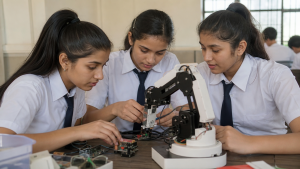
STEM education is central to India’s effort to build a skilled, innovation-driven economy. The government has introduced school-level reforms, innovation labs, research funding schemes and gender-focused initiatives to strengthen science and technology learning from school to higher education.
National Education Policy 2020 and School STEM Reforms
The National Education Policy (NEP) 2020 pushes India’s school system away from rote learning and toward experiential, interdisciplinary learning in science and mathematics. It also seeks to reduce rigid stream divisions and build early analytical ability.
- 5+3+3+4 structure: NEP 2020 replaces the 10+2 format with foundational, preparatory, middle and secondary stages.
- STEAM approach: The policy encourages integration of Science, Technology, Engineering, Arts and Mathematics across stages of learning.
- Coding from Class 6: Computational thinking and coding are introduced early to build problem-solving skills.
- Experiential learning: The policy promotes inquiry-based and hands-on learning instead of memorisation.
- State alignment: Uttar Pradesh expanded its secondary school STEM digital learning programme to all government-aided and self-financed secondary schools under Samagra Shiksha (Secondary) for 2025-26.
- Teacher training: CBSE identified STEM Education as the core theme for teacher-training programmes in the 2025-26 academic session.
Atal Tinkering Labs and Innovation Pathways
Atal Tinkering Labs (ATLs), implemented under the Atal Innovation Mission (AIM) of NITI Aayog, are school-based innovation spaces meant to develop scientific temper and practical problem-solving skills among students.
- Purpose: ATLs provide hands-on exposure to innovation, design and experimentation.
- Operational scale: More than 10,000 ATLs are operational across schools.
- Student reach: These labs engage over 1.1 crore students.
- Innovation output: The platform has generated more than 16 lakh innovation projects.
- Expansion plan: The government has approved 50,000 new ATLs to widen school-level innovation access.
- Technology focus: Students are exposed to 3D printing, artificial intelligence, robotics, Internet of Things (IoT) and other advanced tools.
The Vigyan Dhara Scheme
The Department of Science and Technology (DST) has consolidated several promotional programmes into the central sector scheme Vigyan Dhara to streamline support for scientific capacity building, research and innovation.
- Effective date: Vigyan Dhara came into force on January 16, 2025.
- Merger of schemes: It combines three earlier DST umbrella schemes: Science and Technology Institutional and Human Capacity Building; Research and Development; and Innovation, Technology Development and Deployment.
- Outlay: The proposed outlay is ₹10,579.84 crore for the 15th Finance Commission period (2021-22 to 2025-26).
- Budget allocation: The allocation rose from ₹330.75 crore in 2024-25 to ₹1,425.00 crore in 2025-26.
- Research link: The R&D component aligns with the Anusandhan National Research Foundation (ANRF).
| Parameter | Details |
| Scheme | Vigyan Dhara |
| Enforcement date | January 16, 2025 |
| 15th FC outlay | ₹10,579.84 crore (2021-22 to 2025-26) |
| FY 2025-26 allocation | ₹1,425.00 crore |
| Aligned research body | ANRF |
Gender Parity and WISE-KIRAN Programmes
The DST runs specialised initiatives to increase women’s participation in STEM, especially in education, research and leadership roles.
- Vigyan Jyoti Programme: It encourages girl students in Classes IX to XII to pursue higher education and careers in underrepresented STEM fields.
- Scholarship support: Selected students receive ₹2,000 per month.
- Programme reach: It has benefited 1,12,600 meritorious girls across 300 districts in 34 States and Union Territories.
- Implementation network: Jawahar Navodaya Vidyalayas act as coordinating partners.
- Knowledge partners: Around 250 premier national institutions support the programme.
- WISE-KIRAN: Women in Science and Engineering-KIRAN offers targeted fellowships and support for women scientists.
- WISE-PhD: This fellowship provides ₹37,000 per month.
- WISE-PDF: The Post-Doctoral Fellowship supports women scientists aged 27-60.
- GATI charter: Gender Advancement for Transforming Institutions is a charter-based framework under WISE-KIRAN for gender equity in STEMM fields.
Key Prelims Takeaways
- NEP 2020: Introduces the 5+3+3+4 structure and promotes experiential STEM learning.
- Coding from Class 6: A key NEP reform to build early computational thinking.
- ATLs: School innovation labs under AIM, with more than 10,000 operational labs.
- ATL expansion: The government has approved 50,000 new Atal Tinkering Labs.
- Vigyan Dhara: A consolidated DST scheme effective from January 16, 2025.
- ANRF link: The R&D component of Vigyan Dhara aligns with ANRF established under the ANRF Act, 2023.
- Women in STEM: Vigyan Jyoti, WISE-KIRAN and GATI are major gender-inclusion initiatives.
| Related | |
|---|---|