Major Indian Bronze Sculptures and Their Iconography
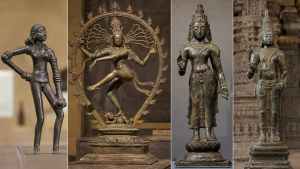
Indian bronze sculpture combines advanced metalworking with religious imagery, and its forms changed across the Indus Valley, Chola, Pala and Vijayanagara periods. Its figures, gestures and attributes offer clues to artistic traditions and religious beliefs, while also supporting heritage education and cultural identity.
Early Bronze Traditions
The earliest examples of Indian bronze artistry date to the Indus Valley Civilisation, around 2500 BCE. The small statuette known as the “Dancing Girl”, found at Mohenjo-daro, is among its best-known works. It portrays a lean female figure in a confident stance and demonstrates sophisticated metalworking for its time.
- Dancing Girl: The statuette is about 10.5 cm high and was made using the lost-wax, or cire perdue, technique.
- Other Harappan finds: Bronze figures of buffaloes with uplifted heads and chariots have been found at Daimabad.
- Chalcolithic metalwork: Copper hoards from parts of Uttar Pradesh and Bihar provide further evidence of early casting, though these objects are generally copper rather than true bronze.
Chola Bronze Masterpieces
The Chola period, from the 9th to the 13th centuries CE, is regarded as a high point in Indian bronze sculpture. Chola bronzes are noted for elegant forms, fluid movement and devotional expression. Many represented deities intended to be carried in temple processions during festivals.
- Lost-wax casting: The artist first shaped a figure in wax and covered it with clay. Heating melted the wax and left a cavity into which molten metal was poured. The method allowed the making of detailed metal images.
- Nataraja: Shiva’s cosmic dance is framed by a flaming halo, or prabhamandala, associated with the cycle of creation and destruction. His upper right hand holds the damaru, or drum, and his upper left hand holds agni, the flame.
- Nataraja’s gestures and pose: The lower right hand offers protection through the abhaya mudra; the lower left points towards the raised foot, associated with liberation. Shiva dances on Apasmara, the demon of ignorance.
- Somaskanda: This family image shows Shiva and Uma (Parvati) with their son Skanda, also known as Kartikeya or Murugan, as a child between them. It presents a benevolent, familial aspect of Shiva.
- Other subjects: Chola bronzes also depict Vishnu, Lakshmi, Parvati, Rama, Sita and Lakshmana, as well as Shaivite and Vaishnavite saints. Saint Kannappa Nayanar, one of Tamil Shaivism’s 63 Nayanars, is among the figures represented.
Pala Period Bronzes
From the 8th to the 12th centuries CE, the Pala dynasty supported bronze sculpture in eastern India, particularly in Bihar and Bengal. These works reflect the region’s Hindu and Buddhist traditions and are distinguished from the more fluid Chola style by their own refined treatment of figures and ornament.
- Form and modelling: Pala bronzes commonly have slender forms, subtle modelling and delicate ornamentation.
- Material: Many were made from ashtadhatu, an alloy of eight metals, giving the sculptures a characteristic sheen.
- Buddhist figures: Common subjects include the Buddha, Avalokiteshvara, Maitreya and Tara. Their gestures and attributes help identify them.
- Hindu figures: Vishnu, Surya and Durga also appear in Pala bronze sculpture.
Vijayanagara and Later Bronzes
Bronze-making continued under the Vijayanagara Empire, from the 14th to the 17th centuries CE. Vijayanagara artists drew on Chola precedents but developed a distinct style. Bronze production continued in later South Indian periods, including the Nayaka and Maratha eras.
- Style: Compared with Chola figures, Vijayanagara bronzes are generally more robust and less fluid, with sharper features and greater emphasis on ornamentation and princely regalia.
- Portrait subjects: Alongside deities, portrait bronzes of rulers, queens and prominent saints became popular.
- Saint Sundarar: A 16th-century bronze depicts Sundarar with Paravai Nachiyar. Sundarar’s hymns form the seventh volume of the twelve-volume Tirumurai, a Shaiva Siddhanta compendium.
- Later production: Nayaka- and Maratha-period bronzes continued the tradition, often with more detailed ornament and close adherence to iconographic texts.
Iconography and Cultural Significance
Bronze images use gestures, objects, vehicles and posture to communicate identity and meaning. Reading these features helps distinguish deities and understand the devotional purpose of a sculpture. Their study also connects artistic technique with religious practice and cultural history.
- Mudras: Abhaya signifies fearlessness or protection; Varada is associated with granting boons; Dhyana indicates meditation; and Vitarka is a teaching gesture.
- Attributes (ayudhas): Objects held by a deity serve as identifiers. Vishnu may carry the conch (shankha) and discus (chakra), Shiva the trident (trishula), and Lakshmi the lotus (padma).
- Vehicles (vahanas): Associated animals or birds include Garuda for Vishnu, Nandi for Shiva and the peacock for Kartikeya.
- Postures: Standing and seated forms convey different qualities. Tribhanga, the three-bend pose, can give a figure a sense of movement, while other postures may suggest composure.
- Headgear and ornaments: Crowns, earrings, necklaces and armlets can indicate divinity or royal status and contribute to a figure’s iconographic identity.
Bronze sculptures are also important for art conservation and heritage education. Their preservation and interpretation help maintain cultural identity and make the techniques and beliefs represented in the works accessible to future generations.
Key Prelims Takeaways
- The Harappan “Dancing Girl” from Mohenjo-daro is about 10.5 cm high and was cast using the lost-wax technique.
- Chola bronzes, produced from the 9th to the 13th centuries CE, are known for processional deities, fluid forms and devotional intensity.
- Nataraja’s drum, flame, protective gesture, raised foot and Apasmara figure convey elements of Shiva’s cosmic dance.
- Somaskanda depicts Shiva, Uma and their son Skanda as a child.
- Pala bronzes from eastern India include Hindu and Buddhist subjects and were often made using ashtadhatu.
- Vijayanagara bronzes include deities as well as portrait figures of rulers and saints.
Recent Context
On November 26, 2026, the Archaeological Survey of India transferred three repatriated bronze antiquities to the Idol Wing CID of Tamil Nadu Police. Two had returned from the Smithsonian Museum in the United States and one from The Hague, Netherlands. They include Somaskanda, Sundarar with Paravai Nachiyar, and Kannappa Nayanar.
| Related | |
|---|---|