Major Attack Helicopters in India
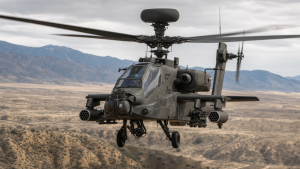
India’s attack helicopter fleet is a key part of its air power and battlefield support capability. These rotary-wing platforms are used for offensive strikes, close air support, reconnaissance, anti-armour operations and, increasingly, joint-force warfare in difficult terrain.
AH-64E Apache Attack Helicopter
The AH-64E Apache Guardian is an advanced twin-engine attack helicopter developed by Boeing in the United States. It is designed for offensive missions, close air support, anti-armour operations, reconnaissance and precision strikes, and is built for integration with ground forces in combined-arms operations.
- Origin: United States
- Manufacturer: Boeing
- Role: Anti-armour, reconnaissance, precision strike, close air support
- Indian fleet: 28 helicopters — 22 with the Indian Air Force and 6 with the Indian Army
- Engine configuration: Twin-engine
- Armament: M230 30 mm chain gun, AGM-114 Hellfire anti-tank missiles, Hydra 70 mm rockets
- Payload: Up to 16 Hellfire missiles, 76 2.75-inch rockets, and 1200 rounds for the 30 mm chain gun
- Systems: Longbow radar and advanced night-vision sensors
- Targeting capability: Can track up to 128 targets simultaneously
Light Combat Helicopter (LCH) Prachand
The Light Combat Helicopter, or Prachand, is an indigenously designed and manufactured attack helicopter developed by Hindustan Aeronautics Limited (HAL). It has been optimised for high-altitude operations, making it especially relevant for India’s mountainous border areas.
- Origin: India
- Manufacturer: Hindustan Aeronautics Limited (HAL)
- Role: Multi-role attack helicopter, especially suited for high-altitude operations
- Indian Army: 5 helicopters inducted; 90 more expected
- Indian Air Force: 10 helicopters in service; 66 more ordered
- Armament: 20 mm turret gun, 70 mm rocket pods, air-to-air missiles
- Features: Stealth features, armour protection, and night attack capability
The Prachand’s importance lies in its ability to operate in rarefied air and rugged terrain where heavier helicopters may face limitations. This makes it a useful platform for defence modernisation and for strengthening indigenous capability in combat aviation.
HAL Rudra
The HAL Rudra is the weapon system integrated (WSI) variant of the indigenous HAL Dhruv Advanced Light Helicopter. It is used for combat, reconnaissance, surveillance and target acquisition, and is operated by both the Indian Army and the Indian Air Force.
- Base platform: HAL Dhruv Advanced Light Helicopter
- Origin: India
- Manufacturer: Hindustan Aeronautics Limited (HAL)
- Operational strength: Approximately 90 helicopters
- Role: Combat, reconnaissance, surveillance, target acquisition
- Armament: 20 mm turret gun, 70 mm rockets, anti-tank guided missiles, air-to-air missiles
- Sensor suite: Forward-looking infrared (FLIR) system, thermal imaging sights, electronic warfare suite
Rudra remains significant because it combines firepower with surveillance capability, giving the armed forces a flexible platform for both offensive and support roles. As an indigenous armed helicopter, it also reflects progress in Indian helicopter design and weapons integration.
Mil Mi-35 (Hind E)
The Mil Mi-35, also known as Hind E, is a Russian-made attack helicopter that earlier served as the primary attack helicopter of the Indian Air Force. It combined heavy attack capability with limited troop transport capacity.
- Origin: Russia
- Role: Attack helicopter with limited transport capability
- Status in India: Formerly the primary attack helicopter of the Indian Air Force
With the induction of more advanced platforms such as the Apache and Prachand, the Mi-35 reflects the transition from legacy imported systems to newer and more specialised combat helicopters.
Training, Doctrine and Modern Battlefield Focus
India’s helicopter capability is linked not only to platforms but also to evolving training and doctrine. The current focus is on joint operations, difficult-terrain warfare and the use of new technologies such as drones and autonomous systems.
- Integrated Battle Groups (IBGs): A key focus for improving joint military capability, especially in infantry-dominated mountain and semi-mountainous operations
- Counter-drone warfare: Growing emphasis on layered anti-drone defence networks
- Drone integration: Drones and autonomous systems are being used for surveillance, reconnaissance and situational awareness
- Drone training centres: Being developed to support modern battlefield requirements
- 3D-printed drone platforms: Deployed by the Indian Army for operations in mountainous terrain
- Mahajan Field Firing Range, Rajasthan: Used for desert warfare training
- Auli Foreign Training Node, Uttarakhand: Used for high-altitude training, including mountain warfare
Defence Modernisation and Indigenisation Angle
India’s attack helicopter inventory highlights a broader shift in defence modernisation. The fleet combines imported high-end systems like the Apache with indigenous platforms such as the Prachand and Rudra. This mix supports operational readiness while also reducing dependence on foreign suppliers over time.
- Air power capability: Attack helicopters provide precision fire support, mobility and flexibility
- Combined-arms operations: Helicopters are increasingly integrated with ground forces for battlefield coordination
- Indigenisation: The Prachand and Rudra show the growing role of Indian design and manufacture
- Mountain warfare: High-altitude platforms are especially relevant for border areas
- Modern sensors: Night-vision, FLIR and radar systems improve all-weather effectiveness
Key Prelims Takeaways
- AH-64E Apache: US-origin twin-engine attack helicopter; 28 in India, with 22 in the IAF and 6 in the Army
- Apache armament: M230 30 mm chain gun, AGM-114 Hellfire missiles and Hydra 70 mm rockets
- Apache capability: Can track up to 128 targets and carry up to 16 Hellfire missiles
- LCH Prachand: Indigenous HAL attack helicopter designed for high-altitude operations
- LCH strength: 5 inducted by the Indian Army and 10 by the Indian Air Force
- HAL Rudra: Armed version of HAL Dhruv; around 90 helicopters operated by the Army and Air Force
- Mi-35: Russian-origin helicopter; formerly the primary attack helicopter of the Indian Air Force
Recent Context
Indian Army and Indian Air Force Apache helicopters have been seen in the context of Exercise Yudh Abhyas 2026, the India-US bilateral military drill. Such exercises are relevant because they test joint operations, battlefield coordination and the use of attack helicopters in integrated field conditions.
| Related | |
|---|---|