Rajasthan’s Agriculture, Minerals and Industries
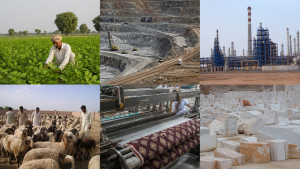
Rajasthan is India’s largest state by area and has a diverse economic base spread across agriculture, mineral resources and industry. Its economy is shaped by arid and semi-arid farming, rich metallic and non-metallic minerals, and a strong manufacturing and handicraft tradition.
For Prelims revision, Rajasthan is important because it leads India in several crops and minerals, while also hosting major industrial clusters, dairy and wool production centres, and key oil and cement-linked projects.
Sectoral Profile and Agro-Climatic Base
Rajasthan’s Gross State Domestic Product is supported by all three sectors, with services forming the largest share and agriculture still employing a large part of the population. The state is divided into 10 agro-climatic zones, ranging from arid western plains to sub-humid and humid southern plains.
- Primary sector: Agriculture, animal husbandry, milk and allied activities remain central to rural livelihoods.
- Secondary sector: Mining, cement, textiles, auto components and ceramics are major drivers.
- Tertiary sector: Tourism, trade, real estate, transport and financial services dominate the services base.
- Water dependence: Farming depends heavily on monsoon rainfall, supplemented in the north-west by the Indira Gandhi Nahar Project.
Major Crops and Regional Concentration
Rajasthan is one of India’s most important states for coarse cereals, oilseeds and pulses. Crop patterns vary sharply across districts because of climate, soil and irrigation availability.
- Bajra: Rajasthan ranks first in India in pearl millet production. Major producing districts include Barmer, Jodhpur, Nagaur, Bikaner and Churu.
- Rapeseed and mustard: The state is the leading national producer. Main centres include Bharatpur, Alwar, Ganganagar, Hanumangarh and Sawai Madhopur.
- Pulses: Rajasthan holds a top position in gram and total pulses production.
- Cotton: Grown extensively in Ganganagar, Hanumangarh and Banswara.
- Sugarcane: Concentrated mainly in Bundi, Chittorgarh and Ganganagar.
- Spices: Kota, Baran and Jhalawar form the main coriander belt.
- Special crops: Jhalawar is known for mandarin oranges; Nagaur for fenugreek; Jalore, Barmer and Jodhpur for cumin.
Livestock, Milk and Wool
Animal husbandry is a major pillar of Rajasthan’s rural economy. The state is among the top two milk-producing states in India and is also a leading wool producer.
- Milk production: The Saras cooperative brand is operated by the Rajasthan Cooperative Dairy Federation (RCDF) through a statewide collection network.
- Wool output: Rajasthan contributes over 30% of India’s total wool production.
- Sheep-rearing centres: Bikaner, Jodhpur, Nagaur and Barmer are prominent sheep-breeding districts.
- Research institute: The Central Sheep and Wool Research Institute (CSWRI) is located at Avikanagar in Malpura, Tonk district.
Mineral Wealth and Energy Resources
Rajasthan is one of India’s richest mineral states. It has 81 minerals, of which 57 are commercially mined. The state has a near-monopoly in several minerals, including wollastonite, jasper, lead, zinc and selenite.
- Lead and zinc: Rajasthan holds over 90% of India’s lead and zinc reserves.
- Major mines: Rampura-Agucha (Bhilwara), Zawar (Udaipur), Rajpura-Dariba (Rajsamand) and Kayar (Ajmer).
- Smelting: Hindustan Zinc Limited operates primary smelters at Debari (Udaipur) and Chanderiya (Chittorgarh).
- Copper belt: The Khetri-Singhana region in Jhunjhunu is the main copper belt, managed by Hindustan Copper Limited.
- Other copper deposits: Kho-Dariba (Alwar) and Delwara (Sirohi).
- Iron ore: Important deposits are found at Morija-Banol (Jaipur), Neemla-Raisela (Dausa) and Nathara-Ki-Pal (Udaipur).
- Gold: Reserves are reported from Anandpur-Bhukia and Jagpura-Bhukia in Banswara, and Devtalai in Bhilwara.
- Rock phosphate: The major deposit is at Jhamarkotda in Udaipur, operated by Rajasthan State Mines and Minerals Limited (RSMM).
- Limestone: Chittorgarh, Nagaur, Kota, Bundi and Sirohi support the state’s cement industry.
- Gypsum: Large beds occur in Bikaner, Nagaur, Barmer and Jaisalmer.
- Petroleum and gas: The Barmer-Sanchore Basin has oil fields such as Mangala, Bhagyam and Aishwariya, while natural gas deposits exist in Jaisalmer.
- Refinery: The Rajasthan Refinery Project is located at Pachpadra in Balotra/Barmer.
- Lignite: Key deposits occur at Palana, Barsingsar (Bikaner), Kapurdi, Jalipa (Barmer) and Merta Road (Nagaur).
- Atomic minerals: Uranium deposits are located at Rohil in Khandela (Sikar) and Umra (Udaipur); lithium reserves exist near Degana (Nagaur).
| Resource / Industry | Important locations |
| Wollastonite, Jasper | 100% national production from Rajasthan |
| Lead and Zinc | Rampura-Agucha, Zawar, Rajpura-Dariba, Kayar |
| Rock phosphate | Jhamarkotda, Udaipur |
| Marble and granite processing | Kishangarh, Ajmer |
| Oil fields | Mangala, Bhagyam, Aishwariya |
Industrial Clusters and Manufacturing Hubs
The state’s industry is closely linked with its minerals, textiles and traditional crafts. Mineral-based manufacturing and export-oriented clusters are important features of Rajasthan’s economy.
- Automotive and engineering: Bhiwadi, Neemrana and Khairthal-Tijara in the NCR region host auto OEMs, electronic units and the Japanese Industrial Zone.
- Textiles: Bhilwara is known as the Textile City and Manchester of Rajasthan for synthetic suitings.
- Textile processing: Pali, Balotra and Sanganer (Jaipur) are major fabric processing and dyeing centres.
- Cement: Chittorgarh is the main cement hub because of limestone availability; plants also operate in Nagaur, Sirohi, Bundi and Sawai Madhopur.
- Chemicals and fertilisers: Kota is an industrial processing hub with fertilizer and chemical facilities, including Chambal Fertilisers at Gadepan.
- Handicrafts: Jaipur is known for gemstone cutting, polishing, Blue Pottery and Sanganeri block prints.
- Furniture and leather: Jodhpur is famous for wooden furniture, handicraft exports and leather goods.
- Handloom: Kota and Baran are known for Kota Doria sarees.
- Carpets and embroidery: Bikaner and Barmer are centres for woollen carpets, embroidery and ajrakh prints.
Key Prelims Takeaways
- Largest state: Rajasthan is India’s largest state by area and covers 10.4% of the country’s geographical expanse.
- Bajra leader: The state ranks first in India in bajra production.
- Mustard leader: Rajasthan is the leading producer of rapeseed and mustard.
- Milk and wool: The state is among the top two milk-producing states and produces over 30% of India’s wool.
- Lead-zinc reserves: Rajasthan holds over 90% of India’s lead and zinc reserves.
- World’s largest open-cast zinc-lead mine: Rampura-Agucha in Bhilwara is the world’s largest open-cast zinc-lead mine.
- Jhamarkotda: Udaipur’s Jhamarkotda is the largest rock phosphate mine in India.
| Related | |
|---|---|