
Major Defence Pacts and Security Agreements in the World
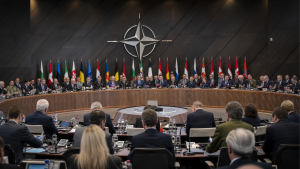
Defence pacts and security agreements shape how states respond to external threats, share military resources, and coordinate strategy. Some are collective-defence treaties with binding obligations, while others are looser security forums focused on consultation, technology, or regional stability.
NATO and the Logic of Collective Defence
North Atlantic Treaty Organization (NATO) is the most enduring military alliance in modern history. It was established on 4 April 1949 by 12 founding members from Europe and North America, with headquarters in Brussels, Belgium.
- Core objective: To safeguard the freedom and security of its members through political and military means.
- Article 5: An armed attack on one member is treated as an attack on all members, creating an obligation to assist.
- Invocation: Article 5 has been invoked only once, after the September 11, 2001 attacks on the United States.
- Membership: NATO has expanded from 12 to 32 countries as of 2024.
- Recent enlargements: Finland joined in 2023 and Sweden in 2024.
Exam point: NATO’s Article 5 is the classic example of collective defence in international relations.
Cold War Alliances: SEATO and CENTO
During the Cold War, the United States and its partners created regional pacts to contain communism and limit Soviet influence in Asia and the Middle East. Two important examples were SEATO and CENTO.
SEATO
- Full form: Southeast Asia Treaty Organization.
- Formation: Created on 8 September 1954 under the Manila Pact.
- Objective: To prevent the spread of communism in Southeast Asia.
- Members: United States, United Kingdom, France, Australia, New Zealand, Pakistan, Thailand and the Philippines.
- Headquarters: Bangkok, Thailand.
- Dissolution: It was dissolved on 30 June 1977 due to changing geopolitics and limited effectiveness.
CENTO
- Full form: Central Treaty Organization.
- Also known as: Baghdad Pact, later Middle East Treaty Organization (METO).
- Formation: Established on 24 February 1955.
- Objective: To counter Soviet expansion into the Middle East and South Asia.
- Members: Iran, Iraq, Pakistan, Turkey and the United Kingdom; the United States became an associate member in 1958.
- Headquarters: Baghdad from 1955 to 1958, then Ankara from 1958 to 1979.
- Dissolution: Iraq withdrew in 1959, Iran later withdrew after the fall of its monarchy, and CENTO was formally dissolved on 16 March 1979.
ANZUS and Regional Security in the Pacific
The Australia, New Zealand, United States Security Treaty (ANZUS) was signed in 1951 and was designed to ensure collective security in the Pacific during the Cold War.
- Members: Australia, New Zealand and the United States.
- Purpose: Members consult on mutual threats and act to meet common dangers.
- Status: The treaty has not been formally abrogated.
- Practical position: The United States and New Zealand no longer maintain their security relationship under this framework.
- First invocation by Australia: Australia invoked ANZUS on 14 September 2001 after the 9/11 attacks.
QUAD, AUKUS and the Indo-Pacific Security Architecture
Modern security partnerships often focus less on formal war obligations and more on strategic coordination, technology, and maritime stability in the Indo-Pacific. The most notable examples are the Quad and AUKUS.
Quadrilateral Security Dialogue (QUAD)
- Members: United States, India, Australia and Japan.
- Origin: Initiated in 2007 by then Japanese Prime Minister Shinzo Abe, became inactive, and was revived in 2017.
- Objective: To support a free, open, prosperous and inclusive Indo-Pacific region.
- Focus areas: Freedom of navigation, counterterrorism, cybersecurity and resilient supply chains.
- Nature: An informal strategic forum, not a treaty alliance.
- Activities: Regular meetings, summits, information exchange and joint drills such as Exercise Malabar.
AUKUS
- Members: Australia, the United Kingdom and the United States.
- Announced: 15 September 2021.
- Objective: To deepen diplomatic, security and defence cooperation, especially through technology sharing in the Indo-Pacific.
- Pillar 1: Australia’s acquisition of nuclear-powered attack submarines, including nuclear propulsion technology sharing.
- Pillar 2: Joint work on undersea capabilities, quantum technologies, artificial intelligence, cyber operations, hypersonic and counter-hypersonic systems, and electronic warfare.
SCO and CSTO: Eurasian Security Frameworks
Two major Eurasian arrangements reflect different approaches to security. The Shanghai Cooperation Organization (SCO) is a broad political-security organization, while the Collective Security Treaty Organization (CSTO) is a military alliance.
Shanghai Cooperation Organization (SCO)
- Founded: 15 June 2001 in Shanghai.
- Predecessor: The Shanghai Five, formed in 1996.
- Members: China, Russia, Kazakhstan, Kyrgyzstan, Tajikistan and Uzbekistan as founders; India and Pakistan joined in 2017, Iran in 2023 and Belarus in 2024.
- Objective: To strengthen regional stability and security and promote cooperation in politics, economy, trade, science, technology and culture.
- Security focus: Combating terrorism, separatism and extremism.
- Nature: It is not a military bloc.
- Headquarters: Secretariat in Beijing and RATS Executive Committee in Tashkent.
CSTO
- Formation: Established in 2002, based on the Collective Security Treaty signed in 1992.
- Members: Armenia, Belarus, Kazakhstan, Kyrgyzstan, Russia and Tajikistan.
- Uzbekistan: Joined in 2006 and suspended its membership in 2012.
- Objective: Collective defence against external aggression and threats to member states’ security, territory or sovereignty.
- Principle: An attack on one member is treated as an attack on all, similar to NATO’s Article 5.
- Headquarters: Moscow, Russia.
- Activities: Joint exercises, counterterrorism, anti-drug operations and border security coordination.
Key Prelims Takeaways
- Collective defence: NATO and CSTO are the clearest examples of “an attack on one is an attack on all.”
- Article 5: NATO’s most important legal principle and a frequent prelims favourite.
- Cold War legacy: SEATO and CENTO were created to contain communism and later dissolved due to weak effectiveness.
- Indo-Pacific focus: QUAD and AUKUS reflect current strategic concerns in the Indo-Pacific, especially maritime security and technology sharing.
- Different nature of groups: SCO is a political-security organization, while CSTO is a military alliance.
- Security pacts are evolving: Many modern agreements emphasize logistics, access, intelligence, cyber and advanced technologies rather than only troop commitments.
- Military access rights: Agreements such as the Greenland security pact show how treaty law can regulate basing rights, territorial access and strategic investment screening.
Recent Context
The United States, Denmark and Greenland signed a new security agreement on 22 September 2026 in New York, updating the 1951 US-Danish Defence Agreement. It expands US access to Greenland for Arctic defence, including Pituffik Space Base, while reaffirming Danish sovereignty and Greenland’s right to self-determination.
| Related | |
|---|---|


