Major Types of Silk in India
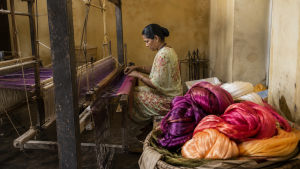
India is among the world’s leading silk-producing countries and has a wide range of silk varieties suited to different climates, crops and traditions. Sericulture is an agro-based, labour-intensive industry that supports rural livelihoods, farm income and value-chain development from cocoon rearing to weaving.
Sericulture in India
Sericulture covers the cultivation of host plants, silkworm rearing, cocoon production, reeling and weaving. It is closely linked to rural employment because it requires steady human input across the production chain. India is the second-largest producer of silk in the world after China, and Karnataka leads among Indian states in overall silk production.
Mulberry Silk
Mulberry silk is the most common and widely produced silk in India, contributing the largest share of total raw silk output. It generally accounts for about 70-90% of India’s raw silk production. The silk is produced by Bombyx mori L., a silkworm that feeds exclusively on mulberry leaves. Its smoothness, softness, natural luster and excellent drape make it highly suitable for luxury fabrics. Major mulberry silk-producing states include Karnataka, Andhra Pradesh, West Bengal, Tamil Nadu and Jammu & Kashmir. Together, these states account for about 92% of the country’s mulberry raw silk production, with Karnataka as the leading producer.
Tasar Silk
Tasar silk, also called Tussah silk, is a non-mulberry silk known for its copperish colour, coarse texture and natural golden hue. It is less lustrous than mulberry silk but is valued for its distinct feel and is commonly used in furnishings and interior decoration. It is produced by the silkworm Antheraea mylitta, which feeds on host plants such as Asan and Arjun. Tasar rearing is often carried out in natural forest environments, making it closely linked with forest-based livelihoods. India is the second-largest producer of tasar silk in the world. Jharkhand is a leading producer and contributes about 40% of India’s tasar output. Other producing states include Chhattisgarh, Odisha, Maharashtra, West Bengal and Andhra Pradesh. A finer variety, Oak Tasar, is produced by Antheraea proyeli J. in the sub-Himalayan belt, including Manipur, Himachal Pradesh, Uttar Pradesh, Assam, Meghalaya and Jammu & Kashmir.
Eri Silk
Eri silk is also known as Endi or Errandi silk. It is unique because it is obtained from open-ended cocoons after the silkworm has emerged, which is why it is called “Ahimsa silk” or “peace silk”. The silkworms, mainly Philosamia ricini or Samia ricini, feed on castor leaves. Eri silk has a soft, woolly or cotton-like texture with a moderate sheen. Its isothermal properties make it suitable for different climates and seasons. It is widely used for shawls, blankets, sarees and garments. Production is concentrated in the northeastern states, especially Assam, which is the largest producer. Meghalaya, Manipur and Nagaland also contribute, along with smaller quantities from Bihar, Odisha, West Bengal and Andhra Pradesh.
Muga Silk
Muga silk is known as India’s “golden silk” and is among the rarest silks in the world. It is prized for its natural yellowish-golden tint, durability and glossy texture, with luster that improves after each wash. It is exclusive to Assam and has a Geographical Indication (GI) tag, which protects its origin and authenticity. The silk is produced by Antheraea assamensis, whose silkworms feed on the aromatic Som (Machilus bombycina) and Soalu (Litsaea polyantha) trees. Muga silk has deep cultural significance in Assamese tradition and is closely associated with heritage craftsmanship.
Central Silk Board and Sector Support
The Central Silk Board (CSB) is a statutory body under the Ministry of Textiles, Government of India, established in 1948 under the Central Silk Board Act, 1948. Its role covers research, development and coordination across the silk sector, with attention to the full value chain from sericulture to weaving. The Ministry of Textiles has also promoted modern sericulture technologies, high-density production methods and quality improvement measures. Tools such as Artificial Intelligence (AI), Geographic Information Systems (GIS) and Machine Learning (ML) are being used for quality inspection and to improve production efficiency.
Key Prelims Takeaways
- India’s global position: India is the world’s second-largest silk producer after China.
- Mulberry share: Mulberry silk contributes about 70-90% of India’s total raw silk production.
- Mulberry silkworm: Bombyx mori L. feeds exclusively on mulberry leaves.
- Top state: Karnataka is the leading silk-producing state in India.
- Tasar silk: Produced by Antheraea mylitta; Jharkhand is the leading producer.
- Eri silk: Called “Ahimsa silk” because cocoons are harvested after the silkworm emerges alive.
- Muga silk: Exclusive to Assam and protected by a GI tag.
- Silk Board: The Central Silk Board was established in 1948 under the Ministry of Textiles.
- Key feed plants: Mulberry, Asan, Arjun, castor, Som and Soalu are important host plants in sericulture.
- Oak Tasar: A finer tasar variety found in the sub-Himalayan belt.
- Rural economy: Sericulture supports farm-based income and rural employment.
Recent Context
India has set a target of 60,000 metric tonnes of silk production by 2030-31, with the aim of becoming the world’s largest silk producer by 2028-29. The target was highlighted in Bengaluru during the 77th Foundation Day of the Central Silk Board. Current annual production is about 42,000 metric tonnes, up from 26,000 metric tonnes in 2014.
| Related | |
|---|---|