Major Ocean Pollution and Marine Litter Concepts
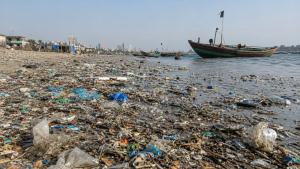
Ocean pollution is a major environmental challenge that affects marine ecosystems, coastal economies, and human well-being. Among its many forms, marine litter—especially plastic waste—has become highly visible and persistent, spreading across coastlines, open seas, and ocean gyres. Understanding its sources, types, and impacts is essential for Prelims revision.
Understanding Ocean Pollution
Ocean pollution refers to the introduction of harmful substances, energy, or organisms into the marine environment, causing damage to biodiversity and ecological balance. It comes from both land-based and ocean-based activities. Land-based sources account for about 80% of marine pollution and include agricultural runoff, industrial discharges, municipal wastewater, and discarded solid waste. Ocean-based sources include shipping, offshore oil and gas operations, aquaculture, and fishing.
- Chemical pollution: Toxic substances such as heavy metals, persistent organic pollutants (POPs), pesticides, and industrial chemicals.
- Nutrient pollution: Excess nitrogen and phosphorus from runoff and sewage, leading to eutrophication, algal blooms, and oxygen-depleted dead zones.
- Oil pollution: Spills from tankers, offshore drilling, and shipping operations that damage marine life and habitats.
- Noise pollution: Underwater sound from shipping, sonar, and seismic surveys that disturbs marine mammals.
- Thermal pollution: Heated water released from industrial plants that alters marine temperatures and biodiversity.
- Plastic pollution: Accumulation of plastic debris, one of the most visible and persistent forms of marine litter.
Marine Litter and Marine Debris
Marine litter is any persistent, manufactured, or processed solid material that is discarded, disposed of, or abandoned in the marine and coastal environment. The term marine debris is broader and covers persistent solid material found in the ocean. Much of this waste comes from human activities on land and at sea, and a large share consists of plastics.
Marine plastic litter is important because it travels long distances, accumulates in certain zones, and persists for hundreds of years. It breaks into smaller pieces over time but does not fully degrade, making it a long-term environmental problem.
- Plastic items: Bottles, bags, packaging, and microplastics.
- Abandoned fishing gear: Lost or discarded nets, lines, and traps, often called ghost fishing gear.
- Glass: Bottles and broken fragments.
- Metal: Cans and other debris.
- Other items: Rubber, clothing, and processed wood products.
Plastic Pollution and Microplastics
Plastic pollution in the marine environment comes from consumer plastics, single-use items, packaging, industrial pellets, and synthetic textiles. During washing, synthetic fabrics release microfibers, adding to the microplastic load in oceans.
Microplastics are plastic fragments smaller than 5 millimeters. They are classified into primary and secondary microplastics.
- Primary microplastics: Manufactured in small form, such as microbeads, industrial abrasives, and plastic pellets.
- Secondary microplastics: Formed when larger plastic waste breaks down through physical, chemical, and biological processes.
These particles enter marine systems through wastewater, runoff, and atmospheric deposition. Marine organisms ingest them directly or indirectly, allowing plastics and associated chemicals to move through the food chain. Ocean gyres can concentrate floating debris, and the Great Pacific Garbage Patch is a well-known example of such accumulation.
Impacts on Ecosystems, Economy, and Health
Ocean pollution and marine litter have wide-ranging effects on ecosystems, livelihoods, and public health. Their impact is not limited to the sea; it reaches fisheries, tourism, shipping, and coastal communities.
- Entanglement: Turtles, seals, birds, and other animals get trapped in plastic waste and fishing gear, leading to injury, suffocation, or drowning.
- Ingestion: Marine animals mistake plastic for food, causing internal injury, starvation, and toxic exposure.
- Habitat damage: Debris can smother corals, seagrass beds, and other sensitive habitats.
- Invasive species: Floating litter can transport non-native species across ocean basins.
- Fisheries losses: Damaged gear, reduced catches, and contamination of seafood affect livelihoods.
- Tourism damage: Polluted beaches and degraded marine environments reduce coastal tourism value.
- Shipping risks: Debris can cause propeller entanglement and vessel damage.
- Human health concerns: Microplastics and associated toxins may enter seafood, while nutrient pollution can trigger harmful algal blooms and dead zones.
Global and Indian Responses
Marine litter needs coordinated action at the global and national levels. Internationally, the United Nations Environment Assembly (UNEA) has adopted resolutions on marine plastic litter and microplastics. MARPOL, the International Convention for the Prevention of Pollution from Ships, seeks to prevent ship-based pollution, including garbage disposal. Negotiations are also underway for a global treaty to end plastic pollution.
- Swachh Bharat Abhiyan: A broader cleanliness drive that indirectly reduces land-based litter reaching the sea.
- Plastic Waste Management Rules, 2016: Regulate plastic waste management and include Extended Producer Responsibility (EPR).
- Coastal Regulation Zone (CRZ) Notification: Protects coastal ecosystems from harmful development and pollution.
- Swachh Sagar Surakshit Sagar: A coastal cleanliness and marine conservation campaign with public participation.
- NIRMaL Sāgar: The National Initiative for Remediation of Marine Litter.
These measures reflect the growing focus on plastic waste management, environmental protection, and sustainability in coastal zones.
Key Prelims Takeaways
- INCOIS: Indian National Centre for Ocean Information Services, an autonomous institute under the Ministry of Earth Sciences, based in Hyderabad, Telangana.
- INCOIS functions: Ocean state forecasting, tsunami warning services, potential fishing zone advisories, and ocean data products.
- NIRMaL Sāgar: National Initiative for Remediation of Marine Litter.
- Marine litter: Solid waste, including plastics, that enters seas and coastal waters.
- Marine plastic litter: A major part of marine debris, studied for movement, accumulation zones, and sources.
- Microplastics: Plastic fragments smaller than 5 mm.
- Swachh Sagar Surakshit Sagar: India’s coastal cleanliness and marine conservation campaign.
- Visakhapatnam: A major port city on India’s eastern coast along the Bay of Bengal.
- Pilot project aim: To establish India’s first integrated marine litter tracking framework.
- Tracking tools: Ocean modelling, satellite remote sensing, AI, and ML are used to identify, monitor, and forecast marine litter hotspots.
- Satellite remote sensing: Observing Earth’s surface, oceans, and atmosphere using satellite sensors.
- AI and ML: Used in environmental monitoring for pattern detection, prediction, and classification.
- Current Secretary, Ministry of Earth Sciences: Dr. T. Srinivasa Kumar.
- MP for Visakhapatnam: M. Sribharat.
Recent Context
INCOIS, Hyderabad, is using ocean modelling, satellite remote sensing, AI, and ML to identify and forecast marine litter hotspots under NIRMaL Sāgar. The pilot began in Visakhapatnam on September 19, 2026, with the goal of creating India’s first integrated marine litter tracking framework and supporting the Swachh Sagar Surakshit Sagar campaign.
| Related | |
|---|---|