Major Schools of Indian Philosophy
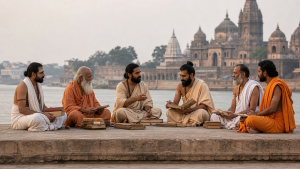
Classical Indian philosophy is commonly divided into Astika and Nastika traditions on the basis of their acceptance or rejection of Vedic authority. These schools examine reality, knowledge, ethics, liberation, and the means by which valid knowledge is obtained.
Classification of Indian Philosophy
- Astika (Orthodox) schools: These accept the authority of the Vedas. They are collectively known as the Shad Darshana: Samkhya, Yoga, Nyaya, Vaisheshika, Mimamsa, and Vedanta.
- Nastika (Heterodox) schools: These reject Vedic authority. The major heterodox traditions are Charvaka, Buddhism, and Jainism.
- Pramanas: Classical systems use recognized means of valid knowledge such as pratyaksha (perception), anumana (inference), upamana (comparison), and shabda (verbal testimony).
Samkhya, Yoga, and Nyaya
- Samkhya: Associated with Sage Kapila, this dualistic system explains existence through Purusha (pure consciousness) and Prakriti (matter or energy). Liberation comes when Purusha realizes its distinctness from Prakriti.
- Yoga: Associated with Sage Patanjali, this school offers a practical method of self-control, meditation, and discipline through Ashtanga Yoga for attaining liberation (mukti). Unlike Samkhya, it accepts a personal God (Ishvara).
- Nyaya: Associated with Sage Aksapada Gautama, this school is centered on logic and epistemology. It recognizes four sources of valid knowledge: perception, inference, comparison, and verbal testimony.
Vaisheshika, Mimamsa, and Vedanta
- Vaisheshika: Founded by Sage Kanada, this pluralistic and atomist system explains the physical universe through indivisible atoms (paramanu) and classifies reality into distinct categories or padarthas.
- Mimamsa (Purva Mimamsa): Associated with Sage Jaimini, this school emphasizes the ritual portion of the Vedas, the philosophy of action (dharma), and proper textual interpretation.
- Vedanta (Uttara Mimamsa): Formulated by Sage Vyasa (Badarayana) on the basis of the Upanishads, this school developed major sub-schools such as Advaita by Adi Shankara, Vishishtadvaita by Ramanuja, and Dvaita by Madhvacharya.
Major Nastika Schools
- Charvaka (Lokayata): This materialistic and skeptical philosophy rejects metaphysical concepts, life after death, and God. It accepts only direct sensory perception (pratyaksha) as valid knowledge.
- Buddhism: Founded by Gautama Buddha, it rejects the Vedas and the idea of an eternal soul (anatmavada). Its central ideas include the Four Noble Truths, dependent origination (pratityasamutpada), and the Eightfold Path.
- Jainism: Codified by Vardhamana Mahavira, it rejects Vedic authority and stresses non-violence (ahimsa), karma, Anekantavada and Syadvada.
| School | Founder | Classification | Core doctrine |
| Samkhya | Sage Kapila | Astika | Dualism of Purusha and Prakriti |
| Yoga | Sage Patanjali | Astika | Ashtanga Yoga; accepts Ishvara |
| Nyaya | Sage Aksapada Gautama | Astika | Logic and four pramanas |
| Vaisheshika | Sage Kanada | Astika | Atoms (paramanu) and padarthas |
| Mimamsa | Sage Jaimini | Astika | Ritual action and Vedic dharma |
| Vedanta | Sage Vyasa | Astika | Upanishadic philosophy; Advaita, Vishishtadvaita, Dvaita |
| Charvaka | Brihaspati (trad.) | Nastika | Materialism; only pratyaksha valid |
| Buddhism | Gautama Buddha | Nastika | Anatmavada and Pratityasamutpada |
| Jainism | Vardhamana Mahavira | Nastika | Ahimsa, Anekantavada, Syadvada |
Key Prelims Takeaways
- Astika vs Nastika: The basic classification depends on acceptance or rejection of Vedic authority.
- Shad Darshana: The six orthodox schools are Samkhya, Yoga, Nyaya, Vaisheshika, Mimamsa, and Vedanta.
- Founder-school pairs: Kapila-Samkhya, Patanjali-Yoga, Gautama-Nyaya, Kanada-Vaisheshika, Jaimini-Mimamsa, Vyasa-Vedanta.
- Pramana pattern: Charvaka accepts only perception; Nyaya accepts four pramanas; Vaisheshika and Buddhism accept perception and inference.
- Theistic distinction: Samkhya is non-theistic, while Yoga accepts Ishvara.
- Soul doctrine: Buddhism rejects an eternal soul through anatmavada, while Jainism recognizes jiva.
- Vedanta text base: The Upanishads, Bhagavad Gita, and Brahma Sutras are called the Prasthanatrayi.
Current General Studies comprises current-affairs-based, General Studies-rich study material on policies, laws, institutions, economy, science, environment, governance, international relations, and other varied but important topics for UPSC and State PSC Prelims examinations.
Fortnightly PDF compilations: Available here
Originally written on
March 29, 2026
and last modified on
September 5, 2026.
| Related | |
|---|---|