Mountain Development Schemes and Institutions in India
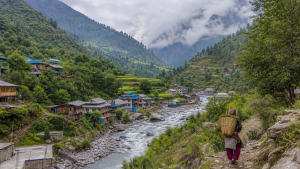
India’s mountain regions include the Himalayas, the Western Ghats, the Eastern Ghats and the North-Eastern hill tracts. These areas are ecologically fragile and face pressure from climate change, erosion, landslides and unplanned infrastructure growth.
To address these challenges, the Central Government has created targeted policy frameworks, development programmes and research institutions for sustainable mountain development, disaster risk reduction and livelihood support for hill communities.
Policy Frameworks and National Initiatives
- MoEFCC and NITI Aayog: These bodies help frame guidelines to balance economic growth with ecological conservation in mountain regions.
- National Mission for Sustaining the Himalayan Ecosystem (NMSHE): Launched under the National Action Plan on Climate Change (NAPCC), it assesses the health of the Himalayan ecosystem and strengthens scientific capacity. The Department of Science and Technology (DST) is the nodal agency.
- Coverage under NMSHE: The mission covers 12 Himalayan states and Union Territories, with focus on glacier health, biodiversity conservation and climate monitoring.
- NITI Aayog Action Agenda: NITI Aayog constituted thematic working groups for sustainable development in the Indian Himalayan Region (IHR).
- Springshed management: A key focus area is inventory and rejuvenation of mountain springs to improve water security.
- Sustainable tourism: The agenda promotes carrying-capacity-based tourism and eco-tourism to reduce environmental stress.
- Transforming agriculture: The plan encourages organic farming, agroforestry and preservation of indigenous crops.
- Skill development: It seeks non-farm livelihood opportunities for mountain youth to reduce distress migration.
- Data and analytics: A centralised digital database is proposed for mountain resources and spatial planning.
- Secure Himalaya Project: Funded by the Global Environment Facility (GEF) and implemented by MoEFCC with UNDP, this project focuses on high-altitude biodiversity conservation, especially snow leopard landscapes.
Area Development Programmes and Livelihood Schemes
- Border Area Development Programme (BADP): Administered by the Ministry of Home Affairs, it supports remote border villages near international land borders, including the Himalayan frontier.
- BADP assistance: The programme funds community infrastructure, health facilities, rural roads and water supply projects.
- Vibrant Villages Programme (VVP): Launched as a Centrally Sponsored Scheme, it aims to develop selected border villages in Ladakh, Himachal Pradesh, Uttarakhand, Sikkim and Arunachal Pradesh.
- VVP focus areas: The scheme provides support for infrastructure, green energy, mobile connectivity and eco-tourism.
- VVP objective: It aims to reverse out-migration from border areas and strengthen settlement in strategically important locations.
- Hill Area Development Programme (HADP): Initiated during the Fifth Five-Year Plan, this programme provided targeted central assistance to designated hill districts.
- Western Ghats Development Programme (WGDP): Also begun during the Fifth Five-Year Plan, it supported eco-restoration, soil conservation and watershed development in Western Ghats districts.
- Coverage of older hill programmes: These initiatives benefited areas in Tamil Nadu, Kerala, Maharashtra, Karnataka and West Bengal, including Darjeeling.
Institutional Framework for Mountain Governance and Research
| Institution | Location | Primary mandate |
| G.B. Pant National Institute of Himalayan Environment (NIHE) | Almora, Uttarakhand | Interdisciplinary research on natural resource management and conservation in the Indian Himalayan Region. |
| Wadia Institute of Himalayan Geology (WIHG) | Dehradun, Uttarakhand | Studies structural geology, glaciology, seismology and natural hazards in the Himalayan terrain. |
| National Institute of Mountain Health and Disaster Management | Tehri, Uttarakhand | Focuses on high-altitude medical research, disaster medicine and relief coordination. |
| C-DAC and ISRO Remote Sensing Units | Dehradun / Shillong | Use GIS and satellite imagery for landslide hazard zonation and terrain mapping. |
| North Eastern Council (NEC) | Shillong, Meghalaya | Statutory regional planning body for the eight North-Eastern states, with emphasis on mountain infrastructure. |
| National Centre for Polar and Ocean Research (NCPOR) | Vasco da Gama, Goa | Monitors high-altitude Himalayan glaciers through its HIMANSH research station in Lahaul-Spiti. |
Disaster Risk Reduction and Infrastructure Guidelines
- Landslide risk mitigation: The Geological Survey of India (GSI) is the nodal agency for landslide hazard assessment.
- National Landslide Susceptibility Mapping (NLSM): GSI maintains this database, which covers over 0.42 million square kilometres of landslide-prone mountain areas in India.
- Carrying capacity guidelines: The Ministry of Environment, Forest and Climate Change has asked all 13 mountain states and Union Territories to conduct scientific carrying-capacity assessments.
- Purpose of carrying-capacity studies: These studies help regulate construction based on soil stability, slope angle and available water supply.
- NDMA guidelines: The National Disaster Management Authority issues specific guidelines for Glacial Lake Outburst Floods (GLOFs), earthquakes and landslides in mountain regions.
- Early warning systems: Such systems are deployed in vulnerable high-altitude lakes, including South Lhonak Lake in Sikkim.
Important Facts for Quick Reference
- Indian Himalayan Region (IHR): It spans 13 states and Union Territories.
- IHR components: Jammu & Kashmir, Ladakh, Himachal Pradesh, Uttarakhand, Sikkim, West Bengal (Darjeeling district), Arunachal Pradesh, Nagaland, Manipur, Mizoram, Tripura, Meghalaya and Assam (Dima Hasao and Karbi Anglong districts).
- NMSHE nodal agency: Department of Science and Technology (DST).
- HIMANSH: India’s high-altitude research station in the Lahaul-Spiti region of Himachal Pradesh.
- HIMANSH elevation: It is located at an elevation of over 13,000 feet.
- G.B. Pant NIHE: This institute is a key research body for Himalayan environment studies and conservation.
Key Prelims Takeaways
- NMSHE was launched under NAPCC and is implemented through DST.
- NITI Aayog’s Himalayan agenda focuses on springs, tourism, agriculture, livelihoods and data systems.
- Secure Himalaya is a GEF-funded project with MoEFCC and UNDP for snow leopard landscapes.
- BADP supports border-village infrastructure, health, roads and water supply.
- VVP targets border villages in five northern mountain states/UTs for infrastructure and connectivity.
- GSI is the nodal agency for landslide hazard assessment and NLSM mapping.
- NDMA issues guidance on GLOFs, earthquakes and landslides in mountain areas.
Current General Studies comprises current-affairs-based, General Studies-rich study material on policies, laws, institutions, economy, science, environment, governance, international relations, and other varied but important topics for UPSC and State PSC Prelims examinations.
Fortnightly PDF compilations: Available here
Originally written on
May 23, 2026
and last modified on
September 6, 2026.
| Related | |
|---|---|