Major Institutions in India’s Official Statistical System
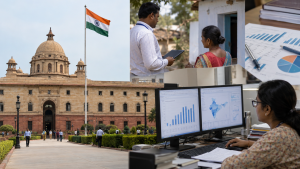
India’s official statistical system produces the economic and social data used for policymaking, planning and research. It combines coordinating institutions with specialised data producers across government, making clear roles, consistent methods and reliable dissemination essential.
MoSPI and the National Statistical Office
The Ministry of Statistics and Programme Implementation (MoSPI) is the nodal ministry for India’s official economic statistics. It compiles national accounts, including Gross Domestic Product (GDP), and oversees the Consumer Price Index (CPI) and Index of Industrial Production (IIP). It also coordinates statistical work across central ministries and state statistical agencies. MoSPI has two wings:
- Statistics Wing: Handles statistical work through the National Statistical Office (NSO), including data collection, compilation and dissemination.
- Programme Implementation Wing: Monitors central sector projects costing ₹150 crore or more, the 20-Point Programme and the performance of 11 infrastructure sectors.
The NSO was formed in 2019 by merging the Central Statistics Office (CSO) and the National Sample Survey Office (NSSO). Its principal functions include:
- National accounts: Compiles estimates of national income, GDP, Gross Value Added (GVA), consumption expenditure and capital formation.
- Industrial statistics: Conducts the Annual Survey of Industries (ASI) and compiles the IIP.
- Prices: Compiles the general CPI for India, including all-India and state and Union Territory series.
- Surveys and standards: Conducts socio-economic sample surveys, including the Periodic Labour Force Survey (PLFS), and develops statistical methods and standards for government agencies.
National Statistical Commission
The National Statistical Commission (NSC) is an independent advisory body established in 2005 following the recommendations of the C. Rangarajan Commission. It advises on statistical priorities, standards and coordination, and works to safeguard the autonomy and credibility of official statistics. Its composition includes:
- A part-time Chairperson and four part-time members with expertise in statistical fields.
- The Chief Statistician of India, who is also Secretary to MoSPI, as an ex-officio member and Secretary to the Commission.
Indian Statistical Service
The Indian Statistical Service (ISS) is a Group ‘A’ central civil service established in 1961. Recruitment is through a competitive examination conducted by the Union Public Service Commission. ISS officers serve in MoSPI and other central ministries and departments, where they manage statistical operations, analyse data and contribute statistical expertise to policy formulation. Their work supports the production and use of comparable, technically sound government statistics.
Other official data producers
Several institutions produce specialised statistics alongside MoSPI and the NSO. Their distinct mandates make coordination and consistent methods important for an integrated picture of the economy and society.
- Reserve Bank of India (RBI): Compiles data on money, banking, financial markets and the external sector, supporting monetary policy and economic analysis.
- Labour Bureau: Under the Ministry of Labour and Employment, it compiles the CPI for Industrial Workers (CPI-IW), CPI for Agricultural Labourers (CPI-AL) and CPI for Rural Labourers (CPI-RL). The CPI-IW base year is 2016.
- Registrar General and Census Commissioner of India: Under the Ministry of Home Affairs, it conducts the decennial population census and collects vital statistics, including birth and death registration data.
- Directorate General of Commercial Intelligence and Statistics (DGCIS): Under the Ministry of Commerce and Industry, it compiles and disseminates foreign trade statistics, including import and export data.
Statistical concepts and system challenges
National accounts, price statistics and industrial indicators measure different aspects of economic activity. Understanding their methods helps in interpreting estimates and comparing changes over time.
- GDP at market prices: In India’s national accounts, it is obtained by adding product taxes and subtracting product subsidies from GVA at basic prices.
- Value-added approach: GDP is estimated by summing the value contributed at each production stage after accounting for intermediate consumption.
- IIP: Tracks short-term changes in the production volume of a selected basket of industrial products against a chosen base period.
Institutional capacity, data governance and Centre–state coordination remain important for the quality and timeliness of official statistics. Differences in administrative systems and data coverage can complicate comparability. Strong methods, skilled statistical personnel and coordination among data-producing bodies help address these challenges and support informed public decisions.
Key Prelims Takeaways
- MoSPI: Nodal ministry for official economic statistics and national accounts.
- NSO: Formed in 2019 by merging the CSO and NSSO; compiles GDP, the general CPI and IIP.
- NSC: Independent advisory body established in 2005 following C. Rangarajan Commission recommendations.
- Chief Statistician of India: Ex-officio NSC member and Secretary to the Commission; also Secretary to MoSPI.
- Labour Bureau: Compiles CPI-IW, CPI-AL and CPI-RL; CPI-IW uses 2016 as its base year.
- Other key producers: RBI compiles financial and external-sector data; the Registrar General conducts the census; DGCIS compiles foreign trade statistics.
Recent Context
MoSPI held a Data Users Conference on November 23, 2026, on revised GDP, CPI and IIP methods. The new GDP and IIP series use 2022–23 as their base year; CPI uses 2024. Revisions expand data coverage, update the CPI basket and introduce a new deflator for selected IIP items.
| Related | |
|---|---|