Green Chemistry and Cleaner Manufacturing Technologies
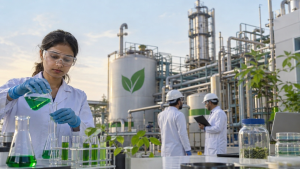
Green chemistry and cleaner manufacturing prevent pollution at its source by designing safer chemical products and more efficient industrial processes. They support industrial sustainability through reduced waste, lower resource use and improved protection of human health and the environment.
Green Chemistry: Foundations and Principles
Green chemistry, also called sustainable chemistry, seeks to prevent pollution rather than manage it after it forms. Paul Anastas and John Warner formally articulated its 12 principles in 1991. The principles guide the design of chemical products and processes across their life cycles, with emphasis on hazard reduction and efficient use of resources. The principles can be grouped into six practical areas:
- Prevent waste and improve atom economy: Avoid generating waste in the first place, rather than treating it later. Design reactions so that the greatest possible proportion of starting materials is incorporated into the final product. Waste prevention is preferable to cleanup and supports the goal of zero-waste technology.
- Reduce hazards in chemicals and synthesis: Choose processes that use and generate substances with lower toxicity to people and the environment. Design products to perform their intended function while minimizing toxicity.
- Use safer solvents and auxiliaries: Avoid auxiliary substances where possible; when needed, choose safer options. Water or ethanol may be considered in place of more hazardous solvents such as benzene or hexane.
- Improve energy and feedstock efficiency: Minimize energy requirements and use ambient temperature and pressure where feasible. Prefer renewable feedstocks over finite raw materials.
- Limit derivatives and favour catalysis: Avoid unnecessary derivatization, which consumes additional reagents and can create waste. Use selective catalysts instead of stoichiometric reagents where possible.
- Design for degradation, monitoring and safety: Develop products that break down into innocuous substances after use. Monitor processes in real time to prevent hazardous by-products, and design chemicals and processes to reduce the risk of fires, explosions and releases.
Cleaner Manufacturing Technologies
Cleaner manufacturing technologies (CMT) reduce the environmental impact of production by lowering energy, water and material inputs, while minimizing waste and emissions. They combine process redesign, safer material choices and resource recovery.
- Process changes: Optimize reaction conditions, use more efficient catalysts and adopt closed-loop systems that recirculate materials within production.
- Material substitution and solvent-free production: Replace hazardous raw materials and auxiliaries with less harmful or renewable alternatives. Solvent-free processes can avoid solvent-related waste and hazards.
- Plasma-activated water (PAW): Produced by generating plasma in water, including through interaction with cold atmospheric plasma, PAW has altered chemistry. It contains reactive oxygen and nitrogen species and, compared with untreated water, has lower pH and higher electrical conductivity. It is being developed as a sustainable alternative to conventional nitrogen fertilisers.
- Supercritical fluids: Supercritical carbon dioxide can serve as a solvent. A supercritical fluid can dissolve materials like a liquid while diffusing like a gas, offering an alternative to some conventional solvents.
- Energy and resource recovery: LED lighting, high-efficiency motors and heat-recovery systems can reduce energy use and associated greenhouse gas emissions. Water-recycling systems and chemical-recovery units conserve resources and limit contamination.
India’s Regulatory and Promotional Framework
India’s environmental laws and regulatory systems shape industrial pollution control and encourage cleaner production. The Central Pollution Control Board (CPCB) classifies industries as Red, Orange, Green or White according to their Pollution Index (PI), which reflects their potential to cause air, water and hazardous-waste pollution.
- Environment (Protection) Act, 1986: Provides umbrella legislation empowering the Central Government to set environmental standards and issue directions for environmental protection.
- Water (Prevention and Control of Pollution) Act, 1974: Provides for control of water pollution and regulation of pollutant discharges into water bodies.
- Air (Prevention and Control of Pollution) Act, 1981: Provides for the prevention, control and abatement of air pollution, including emissions from industries.
- Hazardous and Other Wastes Rules, 2016: The Hazardous and Other Wastes (Management and Transboundary Movement) Rules govern the generation, handling and disposal of hazardous waste.
CPCB incentives for cleaner fuels and technologies can contribute to a more favourable Pollution Index status and potentially reduce regulatory burdens. Measures considered include treating and reusing wastewater, reducing freshwater consumption and switching to cleaner fuels or technologies. Make in India and Atmanirbhar Bharat promote domestic manufacturing and innovation, which can also support the development and adoption of clean technologies.
Benefits and Industrial Sustainability
Cleaner manufacturing advances pollution prevention by reducing hazardous releases to air, water and soil. Lower emissions and safer chemical use can improve environmental quality and worker safety, while reducing risks associated with toxic exposure and industrial accidents. Resource efficiency can generate economic gains: using fewer raw materials, water and energy can lower operating costs, and reduced waste can cut disposal expenses. Higher yields, fewer synthetic steps and less need for remediation can also improve process efficiency. Greater use of renewable feedstocks helps conserve finite resources. For industry, these measures can support compliance with environmental standards while strengthening sustainable production. Their contribution depends on suitable process design, effective monitoring and adoption across relevant stages of manufacturing.
Key Prelims Takeaways
- Paul Anastas and John Warner articulated the 12 principles of green chemistry in 1991.
- Waste prevention is preferred to treatment or cleanup; atom economy measures incorporation of starting materials into the final product.
- Green chemistry emphasizes safer chemicals, solvents and synthesis, energy efficiency, renewable feedstocks, catalysis and design for degradation.
- CMT reduces resource inputs and pollution outputs; examples include solvent-free processes, PAW, supercritical fluids and heat recovery.
- PAW contains reactive oxygen and nitrogen species and has lower pH and higher electrical conductivity than untreated water.
- CPCB’s Red, Orange, Green and White industry categories are based on the Pollution Index.
- Key Indian laws include the Environment (Protection) Act, 1986, the Water Act, 1974, the Air Act, 1981 and the Hazardous and Other Wastes Rules, 2016.
Recent Context
Announced on 23 November 2026, the Tata Transformation Prize recognized Lakshminarayana Rao (IISc) for plasma-activated water and Sustainability awardee Amol Kulkarni (CSIR-NCL) for screw-reactor, solvent-free production of dyes, zeolites and pharmaceuticals. Winners receive ₹2 crore each; an international jury selected them from 217 nominations across 19 states.
| Related | |
|---|---|