Nucleosynthesis and the Origin of Elements in the Universe
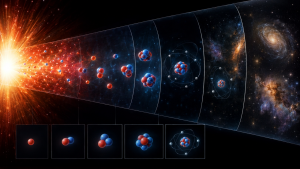
Nucleosynthesis is the formation of atomic nuclei from protons, neutrons or lighter nuclei. It explains the origin and abundance of elements, from the first minutes of the universe to the interiors of stars and explosive cosmic events.
Big Bang Nucleosynthesis
Big Bang nucleosynthesis (BBN), or primordial nucleosynthesis, produced the universe’s lightest elements during its first few minutes. Temperatures and densities were initially high enough for nuclear reactions, but expansion rapidly cooled the universe and ended this phase.
- Timing: BBN occurred approximately 3 to 20 minutes after the Big Bang.
- Products: It formed mainly hydrogen and helium-4, with trace amounts of deuterium, helium-3 and lithium-7.
- Deuterium: This hydrogen isotope contains one proton and one neutron.
- Abundance: Helium-4 accounts for about 25% of the universe’s baryonic mass; hydrogen makes up most of the remainder.
- Limit: Rapid expansion and cooling halted BBN before heavier elements could form in significant amounts.
Stellar Nucleosynthesis
Nuclear fusion inside stars releases energy and builds heavier nuclei. The sequence of reactions depends on a star’s mass and evolutionary stage; stellar fusion produces elements up to the iron group.
- Hydrogen fusion: Main-sequence stars convert hydrogen nuclei into helium. In the Sun and other less massive stars, the proton-proton chain is the dominant process.
- CNO cycle: In more massive stars, carbon, nitrogen and oxygen act as catalysts in hydrogen fusion. These elements facilitate the reactions but are not consumed overall.
- Helium fusion: Once hydrogen in a star’s core is depleted, the core contracts and heats. The triple-alpha process fuses three helium-4 nuclei to form carbon-12; further helium capture can produce oxygen-16.
- Carbon burning: In massive stars, subsequent burning stages can produce neon, sodium and magnesium from carbon.
- Later stages: Neon burning produces oxygen and magnesium, while oxygen burning forms silicon and sulfur. Silicon burning creates elements up to iron-56 and nickel-56 in the core.
- Fusion limit: Fusion of nuclei heavier than iron requires an energy input rather than releasing energy. It therefore cannot continue as a source of stellar energy in the same way as lighter-element fusion.
Elements Beyond Iron
Many nuclei heavier than iron form through neutron capture. The two principal pathways are the rapid neutron-capture process (r-process) and the slow neutron-capture process (s-process). Explosive events and evolved stars provide environments for these reactions.
- Supernovae: Explosions of massive stars, including Type II supernovae, provide energetic conditions and abundant neutrons. The r-process can form heavy elements, including gold, platinum and uranium.
- Neutron star mergers: Collisions between neutron stars also create neutron-rich conditions that enable rapid neutron capture and the formation of heavy elements.
- R-process contribution: The r-process is responsible for about half of the elements heavier than iron.
- AGB stars: Asymptotic Giant Branch stars contribute through the s-process, in which nuclei capture neutrons more slowly. This process produces about half of the elements heavier than iron, including barium and strontium.
- Cosmic-ray spallation: High-energy cosmic rays break heavier nuclei apart when they collide with nuclei in interstellar gas. This process forms light elements, particularly lithium, beryllium and boron.
- Dispersal: Supernovae eject newly formed elements into the interstellar medium, enriching gas from which later generations of stars can form.
Metallicity and Stellar Populations
In astronomy, “metals” means all elements heavier than helium. A star’s metallicity describes the abundance of these elements and provides clues about the material from which it formed and the history of cosmic chemical evolution.
- Population III: These hypothetical first-generation stars would have formed largely from hydrogen and helium, with virtually no metals. Their existence is inferred, but none have been directly observed.
- Population II: These old, metal-poor stars occur in regions such as galactic halos and globular clusters. They contain fewer heavy elements than the Sun.
- Population I: These younger, metal-rich stars include the Sun. They are found in the galactic disk and spiral arms and formed from gas enriched by earlier stellar generations.
- CEMP stars: Carbon-enhanced metal-poor stars have [C/Fe] > +1 and [Fe/H] < −1. These values indicate carbon enhanced at least tenfold relative to iron and iron below one-tenth of the solar level.
- CEMP subclasses: CEMP-no stars lack strong enhancement of neutron-capture elements such as barium. Their abundance patterns differ from those of CEMP-s stars, which show such enhancement.
- Faint supernovae: Some CEMP-no abundance patterns are modelled as yields from faint supernovae. Mixing and fallback can leave carbon-rich gas while retaining much of the iron.
- Spectroscopy: High-resolution spectroscopy separates closely spaced absorption lines. Astronomers compare observed spectra with stellar-atmosphere models to infer a star’s elemental abundances.
Key Prelims Takeaways
- BBN: Formed hydrogen, helium and trace deuterium, helium-3 and lithium-7 in the first minutes after the Big Bang.
- Stellar fusion: The proton-proton chain and CNO cycle fuse hydrogen; the triple-alpha process forms carbon from helium.
- Iron group: Stellar fusion builds nuclei up to the iron group; heavier elements require other processes.
- Neutron capture: The r-process occurs in explosive, neutron-rich events; AGB stars contribute through the s-process.
- Spallation: Cosmic-ray collisions produce lithium, beryllium and boron.
- Stellar populations: Population III stars are hypothetical and metal-free or nearly so; Population II stars are old and metal-poor, while Population I stars are younger and metal-rich.
Recent Context
On 23 November 2026, astronomers identified HE 1153−0518, a carbon- and sodium-rich CEMP-no star with about one-thousandth of the Sun’s iron abundance. Separately, PicII-503, an iron-deficient Population II star in the dwarf galaxy Pictor II, was announced on 18 March 2026.
| Related | |
|---|---|