Major Indian Temple Architectural Styles
Introduction
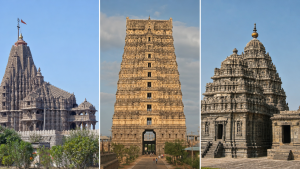
Indian temple architecture evolved into three major styles: Nagara, Dravidian and Vesara. These forms developed in different regions and under different dynasties, giving each style distinct plans, towers, gateways and sculptural traditions.
For Prelims, the key is to identify the region, tower form, gateway type and temple examples associated with each style.
Nagara Style
The Nagara style originated in northern India and flourished from the fifth century onwards under dynasties such as the Guptas, Chandellas and Solankis.
- Ground plan: Usually square with graduated projections called rathas, creating a cruciform effect.
- Superstructure: The tower is the shikhara, a curved spire that bends inward as it rises.
- Crowning elements: The top of the shikhara carries the circular stone disk amalaka, crowned by the vase-shaped kalasha.
- Enclosure: Massive boundary walls and elaborate gateways are generally absent.
- Mandapas: Pillared halls such as the mandapa, ardha mandapa and maha mandapa lead to the sanctum.
- Regional idioms: Nagara traditions include Central Indian, Western Indian, Eastern Indian and Hill architecture.
- Kandariya Mahadeva Temple: Khajuraho, Madhya Pradesh; built by the Chandella dynasty.
- Sun Temple: Konark, Odisha; built by King Narasimhadeva I of the Ganga dynasty.
- Dashavatara Temple: Deogarh, Uttar Pradesh; an early example of Gupta architecture.
- Khajuraho temples: Elevated on a high platform called the jagati.
Dravidian Style
The Dravidian style developed in peninsular India, mainly south of the Krishna River, under the Pallavas, Cholas, Pandyas and Vijayanagara rulers.
- Layout: Strictly geometric, often with a rectangular enclosure containing the main shrine and subsidiary shrines.
- Gateway: The most defining feature is the gopuram, a monumental and richly sculpted entrance tower.
- Main tower: The sanctum tower is the vimana, which is pyramid-shaped and built in progressively smaller tiers.
- Temple tanks: Large tanks are common for ritual ablutions and water conservation.
- Mandapas: Expansive pillared halls are typical, including the later thousand-pillared halls.
- Compound walls: High enclosing walls are a common feature.
- Brihadisvara Temple: Thanjavur, Tamil Nadu; built by Rajaraja Chola I.
- Meenakshi Amman Temple: Madurai, Tamil Nadu; known for towering gopurams.
- Shore Temple: Mahabalipuram, Tamil Nadu; built by the Pallava king Narasimhavarman II.
- Pancha Rathas: Mahabalipuram; monolithic rock-cut architecture carved from single granite boulders.
Vesara Style
The Vesara style, also called the Karnataka school, is a hybrid tradition combining Nagara and Dravidian features. It developed mainly in the Deccan region under the Chalukyas of Badami, Rashtrakutas and Hoysalas.
- Ground plan: Often star-shaped or stellate, especially in later Hoysala architecture.
- Tower form: Lower in height than Nagara shikharas and Dravidian vimanas, with a mixed curved and tiered profile.
- Pillars: Noted for lathe-turned, highly polished pillars.
- Carving style: Intricate soapstone carvings with mythological themes are a hallmark.
- Shrine arrangement: Often has multiple shrines such as dvikuta or trikuta plans sharing a common hall.
- Virupaksha Temple: Pattadakal, Karnataka; built by Queen Lokamahadevi under the Chalukyas.
- Hoysaleswara Temple: Halebidu, Karnataka; built during the Hoysala Empire.
- Chennakeshava Temple: Belur, Karnataka; known for bracket figures and miniature shrines.
Comparative Overview
| Architectural feature | Nagara | Dravidian | Vesara |
| Region | Northern India | Southern India | Deccan and Central India |
| Main tower | Shikhara | Vimana | Hybrid tower |
| Tower shape | Curved, beehive-shaped | Pyramidal, stepped tiers | Curved and tiered |
| Gateway | Simple or absent | Monumental gopurams | Moderate gateways |
| Boundary walls | Rare or minimal | High compound walls | Moderate enclosure walls |
| Temple tank | Rare | Common feature | Moderate presence |
Important Exam Facts
- Vesara: The term appears in ancient Sanskrit texts and means a mule, reflecting its hybrid nature.
- Brihadisvara Temple: Built entirely of granite without mortar, using interlocking stone technology.
- Hoysala temples: Used chloritic schist, a soft soapstone that allowed very fine carving.
- Sun Temple, Konark: Designed as a colossal chariot of the Sun God with twelve pairs of carved stone wheels and horses.
- Dravidian complexes: The gopuram often becomes more imposing than the main shrine tower.
- Nagara temples: Usually lack the massive enclosure walls seen in the south.
Key Prelims Takeaways
- Nagara is the northern style with a curved shikhara and minimal boundary walls.
- Dravidian is the southern style marked by pyramidal vimana towers and huge gopurams.
- Vesara is a hybrid Deccan style combining Nagara and Dravidian elements.
- Amalaka and kalasha are the crowning elements of a Nagara shikhara.
- Temple tanks are a common Dravidian feature, especially in large temple complexes.
- Khajuraho, Konark and Deogarh are important Nagara examples.
- Thanjavur, Madurai and Mahabalipuram are key Dravidian sites, while Belur, Halebidu and Pattadakal are associated with Vesara.
| Related | |
|---|---|