Types of Copper Smelters and Copper Refining Processes
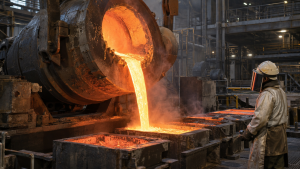
Copper production combines high-temperature smelting with refining to remove impurities and produce metal for industrial and electrical uses. Smelter type depends on its technology and relationship to mines, while recycling can supply copper-bearing material for refining.
Copper Smelting: Processes and Technologies
Copper smelting is a pyrometallurgical process that uses heat to separate copper from impurities, mainly in concentrates from sulphide ores. It produces an intermediate material, such as copper matte, blister copper or anode copper, for further treatment.
- Flash smelting: Finely ground, dried copper sulphide concentrate is injected with oxygen-enriched air into a hot furnace. Oxidation of the sulphides generates heat, enabling rapid reactions and melting. The process produces molten copper matte and slag and is a widely used, energy-efficient smelting method developed in Finland.
- Reverberatory smelting: This older method uses fossil fuels to heat and melt copper concentrates. The products include copper matte and slag.
- Electric furnace smelting: Electrical energy supplies the heat. Its suitability depends on the concentrate being treated and whether electricity is economically viable.
- Converting: After primary smelting, molten matte is treated in converters such as Pierce-Smith or Hoboken vessels. Air or oxygen-enriched air oxidises iron and sulphur, producing blister copper that is typically 98–99.5% pure.
The methods differ in how heat is supplied and how the concentrate is processed, but all contribute to separating copper-bearing material from waste products. Smelting and converting are distinct stages: matte is produced in smelting, while converting further removes iron and sulphur to make blister copper. The blister copper can then be fire-refined and cast as anodes for electrolytic refining.
Types of Copper Smelters
Smelters are also classified by how they obtain their feedstock and whether they are linked to a mine.
- Custom smelters: These treat concentrates for customers or purchase concentrates from external suppliers for processing. They are not directly integrated with a particular mining operation and may serve feedstock from multiple sources.
- Integrated smelters: These are directly dependent on a specific mining operation, often under common ownership, and are typically located adjacent to the mine. They primarily process material from the associated mine.
The distinction matters for understanding supply arrangements: custom smelters source material from outside operations, whereas integrated smelters are linked to a particular mine. Location, ownership and feedstock sourcing therefore help identify the operating model. India’s annual copper refining capacity is nearly 1.3 million tonnes, although the country remains dependent on imported copper concentrates and refined metal.
Copper Refining and Purity
Copper from smelting contains impurities that must be reduced to meet commercial requirements. Anode copper produced by smelters generally has a purity of 98.5–99.8%. Refining may include a fire-refining stage followed by electrolytic refining.
- Fire refining: Blister copper is treated in an anode furnace. Air is blown through the molten metal to remove sulphur and iron; a reducing agent such as natural gas is then used to remove dissolved oxygen.
- Fire-refined copper: The resulting metal can reach about 99.5% purity and is often cast into anodes for the next refining stage.
- Electrolytic refining: Impure copper anodes and thin starter sheets of pure copper, which serve as cathodes, are immersed in an acidic copper sulphate electrolyte. A direct electric current dissolves copper from the anode into the electrolyte and deposits it on the cathode.
- Impurity separation: More noble metals, including gold, silver and platinum, do not dissolve in the same way and collect at the bottom as anode slime, which can be recovered. Less noble metals remain in solution.
- Final purity: Electrorefining can produce cathode copper with 99.99% purity, suitable for electrical applications.
Anode copper and cathode copper are therefore different products: anode copper is an input to electrolytic refining, while cathode copper is the high-purity output. This distinction is important when comparing smelter production with refined copper capacity.
Recycling Copper from E-waste
Electronic waste and batteries can provide secondary copper for production. Recovered copper-rich material can be melted and cast into anodes, which can then enter refining circuits. Recycling thus connects waste processing with established copper-refining stages.
- Initial processing: E-waste is dismantled and shredded before materials are separated.
- Ferrous metals: Magnets can separate ferrous materials from mixed waste.
- Non-ferrous metals: Eddy currents can be used to separate non-ferrous metals.
- Size and material separation: Trommel screens can help separate glass, plastics and metals by size and density.
- Anode production: Copper-rich fractions can be melted and cast into anodes for further refining.
Resource Efficiency and Industrial Considerations
Copper production involves both resource recovery and industrial processing. Using recovered copper from e-waste can provide feedstock for anode production and reduce dependence on imported copper for a smelter, where the recovered material substitutes for imported supply. The processes also raise considerations around industrial emissions and technology modernisation. Smelting and refining require suitable process equipment, while recycling involves dismantling, separation and subsequent treatment of recovered fractions. These stages are relevant to assessing resource efficiency across primary and secondary copper supply.
Key Prelims Takeaways
- Flash smelting uses oxygen-enriched air and heat generated by sulphide oxidation.
- Converting treats matte and produces blister copper, typically 98–99.5% pure.
- Custom smelters process externally sourced concentrates; integrated smelters are linked to specific mines.
- Anode copper generally has 98.5–99.8% purity; fire-refined copper can reach about 99.5%.
- Electrorefining can produce cathode copper with 99.99% purity.
- Magnets, eddy currents and Trommel screens are used in bulk e-waste separation; India’s annual copper refining capacity is nearly 1.3 million tonnes.
Recent Context
On November 24, 2026, Adani Enterprises disclosed a three-year, approximately USD 1 billion agreement under which Attero will supply Kutch Copper with 2,000 metric tonnes of copper anode monthly, produced from e-waste and batteries. The supply is projected to reduce the smelter’s reliance on imported copper by about 5%.
| Related | |
|---|---|