Applications of Biotechnology in Wildlife Conservation
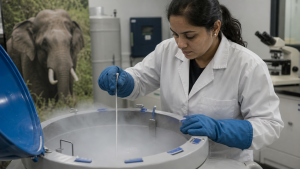
Biotechnology supports wildlife conservation by preserving genetic material, improving breeding and disease management, and monitoring population health. These tools can complement habitat protection and conventional conservation, but their effectiveness depends on sound scientific capacity and careful ethical oversight.
Genetic Resource Banking and Assisted Reproduction
- Cryopreservation: Genetic resource banks store reproductive cells, embryos and somatic cells—along with tissues, blood and other samples—at ultra-low temperatures, commonly in liquid nitrogen. These collections can preserve genetic lineages that may disappear from small or declining wild populations.
- Conservation value: Stored material can serve as an insurance against population loss from disease, disasters or other threats. It may support future research, breeding and genetic rescue, helping address inbreeding and the loss of heterozygosity.
- Long-term resource: Cryopreserved cells from Willa, a black-footed ferret that died in 1988, were later used in cloning. A U.S. National Biobank Initiative is intended to preserve genetic resources from more than 2,300 species listed under the Endangered Species Act.
- Assisted reproductive technologies (ARTs): In vitro fertilisation (IVF) fertilises eggs outside the body; artificial insemination introduces collected sperm into a female; and embryo transfer places an embryo in a recipient or surrogate. These methods can help overcome breeding difficulties and geographical or behavioural barriers.
- Genetic rescue: ARTs can help introduce material from biobanks into living populations. They have been explored in conservation breeding for species including the black-footed ferret and northern white rhinoceros, but do not replace habitat protection or population management.
Genetic Diversity Assessment and Monitoring
- Molecular tools: Microsatellite analysis, mitochondrial DNA sequencing and single nucleotide polymorphism (SNP) genotyping help measure genetic variation within and between wildlife populations.
- Population structure: Genetic data can reveal distinct population units, connectivity and gene flow. This information can guide decisions on habitat restoration, translocation and the management of isolated populations.
- Inbreeding and bottlenecks: Measures such as heterozygosity and allelic richness help identify reduced genetic diversity. Inbreeding and genetic bottlenecks can reduce reproductive success and increase vulnerability to disease.
- Adaptive potential and enforcement: Genetic diversity supports a population’s capacity to respond to environmental change and disease. DNA analysis can also help identify illegally traded wildlife products and support enforcement of conservation laws.
Disease Surveillance and Management
- Diagnostics: Molecular tests such as polymerase chain reaction (PCR) can detect pathogens and support timely disease surveillance. Early detection helps inform outbreak response and conservation action plans.
- Vaccination: Oral sylvatic plague vaccine baits can immunise prairie dogs, the principal prey of black-footed ferrets. Protecting the prey may indirectly benefit ferrets by reducing disease-related disruption to their food supply.
- Flea control: Sylvatic plague is a bacterial disease spread by fleas and affects prairie dogs as well as ferrets. Insecticide application to prairie dog colonies complements vaccination by controlling fleas.
- One Health: Regular monitoring of wildlife health and pathogens supports risk assessment and early intervention. A One Health approach considers links among the health of wildlife, people and the environment.
- Research and limits: Genetic engineering for disease resistance is being explored, but it is not a substitute for established disease management. Unpredictable outbreaks, ecological effects and ethical concerns require careful assessment before applying new interventions.
Cloning and De-extinction
- Somatic Cell Nuclear Transfer (SCNT): The nucleus of a donor somatic cell is transferred into an egg cell whose nucleus has been removed. The reconstructed egg is stimulated to develop, and the resulting embryo may be implanted into a surrogate.
- Genetic rescue: Cloning can potentially restore a genetic lineage represented in preserved cells, increasing variation in a highly inbred population. Its contribution depends on successful reproduction and integration of the cloned animal into the population.
- Black-footed ferret milestones: Elizabeth Ann, the first cloned black-footed ferret, was born on 10 December 2020 using cells preserved from Willa, who died in 1988. Elizabeth Ann died in 2025; a uterine condition prevented her from breeding, although she was otherwise healthy.
- Further clones: Noreen and Antonia were born in April 2024 using the same genetic material as Elizabeth Ann. Future breeding efforts are planned to increase genetic diversity in the species.
- De-extinction and safeguards: Resurrection biology uses approaches such as cloning, genome editing and selective breeding to attempt to produce versions of lost species. These technologies raise questions about animal welfare, ecological consequences, ethical regulation and the scientific capacity needed for long-term care and monitoring.
Key Prelims Takeaways
- Biobanking: Cryopreservation stores reproductive and somatic cells for research and possible future genetic rescue.
- ARTs: IVF, artificial insemination and embryo transfer can support breeding in endangered species.
- Genetic assessment: Microsatellites, mitochondrial DNA and SNPs help assess diversity, population structure and genetic bottlenecks.
- Disease control: PCR supports pathogen detection; vaccination and flea control can reduce threats to wildlife and prey species.
- Cloning: SCNT transfers a somatic-cell nucleus into an enucleated egg and may recover lost genetic lineages.
- Conservation priority: Biotechnology complements, but does not replace, habitat protection, disease management and well-regulated conservation programmes.
Recent Context
By October 2026, the Conata Basin black-footed ferret population in South Dakota was estimated at about 70, down from 250 in 2024, following plague and drought-related breeding failure in 2025. Monitoring, vaccination and insecticide application are among the ongoing responses.
Current General Studies comprises current-affairs-based, General Studies-rich study material on policies, laws, institutions, economy, science, environment, governance, international relations, and other varied but important topics for UPSC and State PSC Prelims examinations.
Fortnightly PDF compilations: Available here
Originally written on
November 2, 2026
and last modified on
November 2, 2026.
| Related | |
|---|---|