Major Spice Crops of India
India is one of the world’s most important spice producers, consumers and exporters, with a long tradition of spice cultivation across diverse agro-climatic zones. From aromatic seeds and rhizomes to prized flower buds, Indian spices are closely linked with cuisine, trade and traditional medicine.
Saffron: The Costliest Spice
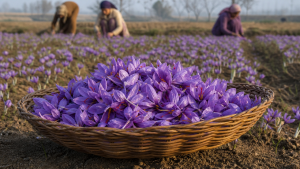
Saffron is obtained from the dried stigmas of Crocus sativus, a perennial flowering plant. It is among the costliest spices in the world because each flower yields only a few stigma threads. India’s saffron story is traditionally associated with Jammu and Kashmir, where Kashmiri saffron, or kesar, is highly valued.
- Origin: Believed to have originated in the Mediterranean region, Asia Minor and Iran.
- Indian cultivation: Traditionally linked to Jammu and Kashmir, introduced by Persian traders or Buddhist monks around the 1st century BCE.
- Distinct features: Long and thick stigmas, deep-red colour, strong aroma, bitter taste and high crocin, safranal and picrocrocin content.
- Altitude: Grown at 1,600 m to 1,800 m above mean sea level.
- Main areas: Pulwama, Budgam, Kishtwar and Srinagar.
- Global note: Iran is the largest producer of saffron.
Pepper and Cardamom
Black pepper and cardamom are among India’s most recognisable spices and are central to the country’s spice economy.
- Black Pepper: Known as the King of Spices, it is a perennial climbing vine indigenous to the tropical forests of the Western Ghats.
- Climate needs: Hot and humid conditions, 1,250-2,000 mm rainfall and temperatures of 23-32°C.
- Production pattern: Kerala accounts for about 94% of production, followed by Karnataka (5%), with smaller contributions from Tamil Nadu and the northeastern states.
- Indian varieties: Over 75 cultivars are grown; Karimunda is a popular variety in Kerala.
- Cardamom: Called the Queen of Spices and one of the costliest spices after saffron and vanilla.
- Small cardamom: Elettaria cardamomum, centred in the evergreen forests of the Western Ghats.
- Major states: Kerala, Karnataka and Tamil Nadu; Idukki is the heart of cultivation in Kerala.
- Conditions: Best at 600-1,200 m altitude, with 1,500-2,500 mm rainfall and temperatures of 15-35°C.
- Large cardamom: Amomum subulatum, mainly cultivated in Sikkim and parts of Northeast India.
Chilli, Turmeric and Ginger
These rhizome and fruit spices are major components of Indian cooking and also have strong export value. India leads global production in each of these crops.
- Chilli: Capsicum annuum and Capsicum frutescens; pungency comes from capsaicin and red colour from capsanthin.
- History: Introduced by the Portuguese in the late 14th century.
- Major states: Andhra Pradesh, Karnataka, Maharashtra, Madhya Pradesh and Telangana.
- Noted varieties: Guntur Sannam from Andhra Pradesh and Byadagi from Karnataka.
- Climate: Warm and humid growth period at 20-25°C, followed by dry weather for ripening.
- Turmeric: Curcuma longa, often called Indian Saffron or Indian Solid Gold.
- Value: Important for its colour, flavour and curcumin content, which gives medicinal properties.
- Major states: Telangana, Maharashtra, Tamil Nadu and Andhra Pradesh.
- Special location: Erode in Tamil Nadu is known as Turmeric City.
- Conditions: Warm and humid climate, 20-30°C temperature and 1,500-2,250 mm annual rainfall.
- Ginger: Zingiber officinale, an herbaceous perennial grown for its rhizomes.
- Leading states: Assam, Madhya Pradesh, Karnataka, Odisha, Meghalaya, Arunachal Pradesh and Gujarat.
- Climate: Warm and humid conditions, 19-28°C temperature and 70-90% humidity.
Seed Spices and Flower Bud Spices
India also dominates several seed spices and aromatic buds that are important in both domestic consumption and export markets.
- Cumin: Cuminum cyminum; mainly grown in the dry, cool regions of Rajasthan and Gujarat.
- Gujarat’s role: Known as India’s cumin capital and the world’s largest exporter of jeera.
- Coriander: Coriandrum sativum; one of the world’s major coriander seed producers and exporters.
- Crop season: Usually a Rabi crop, sown in October-November and harvested in February-March.
- Main states: Rajasthan, Madhya Pradesh, Gujarat, Andhra Pradesh and Uttar Pradesh.
- Climate: Performs well in cool weather, with ideal temperatures of 20-25°C.
- Fennel: Foeniculum vulgare; India supplies about 60-70% of the world’s fennel seeds.
- Production areas: Gujarat, Rajasthan and Madhya Pradesh.
- Favourable conditions: Dry and cold climate for better seed production.
- Fenugreek: Trigonella foenum-graecum; India is the largest producer and exporter.
- Major state: Rajasthan, followed by Gujarat and Madhya Pradesh.
- Season: A cold-season crop, tolerant to frost and very low temperatures.
- Clove: Syzygium aromaticum; grown in the hot and humid coastal areas of Kerala and Tamil Nadu.
- Nutmeg and Mace: Both are derived from Myristica fragrans and grown in the humid tropics of Kerala and Tamil Nadu.
Spices Board of India
The Spices Board of India was established in 1987 under the Spices Board Act, 1986. It functions as a statutory body under the Ministry of Commerce & Industry, with headquarters in Kochi, Kerala.
- Mandate: Development and worldwide promotion of 52 scheduled spices.
- Functions: Research, quality control, export promotion and domestic market development.
Key Prelims Takeaways
- India is a major global producer, consumer and exporter of spices.
- Saffron comes from the dried stigmas of Crocus sativus and is the costliest spice.
- Black pepper is known as the King of Spices.
- Cardamom is known as the Queen of Spices.
- Kerala leads in black pepper and small cardamom production.
- Andhra Pradesh is a leading chilli-producing state.
- Gujarat is the top state for cumin and a major producer of fennel.
- Rajasthan leads in fenugreek production.
- Telangana is a major turmeric-producing state.
- Spices Board of India is headquartered in Kochi, Kerala.
Recent Context
Saffron cultivation began as a pilot project in Ladakh’s Leh district on 2 October 2026, using premium Iranian corms on restored barren land at Spituk Pharka. The initiative, linked to Project Him Sarovar and supported by CSIR-IIIM, reflects efforts to diversify agriculture and strengthen climate-resilient horticulture value chains in Ladakh.
| Related | |
|---|---|