Important Olympic and Non-Olympic Archery Formats
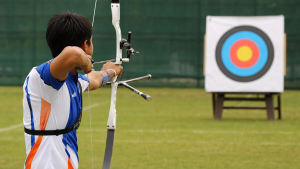
Archery is a precision sport in which athletes shoot arrows at a target using different types of bows. For Prelims revision, the key distinction is between Olympic recurve archery and major non-Olympic formats, especially compound. The sport is governed internationally by World Archery, and its rules vary by bow type, distance and scoring system.
Archery as a Competitive Sport
Archery has evolved from a hunting and warfare skill into a modern international sport that tests physical control, mental focus and hand-eye coordination. It is organised around target shooting, with points awarded according to how close an arrow lands to the centre.
- Global governing body: World Archery Federation (WA), earlier known as FITA.
- Recognised competitions: Olympic Games, World Championships, World Cups and continental events.
- Basic principle: Archers shoot at circular targets from fixed or varying distances, depending on the format.
- Scoring: The inner rings carry higher points, with the centre ring usually worth 10.
Olympic Archery: Recurve Bow
Recurve archery is the only bow style used in the Olympic Games. The recurve bow has limbs that curve away from the archer at the tips, helping store and release energy efficiently. This gives the arrow speed while keeping the equipment relatively simple compared to compound bows.
- Olympic status: Recurve archery has been part of the modern Olympic Games since 1972 as a permanent event, though archery first appeared in 1896 and was included intermittently before that.
- Equipment structure: A recurve bow is commonly made of a riser and two detachable limbs.
- Distance: Olympic archers shoot from 70 metres.
- Events: Men’s and women’s individual, team and mixed team events are contested.
- Target face: The target has 10 concentric scoring rings.
- Highest score: The innermost ring is worth 10 points.
How Olympic Recurve Matches Work
In Olympic recurve, the set system is used rather than only cumulative scoring. Archers or teams try to win sets, and the winner of a set gets set points.
- Individual matches: Archers usually shoot three arrows per set.
- Team matches: Three archers per country compete, and the combined score decides each set.
- Winning the match: The first to reach the required set points wins, usually 6 in individual events and 5 in team events.
- Significance: This format makes matches more tactical and allows comebacks even after losing earlier sets.
Non-Olympic Archery: Compound Bow
Compound archery is the most prominent non-Olympic bow discipline. The compound bow uses a system of cams, cables and pulleys to create mechanical advantage, making it easier to hold at full draw and enabling greater accuracy over longer aiming time.
- Mechanical advantage: Cams reduce the holding weight at full draw, a feature called let-off.
- Speed: The design allows faster arrow speeds than a comparable recurve bow.
- Aiming aids: Compound archers commonly use magnifying sights and release aids.
- Olympic status: Compound archery is not part of the Olympic program.
- Major events: It is seen in the World Championships, World Cups and many multi-sport events, including the Asian Games.
- Typical distance: Standard competition is often held at 50 metres, though other formats also exist.
Scoring and Competition Style
Compound archery is generally associated with cumulative scoring, where the total score across arrows decides the result. In some events, a set format may also be used.
- Cumulative scoring: Total arrow score determines the winner in many compound events.
- Set format: Some competitions use a system similar to recurve.
- Precision focus: The equipment allows fine control, so compound archery is often seen as highly technical.
Other Non-Olympic Bow Types and Formats
Beyond recurve and compound, archery includes several other recognised formats that are important in domestic and international competition.
- Barebow: A recurve bow shot without sights, stabilisers or other major accessories.
- Aiming style: Archers rely on instinctive aiming or gap shooting.
- Longbow: A traditional bow, usually simple in design and often made from a single piece of wood.
- Traditional shooting: Longbow archery is generally shot without sights or mechanical aids.
- Field archery: Conducted outdoors over varied terrain.
- Target distances: Field events may use marked and unmarked distances, testing distance judgement and shooting on uneven ground.
Key Differences, Rules and Training Ecosystem
The main difference between Olympic and non-Olympic archery lies in the bow design and the level of mechanical assistance allowed. Recurve archery is preferred in the Olympics because it is less dependent on advanced equipment and places greater emphasis on athlete skill, consistency and pressure handling.
| Feature | Recurve Bow | Compound Bow |
| Bow design | Limbs curve away from the archer at the tips | Uses cams/pulleys and cables |
| Holding weight | Full draw weight is held more directly | Reduced holding weight due to let-off |
| Sights | Simple pin sights | Magnifying sights and scopes are common |
| Release | Usually fingers with a tab or glove | Mechanical release aid common |
| Olympic status | Yes | No |
| Common distance | 70 metres | 50 metres, among others |
- World Archery Federation (WA): The international governing body recognised by the IOC.
- Asian Archery Federation (AAF): The continental body for Asia, affiliated with World Archery.
- Archery Association of India (AAI): The national federation governing and promoting archery in India.
- Training ecosystem: Top archery systems typically combine technical coaching, strength training, mental conditioning and repeated target practice.
- Equipment regulation: Standardised rules ensure fairness across world events.
Key Prelims Takeaways
- Recurve archery is the only bow style included in the Olympic Games.
- Compound archery is a major non-Olympic discipline.
- World Archery Federation (WA) is the global governing body of the sport.
- Olympic recurve events are shot at 70 metres.
- Olympic recurve matches use the set system, not only cumulative scoring.
- Compound bows use cams, cables and let-off for mechanical advantage.
- Archery at the Asian Games includes both recurve and compound events.
Recent Context
India won its first-ever Asian Games gold in the women’s recurve team event on October 2, 2026, at Aichi-Nagoya, Japan. The team of Ankita Bhakat, Kirti Sharma and Kumkum Mohod beat South Korea 5-3 in the final after defeating China 5-1 in the semifinal. South Korea had won seven straight golds in this event since 1998.
| Related | |
|---|---|