Types of Volcanic Eruptions and Ejecta
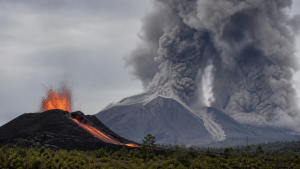
Volcanic eruptions differ widely in intensity, duration and products, depending mainly on magma viscosity, gas content and water interaction. Some eruptions are quiet and lava-dominated, while others are highly explosive and generate ash clouds, pyroclastic flows and new landforms.
For Prelims revision, it is useful to link eruption styles with ejecta, volcano shapes and tectonic settings. This helps in understanding both volcanic hazards and the landforms created by past eruptions.
Types of Volcanic Eruptions
Volcanic eruptions are usually grouped into effusive and explosive types. The style depends largely on whether magma is runny or viscous, and whether gases can escape easily.
- Effusive eruptions: These involve the relatively gentle outpouring of low-viscosity basaltic lava. Gas escapes more easily, so the eruption is less violent.
- Hawaiian eruptions: Very fluid lava flows emerge from vents or fissures. Fire fountains may occur, and such eruptions commonly build shield volcanoes.
- Icelandic eruptions: Similar to Hawaiian eruptions, but often occur along long fissures and can produce vast lava plateaus.
- Explosive eruptions: These are more violent because high-viscosity magma traps gases. Pressure builds up until it is released suddenly.
- Strombolian eruptions: Mildly explosive eruptions with short, intermittent bursts that throw out incandescent bombs and lapilli.
- Vulcanian eruptions: Moderately explosive eruptions that eject dense clouds of ash, bombs and blocks. The eruption column is often dark and ash-rich.
- Pelean eruptions: Highly dangerous eruptions linked to the collapse of a lava dome or eruption column, producing fast-moving pyroclastic flows or nuee ardente.
- Plinian eruptions: Extremely powerful and sustained eruptions that form towering ash-and-gas columns, sometimes reaching the stratosphere. They are associated with caldera formation.
- Surtseyan eruptions: Hydrovolcanic eruptions in shallow seas or lakes, where magma interacts violently with water to produce steam explosions and ash.
- Phreatomagmatic eruptions: Explosive eruptions caused by direct interaction between magma and water, leading to steam-driven blasts.
- Phreatic eruptions: Steam-driven explosions caused when groundwater is heated by magma without direct magma eruption. These mainly eject pre-existing rock.
Volcanic Ejecta and Pyroclastic Material
Volcanic ejecta include all materials expelled during an eruption: lava, gases and fragmented rock. In exam questions, the distinction between lava types and pyroclastic materials is important.
- Lava: Molten rock that reaches the Earth’s surface. Its viscosity determines how far and how fast it flows.
- Pahoehoe: Smooth, ropy-textured basaltic lava, typical of effusive flows.
- Aa: Rough, jagged and clinkery basaltic lava, usually cooler or thicker than pahoehoe.
- Pillow lava: Forms when lava erupts underwater and cools into rounded, pillow-shaped masses.
- Andesitic/rhyolitic lava: More viscous lavas that often form lava domes or short, thick flows.
- Volcanic gases: Mainly water vapor, carbon dioxide, sulfur dioxide and hydrogen sulfide. These gases can drive explosive eruptions and affect air quality.
- Volcanic ash: Fine particles smaller than 2 mm, capable of travelling long distances.
- Lapilli: Fragments measuring 2 to 64 mm in diameter.
- Volcanic bombs: Molten or semi-molten fragments larger than 64 mm, often streamlined during flight.
- Volcanic blocks: Solid, angular fragments larger than 64 mm ejected during an eruption.
- Pumice: Light-colored, highly vesicular volcanic glass formed from gas-rich felsic magma; it is buoyant in water.
- Scoria: Dark-colored, vesicular volcanic rock, usually basaltic or andesitic, and denser than pumice.
- Pyroclastic flows: Hot mixtures of gas, ash and rock fragments that rush down volcanic slopes at high speed.
Volcanic Landforms
The type of eruption and the nature of ejecta strongly influence the landforms that develop. Some landforms are built by lava, while others are shaped mainly by ash and fragmented material.
- Shield volcanoes: Broad, gently sloping cones formed by successive flows of fluid basaltic lava.
- Stratovolcanoes or composite cones: Steep-sided volcanoes made of alternating layers of lava flows, ash and pyroclastic debris.
- Cinder cones: Small, simple cones built from pyroclastic fragments ejected from a single vent and piled around a crater.
- Calderas: Large, basin-shaped depressions formed when a magma chamber collapses after a major eruption.
- Lava domes: Steep, bulbous masses of highly viscous lava that extrude slowly from a vent.
- Lava plateaus or flood basalts: Extensive, flat-topped regions formed by vast outpourings of fluid basaltic lava from fissures.
- Volcanic islands: Islands formed when lava and ash accumulate above sea level over long periods.
Global Distribution of Volcanoes
Most volcanoes occur along tectonic plate boundaries, though some form away from them. Their location reflects how magma is generated and how the crust is fractured.
- Mid-oceanic ridges: Divergent plate boundaries where new oceanic crust is formed by basaltic volcanism.
- Subduction zones: Convergent plate boundaries where one plate sinks beneath another, often producing explosive stratovolcanoes.
- Pacific Ring of Fire: A major belt of volcanoes and earthquakes around the Pacific Ocean, closely linked to subduction zones.
- Hotspots: Volcanic regions away from plate boundaries, caused by rising mantle plumes.
- Examples of hotspots: Hawaii and the Galapagos are well-known volcanic hotspot regions.
Key Prelims Takeaways
- Effusive eruptions involve low-viscosity lava, while explosive eruptions involve viscous, gas-rich magma.
- Hawaiian eruptions are fluid and lava-dominated, and they commonly form shield volcanoes.
- Plinian eruptions are among the most violent and can produce very tall ash columns and caldera formation.
- Pelean eruptions are especially dangerous because of pyroclastic flows.
- Pyroclastic material includes ash, lapilli, bombs, blocks, pumice and scoria.
- Pumice is light and vesicular, while scoria is darker and denser.
- Volcanic bombs are molten fragments that solidify during flight; blocks are already solid and angular.
- Shield volcanoes are broad and gently sloping, whereas stratovolcanoes are steep-sided and layered.
- Calderas form after collapse of a magma chamber roof following a major eruption.
- Most active volcanoes lie along the Pacific Ring of Fire.
- Hotspots are volcanic centres not directly linked to plate boundaries.
- Surtseyan eruptions occur where magma meets shallow water and produces steam-driven explosions.
Recent Context
Indonesia’s Anak Krakatau volcano, “Child of Krakatoa,” saw two new islands emerge after a 25-hour eruption between September 4 and 6, 2026. Sentinel imagery later verified the formations, which likely reflect new vents or secondary eruptive deposits. The case is useful for hazard classification, risk communication and understanding how volcanic islands change shape over time.
| Related | |
|---|---|