Major Venomous Marine Animals of the World
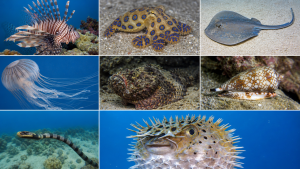
The world’s oceans host several venomous animals that use toxins for hunting, defense, or both. While most species avoid humans, accidental encounters can be dangerous because their venoms are often fast-acting and difficult to treat. For prelims revision, it is useful to know the main groups, their venom type, delivery mechanism, and the habitats where they are commonly found.
General Features of Venomous Marine Animals
Venomous marine species usually have specialized glands that produce toxins and a structure to deliver them, such as fangs, spines, nematocysts, or barbed teeth. Their venoms may contain neurotoxins, cytotoxins, hemotoxins, or cardiotoxins, and can affect the nervous system, tissues, blood, or heart function.
- Purpose: Venom is used mainly for predation and defense.
- Delivery systems: Common mechanisms include bites, stings, spines, and harpoon-like teeth.
- Effects: Symptoms may range from pain and swelling to paralysis, respiratory failure, or cardiac arrest.
- Ecological role: These animals are an important part of marine food webs and biodiversity.
Sea Snakes
Sea snakes are fully marine reptiles belonging to the subfamily Hydrophiinae. They are closely related to terrestrial elapid snakes such as cobras and are adapted to life at sea with paddle-like tails, valve-like nostrils, and the ability to give birth to live young in water.
- Venom: Their venom is mainly neurotoxic and can block nerve impulses, causing muscle paralysis.
- Habitat: They are typically found in the warm waters of the Pacific and Indian oceans.
- Yellow-bellied sea snake: Pelamis platurus is identified by a yellow underside and dark upper body.
- Behavior: This species has potent venom but is generally sluggish out of water.
- Other species: Important examples include the Beaked Sea Snake (Enhydrina schistosa) and the Olive Sea Snake (Aipysurus laevis).
Sea snakes are rarely found on land unless washed ashore.
Stonefish and Other Venomous Fish
Stonefish are among the most venomous fish in the world and are known for exceptional camouflage. They blend with rocky or coral seafloors and are often noticed only when stepped on.
- Genus: Synanceia.
- Distribution: Mainly found in shallow tropical waters of the Indo-Pacific region.
- Venom delivery: They have 13 sharp dorsal fin spines that inject venom when compressed.
- Venom type: Their venom contains neurotoxins and cytotoxins.
- Effects: A sting can cause severe pain, swelling, tissue necrosis, paralysis, respiratory distress, and in extreme cases, cardiac arrest.
Because the fish is camouflaged on the sea floor, accidental human contact is a major risk in shallow coastal waters.
Box Jellyfish and Blue-Ringed Octopus
Some of the most dangerous marine venomous animals belong to groups that are small, hard to notice, or visually striking. Their toxins can act quickly and may be fatal without prompt medical care.
- Box jellyfish: These belong to class Cubozoa and have a cube-shaped bell with long tentacles.
- Nematocysts: Their tentacles carry thousands of microscopic stinging cells called nematocysts.
- Venom: Box jellyfish venom includes cardiotoxic, neurotoxic, and dermatonecrotic compounds.
- Key species: Chironex fleckeri is especially lethal.
- Range: They are mainly found in tropical and subtropical Indo-Pacific waters, especially near northern Australia.
- Effects: Stings can cause intense pain, skin lesions, muscle spasms, and rapid cardiac or respiratory failure.
- Blue-ringed octopus: Species of genus Hapalochlaena inhabit tide pools and coral reefs across the Pacific and Indian oceans.
- Warning signal: They display bright blue rings when threatened.
- Toxin: Their venom contains tetrodotoxin (TTX), a powerful neurotoxin produced by symbiotic bacteria in the salivary glands.
- Effects: TTX can paralyse respiratory muscles and lead to respiratory failure.
There is no known antidote for tetrodotoxin; treatment is supportive, including artificial respiration.
Cone Snails
Cone snails are predatory marine gastropods recognised for their attractive shells and highly potent venom. They use a specialised feeding structure to immobilise prey and can also injure humans handling them carelessly.
- Genus: Conus.
- Habitat: Tropical and subtropical waters worldwide, especially coral reefs and sandy bottoms.
- Venom delivery: A barbed, harpoon-like radular tooth injects venom into prey.
- Prey: Fish, worms, and other mollusks.
- Venom type: Their venom contains neurotoxic peptides called conotoxins.
- Effects: Conotoxins target ion channels and receptors, causing severe pain, paralysis, respiratory failure, and sometimes death in humans.
Marine Safety and Climate-Linked Shifts
Marine venomous animals matter not only for biology but also for wildlife safety and public awareness. Some sightings outside normal ranges are linked to ocean temperature changes and current patterns, showing how climate-linked shifts can affect marine distribution.
- Observation: Unusual marine animals may appear in coastal waters when currents shift or sea-surface temperatures rise.
- Ecological signal: Such sightings can indicate changes in marine conditions rather than isolated events.
- Public safety: Beachgoers should avoid touching unknown marine animals.
- Response: Do not return a venomous animal to the water; inform lifeguards or wildlife officials instead.
- Relevance: These events highlight the intersection of marine biodiversity, ecology, and human safety.
Key Prelims Takeaways
- Sea snakes: Fully marine reptiles; venom is mainly neurotoxic.
- Yellow-bellied sea snake: Pelamis platurus; yellow underside, dark upper body, found in Pacific and Indian oceans.
- Stonefish: Synanceia; among the most venomous fish, with 13 venomous dorsal spines.
- Box jellyfish: Class Cubozoa; cube-shaped bell and nematocyst-bearing tentacles.
- Blue-ringed octopus: Uses tetrodotoxin, a powerful neurotoxin; bite may be painless at first.
- Cone snails: Inject conotoxins through a harpoon-like radular tooth.
- Public caution: Avoid handling unknown marine animals and report sightings to local authorities.
Recent Context
In September 2026, a yellow-bellied sea snake washed ashore at Crystal Cove in Orange County, California. This was the first reported appearance of the species in the state since 2018. California has recorded six confirmed sightings since 1972, and such unusual arrivals are linked to warm sea-surface temperatures and shifting ocean currents, including El Niño conditions.
| Related | |
|---|---|