List of Major Space Telescopes and Observatory Facilities
Space telescopes and observatory facilities are essential tools of modern astronomy. They help scientists study the universe across wavelengths that the human eye cannot see, from radio waves and infrared light to X-rays and gamma rays.
These facilities reveal the structure of galaxies, black holes, stars, exoplanets and the early universe. Together, they show how international collaboration and advanced instrumentation have transformed cosmic exploration.
Space-Based Observatories
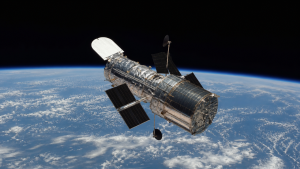
- Hubble Space Telescope (HST): Launched in 1990, Hubble works in low-Earth orbit and observes ultraviolet, visible and near-infrared light. Its 2.4-metre primary mirror has produced iconic images and major scientific results, including measurements related to the universe’s expansion.
- James Webb Space Telescope (JWST): Launched in December 2021, JWST operates near the Sun-Earth L2 point in a halo orbit. Its 6.5-metre primary mirror is made of 18 hexagonal, gold-coated beryllium segments. It is designed mainly for infrared astronomy and is used to study the first galaxies, star and planet formation, and exoplanet atmospheres.
- Chandra X-ray Observatory: Launched in 1999, Chandra detects X-rays from high-energy sources such as supernovae, galaxy clusters and black holes. Its grazing-incidence mirror design allows it to focus X-rays and capture detailed images of extreme cosmic events.
- Spitzer Space Telescope: Launched in 2003, Spitzer was an infrared observatory that studied cool and dusty objects such as brown dwarfs, protoplanetary disks and distant galaxies. After its liquid helium coolant was exhausted in 2009, it continued limited operations before being decommissioned in 2020.
- Fermi Gamma-ray Space Telescope (FGST): Launched on June 11, 2008, Fermi studies gamma-ray sources from low-Earth orbit. Its Large Area Telescope (LAT) performs an all-sky survey, while the Gamma-ray Burst Monitor (GBM) detects transient gamma-ray events.
- Kepler Space Telescope: Operating from 2009 to 2018, Kepler was NASA’s first mission dedicated to finding exoplanets using the transit method. It discovered thousands of exoplanets and showed that planets are common in the Milky Way, including some Earth-sized candidates in habitable zones.
- Transiting Exoplanet Survey Satellite (TESS): Launched in 2018, TESS builds on Kepler’s legacy by surveying a much larger portion of the sky, about 85%, for exoplanets around nearby, bright stars. It uses the transit method, and its discoveries often become targets for detailed follow-up observations.
- Gaia Space Observatory: Launched by the European Space Agency in 2013, Gaia aims to create the most precise three-dimensional map of the Milky Way. It surveys nearly two billion objects and measures their positions, distances and motions to help explain the galaxy’s formation and evolution.
Ground-Based Optical Observatories
- W. M. Keck Observatory: Located on Mauna Kea, Hawaii, it consists of twin 10-metre optical and infrared telescopes, Keck I and Keck II. Each primary mirror is made of 36 hexagonal segments, and the observatory is known for its adaptive optics systems that reduce atmospheric distortion.
- European Southern Observatory (ESO) Very Large Telescope (VLT): Situated at Cerro Paranal in Chile’s Atacama Desert, the VLT includes four 8.2-metre Unit Telescopes and four 1.8-metre Auxiliary Telescopes. They can work individually or combine light as an interferometer through the Very Large Telescope Interferometer (VLTI).
- Extremely Large Telescope (ELT): Under construction by ESO on Cerro Armazones in Chile, the ELT will be the world’s largest optical and mid-infrared telescope. Its 39.3-metre segmented primary mirror is designed to gather far more light than existing telescopes and to use advanced adaptive optics for sharper images.
Radio and Millimetre/Submillimetre Facilities
- Atacama Large Millimeter/submillimeter Array (ALMA): Located on the Chajnantor plateau in the Chilean Andes, ALMA is an international radio telescope facility at an elevation of about 5,000 metres. It consists of 66 high-precision antennas and observes in millimetre and submillimetre wavelengths, making it valuable for studying cold gas, molecular clouds, star formation and early galaxies.
- Square Kilometre Array (SKA): The SKA is an intergovernmental radio telescope project being built in Australia and South Africa. When completed, it will have a total collecting area of about one square kilometre, making it far more sensitive for mapping the sky across a wide frequency range.
Why These Facilities Matter
- Wavelength coverage: Different telescopes observe different parts of the electromagnetic spectrum, helping scientists study objects that cannot be seen in visible light alone.
- Atmospheric advantage: Space observatories avoid atmospheric absorption and distortion, while ground-based facilities use large mirrors and adaptive optics to overcome these limits.
- Exoplanet science: Missions such as Kepler, TESS and JWST have expanded the search for planets beyond the solar system and improved the study of their atmospheres.
- Early universe studies: Infrared observatories such as JWST and Spitzer help scientists examine early galaxies and dusty star-forming regions.
- High-energy astronomy: Chandra and Fermi allow observation of extreme events such as black-hole activity, supernovae and gamma-ray bursts.
- International collaboration: Facilities such as ALMA, ESO’s telescopes and SKA show how global scientific partnerships are central to modern astronomy.
Key Prelims Takeaways
- Hubble: 2.4-metre mirror; low-Earth orbit; ultraviolet, visible and near-infrared observations.
- JWST: 6.5-metre segmented mirror; infrared telescope; placed near Sun-Earth L2.
- Chandra: X-ray observatory for black holes, supernovae and other high-energy sources.
- Fermi: Gamma-ray mission with LAT and GBM instruments; studies pulsars, active galactic nuclei and gamma-ray bursts.
- Kepler and TESS: Both use the transit method to detect exoplanets; TESS focuses on nearby bright stars.
- Gaia: Creates a 3D map of the Milky Way by measuring positions, distances and motions of stars.
- ALMA, VLT, ELT and SKA: Major international ground-based facilities with strong contributions to astronomy and astrophysics.
Recent Context
The confirmation of Elias 2-24 b, one of the youngest known planets, used observations from the W. M. Keck Observatory, ALMA and the ESO Very Large Telescope. Such cases show how complementary facilities support one another in exoplanet research.
The Nancy Grace Roman Space Telescope, launched on August 30, 2026, carries a coronagraph for direct imaging of faint objects near bright stars and is undergoing a 90-day commissioning phase before science operations begin in early 2027.
| Related | |
|---|---|