Major India-China Connectivity Corridors
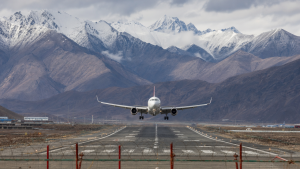
India-China connectivity has long moved through a mix of mountain passes, sea lanes, air routes and digital networks. These links shape trade, mobility and strategic signalling, while also reflecting the broader state of bilateral relations. For prelims revision, the key is to track the main corridors, their present status and the important geographic and institutional terms attached to them.
Air Connectivity
Air links are the most visible current bridge between India and China, supporting passenger movement, cargo transport and business travel. After a long disruption caused by the COVID-19 pandemic and later geopolitical tensions, direct services are being restored gradually.
- China Southern Airlines is scheduled to resume regular passenger flights between Guangzhou and New Delhi from September 21, 2026.
- This will restore the carrier’s India operations after a six-year suspension and add one daily round-trip flight on the route.
- The service will operate as CZ359/CZ360 on Boeing 737 series aircraft.
- Guangzhou Baiyun International Airport is one of China’s busiest airports, while Indira Gandhi International Airport is among India’s largest by passenger traffic.
- China Southern Airlines plans to operate more than 100 weekly flights across eight round-trip routes in South Asia.
- IndiGo commenced daily non-stop flights between Kolkata and Guangzhou on October 26, 2025, and between Delhi and Guangzhou on November 10, 2025.
- IndiGo also launched a daily non-stop service between Kolkata and Shanghai on March 30, 2026.
- China Eastern Airlines resumed direct flights between Shanghai and Delhi on November 9, 2025, and restarted direct flights between Kunming and Kolkata on April 18, 2026.
- Air China resumed its Beijing-Delhi service in April 2026, operating thrice a week.
- Air India restarted Delhi-Shanghai flights in February 2026 and plans to increase frequency to five weekly services.
Land Connectivity: Historical Routes
India and China were historically connected through ancient overland and trans-Himalayan routes, especially the Silk Road network. These routes were not only commercial corridors but also channels for the movement of ideas, religions and cultural practices.
- The Silk Road was a network of overland and maritime paths linking India with China and Central Asia for more than 1,500 years.
- Buddhism spread from India to China and East Asia through these routes.
- Trans-Himalayan trade passed through regions such as Kashmir, Ladakh and Tibet.
- The Southern Silk Route linked East and North-East India with Yunnan province via Myanmar and existed before the Central Asian Silk Route became prominent.
- The South West Silk Route or Sikkim Silk Route connected Yunnan and India through Tibet, including the route from Lhasa via Chumbi Valley and Nathu La Pass to Tamralipta Port in West Bengal.
Land Connectivity: Border Passes and Trade
Several mountain passes along the India-China frontier have served as traditional trade points. Their operation depends on political conditions, infrastructure and local arrangements. These routes remain important for border-region livelihoods and strategic engagement.
- Nathu La Pass is located in Sikkim at an altitude of 4,310 metres and is one of the open trading border posts between India and China.
- Trade through Nathu La uses monetary transactions.
- Shipki La Pass in Kinnaur district, Himachal Pradesh, lies at 3,930 metres and is another significant trade route.
- Trade through Shipki La traditionally operates on a barter system.
- The Sutlej River enters India through the Shipki La region.
- Lipulekh Pass in Uttarakhand lies near the trijunction with Nepal.
- Trade through Lipulekh is conducted using currency.
- Nepal has objected to the route on the ground that it passes through disputed territory.
- Border haats are mainly associated with the India-Bangladesh border, not the India-China frontier.
- China is expanding the Tibet-Xinjiang railway to Shigatse and Gyirong, near the border with India and linked with Nepal, while India is developing the Raxaul-Kathmandu rail project.
Maritime and Digital Connectivity
Sea lanes and digital cables are crucial in modern India-China connectivity, even when direct political relations are strained. Maritime routes remain central to trade, while submarine cables underpin the movement of data and support wider economic integration.
- The Maritime Silk Road, also called the Indian Ocean trade routes, connected India, China, Southeast Asia, the Arab world, East Africa and the Mediterranean for thousands of years.
- Important Indian ports included Calicut, Mahabalipuram, Madurai, Cranganore, Nagapattanam and Mangalore.
- The Strait of Malacca is a key choke point for maritime trade between China and the Indian Ocean.
- China has invested in ports across the Indian Ocean, including Gwadar, Hambantota, Kyaukphyu and Djibouti; this network is often described as the String of Pearls.
- Approximately 80% of China’s oil imports transit the Indian Ocean.
- Submarine fiber-optic cables carry over 98% of international data, indirectly linking India and China through global networks.
- The Indian Ocean hosts a dense cable network that supports India’s digital economy and international connectivity.
- Major cable systems such as the SEA-ME-WE series and India-Middle East-Western Europe routes pass through or terminate in India.
- India’s cable landing points are concentrated in Mumbai and Chennai.
- China’s Digital Silk Road includes undersea cable development and has strategic implications, including the PEACE cable with landing sites in Pakistan and Djibouti.
- India has announced initiatives such as the Cloud and Fiber Initiative and the I-2SEA Submarine Cable Project to strengthen links with Europe and Southeast Asia.
Proposed Corridors and Strategic Initiatives
Some corridors remain proposed rather than operational, but they matter because they show how connectivity is tied to geopolitics, sovereignty and regional influence. The debate is not only about roads and rails, but also about strategic autonomy and the architecture of Asian trade.
- Bangladesh-China-India-Myanmar (BCIM) Economic Corridor was proposed as a road, rail, water and air link connecting India and China through Myanmar and Bangladesh.
- The proposed corridor was envisioned to cover 1.65 million square kilometres, including Yunnan, Bangladesh, Myanmar and West Bengal.
- China proposed including BCIM in the Belt and Road Initiative (BRI) in 2015.
- India has not joined the BRI because of sovereignty and security concerns, especially over the China-Pakistan Economic Corridor (CPEC) passing through disputed territory in Kashmir.
- By May 2019, BCIM was not mentioned in a BRI joint communique, and the corridor was effectively dropped from the BRI framework.
- BRI, launched by China in 2013, includes the Silk Road Economic Belt and the 21st Century Maritime Silk Road.
- India has instead promoted its own connectivity initiatives, including the International North-South Transport Corridor (INSTC) and Chabahar port.
- India is also preparing to dispatch its first cargo ship along Russia’s Northern Sea Route in 2027.
Key Prelims Takeaways
- India-China connectivity: covers air, land, sea and digital routes; it is closely linked to trade, mobility and strategic relations.
- Air routes: direct flights are being restored gradually after the pandemic-era suspension and later tensions.
- Major airports: Indira Gandhi International Airport, Guangzhou Baiyun International Airport, Shanghai Pudong International Airport, Netaji Subhas Chandra Bose International Airport and Kunming Changshui International Airport.
- Key airlines: China Southern Airlines, IndiGo, China Eastern Airlines, Air China and Air India operate or plan India-China routes.
- Historic routes: Silk Road, Southern Silk Route and Sikkim Silk Route are important for the spread of trade and Buddhism.
- Border passes: Nathu La, Shipki La and Lipulekh are important India-China land routes with distinct trade practices.
- Trade modes: Nathu La and Lipulekh use currency-based trade, while Shipki La traditionally follows barter.
- Maritime choke point: the Strait of Malacca is crucial for China’s Indian Ocean access.
- Digital infrastructure: submarine cables carry more than 98% of international data.
- Chinese initiatives: BRI, Digital Silk Road and String of Pearls are key terms in connectivity debates.
- India’s position on BRI: India has stayed out of the BRI due to sovereignty and security concerns, especially over CPEC.
- BCIM corridor: a proposed multi-modal corridor that lost momentum after its association with the BRI.
- Related regional terms: BRICS is a grouping of Brazil, Russia, India, China and South Africa.
Recent Context
China Southern Airlines is scheduled to resume regular passenger flights between Guangzhou and New Delhi from September 21, 2026. The move marks another step in the gradual restoration of India-China direct air links after years of disruption caused by the pandemic and broader bilateral tensions.
| Related | |
|---|---|