Railway Projects in Himalayan Region
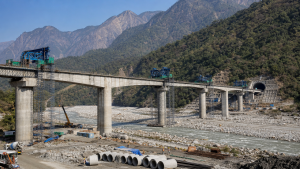
Railway projects in the Himalayan region are among India’s most demanding infrastructure works. They require long tunnels, high bridges and careful alignment through unstable geology, while also serving connectivity, tourism, disaster resilience and border logistics.
In Uttarakhand, Jammu and Kashmir, Sikkim and Himachal Pradesh-Ladakh, these lines are not just transport corridors but strategic lifelines. Their engineering solutions are important for Prelims because they combine geography, tunnelling technology and national security relevance.
Rishikesh-Karnaprayag Rail Project: Core Features
The Rishikesh-Karnaprayag Rail Project is a 125-km broad-gauge railway line in Uttarakhand. It is being developed by Rail Vikas Nigam Limited (RVNL), a public sector undertaking under the Ministry of Railways. The line will connect Rishikesh with Karnaprayag through a difficult Himalayan stretch marked by steep gradients, unstable slopes and fragile rock formations.
The project is estimated to cost Rs 37,000 crore and is targeted for completion by December 2029. It is designed around tunnels, bridges and viaducts to reduce surface disturbance and maintain alignment across deep valleys and mountain ridges. The line is also significant as a feeder route for the broader Char Dham rail connectivity effort.
- Length: 125 km
- Gauge: Broad gauge
- Developer: RVNL under the Ministry of Railways
- Estimated cost: Rs 37,000 crore
- Target completion: December 2029
- Alignment: Rishikesh to Karnaprayag through the Himalayan region
Why Himalayan Rail Projects Are Technically Difficult
Rail construction in the Himalayas is shaped by difficult geology. Many alignments pass through highly tectonised, multi-folded and faulted rock formations, and in some stretches through thick mylonite zones near the Main Boundary Thrust (MBT). These conditions raise risks of slope instability, rockfalls, seepage and excavation delays.
- Geological complexity: Routes often cross tectonised, folded and faulted rock masses.
- Main Boundary Thrust (MBT): A major geological fault zone that affects alignment and tunnelling.
- Controlled blasting: Used to excavate rock with greater precision and less destabilisation.
- Support systems: Required to secure tunnels and cut sections against collapse and rockfall.
- Monitoring: Continuous geological monitoring helps adjust methods to changing strata.
- Drainage and ventilation: Essential for operational safety and maintenance.
- NATM: The New Austrian Tunnelling Method is often used in such delicate mountain geology.
Engineering Features in the Rishikesh-Karnaprayag Line
The Rishikesh-Karnaprayag project illustrates the kind of engineering needed in Himalayan terrain. The line includes multiple long tunnels, escape tunnels, bridges and viaducts, all planned to manage elevation changes and reduce land cutting. Such designs are important in ecologically sensitive regions where large open excavations can cause slope damage.
One important component is Escape Tunnel-1, which is 10.847 km long. It is the second-longest tunnel in the project and reflects the emphasis on safe passage, emergency movement and maintenance access. These features are especially relevant in long tunnel systems where ventilation, evacuation and drainage become critical.
Escape Tunnel-1, at 10.847 km, is one of the key tunnelling milestones in the Rishikesh-Karnaprayag project.
- Multiple tunnels: Help avoid deep cutting and unstable surface slopes.
- Bridges and viaducts: Used to cross ravines and river valleys.
- Escape tunnels: Important for safety, evacuation and maintenance.
- Operational features: Include ventilation and drainage arrangements.
- Project planning: Designed to suit the fragile Himalayan terrain.
Other Major Railway Projects in the Himalayas
Several other railway lines in the Himalayan region have high strategic value. They aim to strengthen connectivity in remote border states, improve logistics and reduce dependence on weather-sensitive road transport. These projects also support civilian movement, tourism and rapid response capabilities.
- Udhampur-Srinagar-Baramulla Rail Link (USBRL): A 272-km line forming part of a 324-km railway connecting Jammu and Baramulla.
- USBRL engineering profile: It includes 36 tunnels with a combined length of 119 km and 943 bridges.
- Chenab Rail Bridge: Part of USBRL; the world’s highest railway arch bridge, 359 meters above the riverbed and 1,315 meters long.
- Anji Khad Bridge: India’s first cable-stayed railway bridge.
- Pir Panjal Railway Tunnel: 11.2 km long; India’s longest railway tunnel as of 2025.
- Sivok-Rangpo Rail Project: A 44.96-km broad-gauge line linking Sivok in West Bengal with Rangpo in Sikkim.
- Bilaspur-Manali-Leh Railway Line: A proposed 489-km line to Ladakh, envisioned with over 62 tunnels and more than 100 bridges.
Economic, Ecological and Strategic Importance
Himalayan railway projects have importance beyond transport. They improve access to isolated regions, support tourism and local markets, and reduce the time and uncertainty of road travel in landslide-prone zones. For many mountain communities, rail connectivity can improve year-round access to goods, services and employment.
These projects are equally important for disaster resilience and national security. Rail links can provide more reliable movement during road blockages, floods or snowfall, and they strengthen border infrastructure in sensitive regions. At the same time, construction must remain mindful of ecological sensitivity, since mountain ecosystems are fragile and slope disturbance can trigger long-term environmental impacts.
- Connectivity: Integrates remote Himalayan areas with the national network.
- Tourism: Improves access to pilgrimage and scenic destinations.
- Disaster resilience: Offers more dependable movement during road disruptions.
- Strategic value: Supports defence logistics in border areas.
- Ecological sensitivity: Requires careful tunnelling and slope management.
Key Prelims Takeaways
- Rishikesh-Karnaprayag Rail Project: 125-km broad-gauge line in Uttarakhand linking Rishikesh and Karnaprayag.
- Developer: RVNL, a PSU under the Ministry of Railways.
- Project cost and deadline: Rs 37,000 crore; completion target December 2029.
- Escape Tunnel-1: 10.847 km long; second-longest tunnel in the project.
- Main Boundary Thrust (MBT): Major Himalayan fault zone affecting railway alignment and tunnelling.
- USBRL: 272-km strategic railway link in Jammu and Kashmir with major tunnels and bridges.
- Important structures: Chenab Rail Bridge, Anji Khad Bridge and Pir Panjal Railway Tunnel.
- Sivok-Rangpo line: 44.96-km project to provide Sikkim’s first railway connectivity.
- Bilaspur-Manali-Leh line: Proposed 489-km strategic railway route to Ladakh.
- NATM: New Austrian Tunnelling Method is widely used in Himalayan tunnelling.
Recent Context
The Rishikesh-Karnaprayag Rail Project completed its 41st tunnel breakthrough on September 11, 2026, with the completion of Escape Tunnel-1. By September 2026, the project had reached 78% physical progress, with around 97% of tunnel excavation completed and five tunnel breakthroughs still pending.
| Related | |
|---|---|