BRICS: Member Countries and Institutions
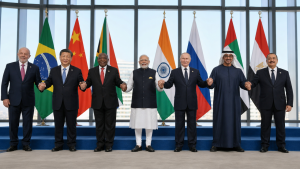
BRICS is a major platform of emerging economies that promotes cooperation on economics, politics, and development. It also seeks reforms in global governance so that international institutions better reflect contemporary power shifts. For prelims, BRICS is important for its evolving membership, key financial institutions, and its role in multilateral economic diplomacy.
Evolution and Membership
The term BRIC was coined in 2001 by Goldman Sachs economist Jim O’Neill for Brazil, Russia, India, and China. These four economies were seen as rising powers with strong growth potential. The first BRIC summit was held in Yekaterinburg, Russia, in 2009, marking the beginning of the grouping’s formal political dialogue.
South Africa joined in 2010, expanding the forum to BRICS and adding an important African dimension to the grouping. The expansion changed BRICS from a purely economic idea into a broader platform for South-South cooperation, development coordination, and global governance discussions.
BRICS expanded further in January 2024, when Egypt, Ethiopia, Iran, and the United Arab Emirates became full members. Indonesia formally joined in January 2025. Official Indian government sources in September 2026 also listed Saudi Arabia as a full member, though its status has been reported inconsistently in different references.
The current member countries of BRICS are: Brazil, China, Egypt, Ethiopia, India, Indonesia, Iran, Russia, South Africa, and the United Arab Emirates.
Objectives and Principles
BRICS functions as a forum for coordination among major emerging economies. Its cooperation covers economic, political, and cultural areas, with a strong emphasis on reforming institutions that govern international finance and development. The grouping is often viewed as a platform for multilateral cooperation, economic diplomacy, and a more balanced global order.
- Non-interference: Members generally avoid intervention in each other’s internal affairs.
- Equality: All members are treated as sovereign equals in discussions and outcomes.
- Mutual benefit: Cooperation is framed around shared development and practical gains.
- Sustainable development: BRICS supports growth that addresses long-term development needs.
- Institutional reform: The grouping advocates reforms in multilateral bodies to improve representation.
- Trade and investment: It seeks to expand intra-BRICS trade, investment, and financial cooperation.
- Global challenges: Cooperation extends to issues such as climate change, terrorism, and food security.
- Cultural ties: BRICS also encourages people-to-people and cultural exchanges.
The New Development Bank (NDB)
The New Development Bank (NDB) is one of the most important institutions created by BRICS. It was established in 2014 at the 6th BRICS Summit in Fortaleza, Brazil, and began operations in 2015. The bank is headquartered in Shanghai, China.
- Purpose: To mobilize resources for infrastructure and sustainable development projects.
- Scope: It supports projects in BRICS countries and other emerging economies.
- Authorized capital: The initial authorized capital was USD 100 billion.
- Membership: Membership is open to all United Nations members.
- Expanded membership: Non-BRICS countries such as Bangladesh, Egypt, Uruguay, and the United Arab Emirates have joined the bank.
The NDB is significant for exam purposes because it reflects BRICS’ attempt to create parallel development finance institutions outside the traditional Bretton Woods framework.
BRICS Contingent Reserve Arrangement (CRA)
The BRICS Contingent Reserve Arrangement (CRA) was also established in 2014 alongside the NDB. It is a self-managed contingency mechanism designed to strengthen financial stability among member states.
- Function: Provides liquidity support to member countries facing short-term balance of payments pressures.
- Nature: It works as a precautionary instrument for financial stability.
- Initial size: The total committed resources were USD 100 billion.
- Use: It helps members meet immediate external financing needs in times of stress.
Other Cooperation Mechanisms
Over time, BRICS has developed several supporting platforms and councils to deepen cooperation beyond formal summits. These mechanisms help connect governments, businesses, researchers, and social groups across member countries.
- BRICS PAY: A payment platform meant to facilitate cross-border transactions among member states.
- BRICS Think Tank Council: Coordinates research and policy analysis on BRICS-related issues.
- BRICS Business Council: Promotes trade links, investment opportunities, and business networking.
- BRICS Women Business Alliance: Focuses on women’s entrepreneurship, business participation, and gender equality.
- BRICS Network of Research Institutes: Supports academic and research collaboration.
- BRICS Productive Ecosystems Platform: Aims to enhance industrial and technological cooperation.
Operational Structure
BRICS does not have a permanent headquarters or a standing secretariat. Instead, it functions through a rotational chairmanship system in which the chair changes annually among member states. The chairing country hosts the annual summit and relevant ministerial meetings.
- Rotational chairmanship: Each member state takes turns leading the forum.
- Annual summit: Heads of state or government meet to take key decisions and issue declarations.
- Flexible structure: The absence of a permanent bureaucracy gives BRICS a decentralized working model.
Key Prelims Takeaways
- BRICS members: Brazil, China, Egypt, Ethiopia, India, Indonesia, Iran, Russia, South Africa, and the United Arab Emirates.
- Original BRIC members: Brazil, Russia, India, and China.
- South Africa: Joined in 2010, turning BRIC into BRICS.
- Recent expansion: Egypt, Ethiopia, Iran, and the UAE joined in January 2024.
- Indonesia: Formally joined BRICS in January 2025.
- Key institutions: The NDB and the CRA are the main formal institutions of BRICS.
- NDB headquarters: Shanghai, China; it finances infrastructure and sustainable development.
- CRA size: USD 100 billion, aimed at liquidity support during balance of payments stress.
- Operational model: BRICS has a rotational chairmanship and no permanent secretariat.
- Supporting platforms: BRICS PAY, Business Council, Think Tank Council, and Women Business Alliance are important cooperation mechanisms.
Recent Context
The resumption of direct flights between Guangzhou and New Delhi from September 21, 2026, is relevant because it reflects improved connectivity between two major BRICS members, India and China. Such developments matter for BRICS-related economic diplomacy, travel links, and broader bilateral engagement within the grouping.
| Related | |
|---|---|