Ashoka’s Dhamma: Principles, Implementation and Evidence
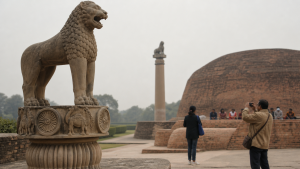
Ashoka’s Dhamma was a moral policy meant to guide personal conduct and public life in the Mauryan Empire. It stressed ethical behaviour, social harmony and restraint rather than ritualism or sectarian identity. The policy was spread through royal instructions, officials and inscriptions, making it one of the most important sources for understanding Ashoka’s rule.
Core Ideas of Dhamma
Ashoka’s Dhamma was not a sectarian creed. It drew on universal ethical values that could be accepted across communities and social groups. Its emphasis was on conduct, self-discipline and compassionate living.
- Respect for elders and superiors: Reverence for parents, teachers and other seniors was presented as a basic moral duty.
- Compassion: Kindness towards animals, servants and slaves formed an important part of the ethical code.
- Ahimsa: Non-injury and non-violence towards living creatures were central to the policy.
- Truthfulness and purity: Ashoka stressed truth, purity of heart and self-restraint in daily conduct.
- Liberality: Generosity towards friends, relatives and ascetics was encouraged.
- Self-examination: Individuals were expected to reduce sin and increase good deeds through moral reflection.
Social Harmony and Religious Tolerance
Dhamma aimed to reduce tension among different sects and strengthen the moral unity of the empire. Instead of promoting a particular ritual system, Ashoka encouraged mutual respect and restraint in religious matters.
- Mutual respect: Different sects were expected to live with goodwill and tolerance.
- Avoiding sectarian pride: Ashoka warned against excessive attachment to one’s own sect and denigration of others.
- Less ritualism: Moral conduct was placed above elaborate sacrifices and ceremonies.
- Public ethics: The policy linked private morality with social order and imperial stability.
Implementation Through Officials and Welfare Measures
Ashoka did not limit Dhamma to royal statements. He created administrative channels and public welfare measures to make it visible in daily life. These steps give the policy a practical, governance-oriented character.
- Dharmamahamatras: A special cadre of officials was created in the fourteenth year of his reign.
- Role of Dharmamahamatras: They spread Dhamma, supervised moral welfare and were associated with prisoner release.
- Existing officials: Rajukas and Pradesikas were also used to propagate moral codes during administrative tours.
- Shady trees and wells: Trees were planted and wells dug along main trade routes.
- Rest houses: Rest houses were established for travellers on important roads.
- Medical care: Treatment facilities were provided for both humans and animals.
- Animal slaughter: Royal kitchen practices were restricted, and unnecessary festive gatherings were discouraged.
Edicts as Evidence of Dhamma
The clearest evidence for Ashoka’s Dhamma comes from inscriptions spread across the subcontinent. These edicts reveal both the moral content of the policy and the methods used to communicate it to subjects and officials.
| Edict category | Medium | Script | Main focus |
| Major Rock Edicts | Natural rock surfaces | Brahmi and Kharosthi | Broad moral principles and social welfare |
| Minor Rock Edicts | Small rock outcrops | Brahmi | Personal life of Ashoka and early Dhamma propagation |
| Pillar Edicts | Monolithic stone pillars | Brahmi | Administrative accountability and royal enforcement |
| Cave Inscriptions | Polished cave walls | Brahmi | Donations to religious ascetics such as the Ajivikas |
Important Epigraphic Sites and Historical Clues
Specific inscriptions help historians reconstruct the spread and meaning of Dhamma. They also show Ashoka’s reach across diverse linguistic and cultural zones.
- Kalsi: Located in Uttarakhand, it contains Major Rock Edicts numbered one to thirteen.
- Girnar: Located in Gujarat, it preserves the complete set of fourteen Major Rock Edicts.
- Shabazgarhi and Mansehra: These sites are in present-day Pakistan and use the Kharosthi script.
- Kandahar bilingual inscription: Written in Greek and Aramaic, it shows outreach to foreign populations.
- Barabar Hill cave inscriptions: These record Ashoka’s donations to the Ajivika sect and show religious impartiality.
- Major Rock Edict XIII: It provides direct evidence of the Kalinga War and Ashoka’s remorse afterward.
- Maski Minor Rock Edict: It explicitly uses the personal name Ashoka along with his royal title.
Significance for Prelims
For examination purposes, Dhamma should be understood as a moral and administrative programme, not merely a religious doctrine. The term itself is important, as are the inscriptions and locations that preserve the message.
- Meaning of Dhamma: Dhamma is the Prakrit form of the Sanskrit word Dharma and refers to a moral code of conduct.
- Not ritual worship: It was intended as ethical guidance, not a system of formal religious worship.
- James Prinsep: He deciphered the Brahmi script in 1837 and read the inscriptions of Devanampiya Piyadassi.
- Identification of Ashoka: Prinsep’s work helped establish that Devanampiya Piyadassi referred to Emperor Ashoka.
- Northwestern inscriptions: Edicts in frontier regions were written in Aramaic and Greek for local administrative populations.
- Royal authority: The policy combined moral persuasion with administrative reach.
Key Prelims Takeaways
- Dhamma was a moral policy: It promoted ethical conduct, harmony and tolerance across the Mauryan Empire.
- Universal values: Respect, compassion, truthfulness, liberality and self-restraint formed its core.
- Ahimsa: Non-violence towards living beings was a central principle.
- Administrative backing: Ashoka used Dharmamahamatras, Rajukas and Pradesikas to spread and supervise Dhamma.
- Welfare measures: Wells, shady trees, rest houses and medical care show the practical side of the policy.
- Edicts are key evidence: Rock edicts, pillar edicts and cave inscriptions preserve the ideas and implementation of Dhamma.
- Important sites and inscriptions: Girnar, Kalsi, Shabazgarhi, Mansehra, Kandahar and Barabar are important for prelims revision.
| Related | |
|---|---|