National Weather Radar Network in India
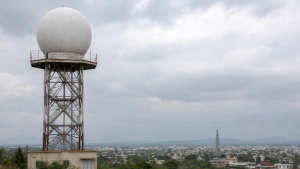
India is strengthening its weather observation system by adding more Doppler Weather Radars across the country. These radars improve short-range forecasting, storm tracking, and rainfall estimation, making them central to disaster preparedness and regional weather security.
Doppler Weather Radar
A Doppler Weather Radar (DWR) is a meteorological instrument that uses the Doppler effect to measure the movement of precipitation particles and wind within clouds. It emits microwave pulses and analyses the frequency shifts in the reflected signals from atmospheric targets such as rain, snow, or hail.
This makes the radar useful for detecting short-range weather phenomena and estimating rainfall intensity. The data generated by DWRs is especially important for nowcasting, which refers to weather forecasts for the next few hours.
How the radar data is used
DWR observations are among the most practical tools for operational meteorology because they provide near-real-time information on weather systems. Their value is highest during fast-changing conditions, when immediate warnings can reduce damage and improve preparedness.
- Short-range forecasting: Helps predict weather over the next few hours with better local accuracy.
- Storm tracking: Monitors the movement, structure, and intensity of storms.
- Rainfall estimation: Assists in assessing precipitation intensity and distribution.
- Severe weather warnings: Supports alerts for thunderstorms, lightning, hailstorms, and heavy rainfall.
- Disaster preparedness: Improves readiness for localized extreme weather events.
- Regional planning: Helps agriculture, water management, and emergency response agencies.
Expansion of India’s radar network
India has steadily expanded its Doppler Weather Radar network since 2014. As of 2026, the network has grown to around 50 operational units across the country. This expansion reflects a broader effort to strengthen weather and climate services through better observational coverage.
The government’s stated target is to take the national radar network to nearly 100 radars within the next two years. To reach this goal, 40 to 50 more Doppler radars are planned across India. This is significant for a country with diverse terrain and highly variable weather patterns.
Improved radar coverage helps fill observational gaps in coastal areas, plains, hill regions, and interior districts. For a country exposed to monsoon extremes, thunderstorms, cyclones, hailstorms, and flash flooding, radar expansion directly supports regional weather security.
Mission Mausam
Mission Mausam is a Government of India initiative under the Ministry of Earth Sciences. It aims to modernize and expand India’s weather and climate services by strengthening core infrastructure and observation systems.
The mission includes the expansion of radar systems, satellite capabilities, and other weather observation platforms. Its focus is on better forecasting, stronger early warning systems, and improved services for public safety and economic resilience.
- Implementing ministry: Ministry of Earth Sciences.
- Main objective: Modernize weather and climate services.
- Major components: Radar systems, satellites, and observation networks.
- Strategic value: Supports timely warnings and better decision-making.
- Policy relevance: Important for disaster management, agriculture, and infrastructure planning.
Sambalpur Doppler Weather Radar
India’s 51st Doppler Weather Radar was inaugurated at Jamadarpali in Sambalpur, Odisha, on September 16, 2026. It is a Make in India installation under Mission Mausam and adds an important layer to India’s radar-based weather monitoring network.
The Sambalpur radar is the third Doppler radar in Odisha, after Paradip and Gopalpur. Its installation improves coverage in western Odisha and nearby regions, which are often affected by intense thunderstorms and rainfall events.
| Parameter | Details |
| Location | Jamadarpali, Sambalpur, Odisha |
| Network position | India’s 51st Doppler Weather Radar |
| Coverage | 250 km radius |
| Resolution | 150 metres |
| Update frequency | Every 10 minutes |
| Regional reach | 13 districts in western Odisha; parts of Chhattisgarh and Jharkhand |
- Early warning role: Designed to alert authorities about thunderstorms, lightning, hailstorms, and heavy rainfall.
- Agricultural value: Useful for crop protection strategies in the Mahanadi basin.
- Water management: Supports monitoring and planning for the Hirakud Reservoir area.
- State coverage: Improves radar density in Odisha, which now has three Doppler radars.
- Operational usefulness: Strengthens local response to fast-evolving weather events.
Why the network matters for Prelims
For Prelims, the key point is that radar expansion is not only about forecasting but also about building a stronger warning ecosystem. DWRs provide high-frequency, location-specific observations that improve the response time of meteorological agencies and disaster managers.
In a country where weather impacts agriculture, transport, power supply, and water resources, a denser radar network is an important technology deployment for both public safety and economic planning.
Key Prelims Takeaways
- Doppler Weather Radar: Uses the Doppler effect to measure precipitation movement and wind within clouds.
- Signal analysis: Estimates atmospheric motion by studying frequency shifts in reflected microwave signals.
- Main uses: Short-range weather monitoring, storm tracking, and rainfall estimation.
- Nowcasting: DWR data is crucial for forecasting weather for the next few hours.
- Network size: India’s DWR network has reached around 50 operational units as of 2026.
- Expansion target: The national goal is nearly 100 radars within the next two years.
- Mission Mausam: A Government of India initiative under the Ministry of Earth Sciences.
- Mission components: Expands radar, satellite, and observation systems for weather and climate services.
- 51st radar: Inaugurated at Sambalpur, Odisha, on September 16, 2026.
- Coverage of Sambalpur radar: 250 km radius, 150-metre resolution, and 10-minute updates.
- Regional importance: Covers 13 districts in western Odisha and parts of Chhattisgarh and Jharkhand.
- Practical benefits: Helps crop protection in the Mahanadi basin and water management in the Hirakud Reservoir area.
Recent Context
The inauguration of the Sambalpur Doppler Weather Radar on September 16, 2026, is the latest addition to India’s expanding radar network. It highlights the push under Mission Mausam to improve observational coverage and strengthen early warning systems across weather-sensitive regions.
| Related | |
|---|---|