Important Semiconductor Materials and Devices
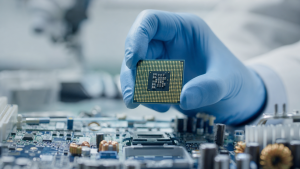
Semiconductors are the core building blocks of modern electronics, controlling how devices switch, amplify and process signals. Their electrical behaviour can be engineered through doping and material choice, which is why they power everything from smartphones and servers to electric vehicles and grid systems.
Basics of Semiconductors
Semiconductors conduct electricity better than insulators but not as freely as conductors. Their usefulness comes from the band gap, the energy difference between the valence band and the conduction band, which can be manipulated for different applications.
- Intrinsic semiconductors: Pure materials such as silicon or germanium. Their conductivity is low at room temperature but rises with temperature.
- Extrinsic semiconductors: Materials whose conductivity is controlled by adding impurities, a process called doping.
- N-type semiconductors: Doped with donor impurities such as phosphorus or arsenic, which supply extra electrons as majority carriers.
- P-type semiconductors: Doped with acceptor impurities such as boron or gallium, which create holes as majority carriers.
- P-N junction: Formed by joining P-type and N-type materials. It creates a depletion region and is the basic working structure of a diode.
Important Semiconductor Materials
Semiconductor materials are broadly grouped into elemental and compound types. Each has distinct properties and is chosen according to speed, heat tolerance, voltage handling and cost.
- Silicon (Si): The most widely used semiconductor material because it is abundant, stable and forms silicon dioxide (SiO2), which is vital for MOSFET fabrication. It is the base material for microprocessors, memory chips and solar cells.
- Germanium (Ge): One of the earliest semiconductor materials. It is now less common than silicon because silicon offers better high-temperature performance and lower cost, though germanium still finds use in some high-frequency and infrared applications.
- Gallium Arsenide (GaAs): A compound semiconductor known for high electron mobility. It is used in high-frequency circuits, microwave systems and optoelectronic devices such as LEDs and laser diodes.
- Indium Phosphide (InP): Used in high-frequency applications and fibre optic communication systems because of its excellent electron transport properties.
- Silicon Carbide (SiC): A wide-bandgap compound semiconductor made of silicon and carbon. It can operate at higher voltages, temperatures and frequencies than silicon, making it ideal for power electronics.
- Gallium Nitride (GaN): Another wide-bandgap semiconductor used in RF devices, LEDs and power converters. It is valued for efficient operation at high voltage and temperature.
Key Semiconductor Devices
Semiconductor materials are fabricated into devices that perform specific electronic functions. These devices are central to computation, communication and power management.
- Diode: A two-terminal device that allows current to flow mainly in one direction.
- Rectifier diode: Converts alternating current (AC) into direct current (DC).
- Light Emitting Diode (LED): Emits light when current passes through it.
- Photodiode: Detects light and converts it into electrical current.
- Transistor: A three-terminal device used for switching and amplifying electronic signals and electrical power.
- Bipolar Junction Transistor (BJT): A current-controlled device that was historically important and is still used in several applications.
- Field-Effect Transistor (FET): A voltage-controlled device. Major types include Junction FETs (JFETs) and Metal-Oxide-Semiconductor FETs (MOSFETs).
- MOSFET: The most common transistor in digital circuits, forming the foundation of microprocessors, memory chips and many power-management systems.
SiC and GaN are wide-bandgap semiconductors, a key reason they are used in high-voltage, high-temperature and high-efficiency power applications.
Integrated Circuits and System-Level Devices
Integrated circuits (ICs) combine many transistors, diodes and other components on a single semiconductor chip. They are the heart of modern electronic systems and have transformed the scale and speed of computing.
- Microprocessors: Central processing units that execute instructions and perform computations.
- Memory chips: Store digital data, including RAM and ROM.
- System-on-Chip (SoC): Integrates most or all components of a computer or electronic system onto one chip.
- Power ICs: Manage voltage conversion and efficient power delivery in electronic systems.
Silicon Carbide (SiC) Technology
SiC has become especially important for high-performance power electronics. Its wide band gap means more energy is needed to move electrons into the conduction band, which improves performance in demanding environments.
- Material composition: SiC is a compound semiconductor made of silicon and carbon.
- High-voltage capability: SiC devices can handle higher breakdown voltages than conventional silicon devices.
- Thermal advantage: They operate efficiently at high temperatures because of excellent thermal conductivity.
- Lower losses: SiC reduces switching losses, improving energy efficiency in power conversion.
- SiC MOSFETs: A key device type for high-power and high-frequency uses.
- Major uses: EV fast chargers, microgrids, solid-state transformers, traction inverters, renewable energy systems and industrial power electronics.
Applications and Policy Relevance
Semiconductors are used across the economy, making their supply chain a strategic concern for technology self-reliance, industrial policy and resilience.
- Information technology: CPUs, GPUs and memory in computers, smartphones and servers.
- Automotive industry: Engine control units, infotainment systems and advanced driver-assistance systems (ADAS).
- Telecommunications: Base stations, networking equipment and fibre optic communication systems.
- Consumer electronics: Televisions, washing machines and refrigerators that rely on ICs and efficient motor controls.
- Industrial power electronics: Motor drives, UPS systems and welding equipment.
- Renewable energy: Inverters for solar panels and wind turbines, along with grid-tie systems.
- BLDC motors: Brushless direct current motors used in energy-efficient appliances and systems.
Key Prelims Takeaways
- Silicon (Si) and Germanium (Ge) are elemental semiconductors.
- GaAs, SiC, GaN and InP are compound semiconductors with specialised uses.
- SiC and GaN are wide-bandgap materials suited to high-power and high-temperature applications.
- Doping is the addition of impurities to control semiconductor conductivity.
- N-type semiconductors have electrons as majority carriers, while P-type semiconductors have holes.
- MOSFETs are voltage-controlled transistors and are fundamental to digital circuits.
- BLDC stands for brushless direct current motor and is used in energy-efficient appliances.
Recent Context
L&T Semiconductor Technologies (LTSCT), a wholly owned subsidiary of Larsen & Toubro, unveiled its first SiC product platform on 18 September 2026 at SEMICON India 2026. The platform includes a 1200V SiC MOSFET for power conversion applications and reflects the growing role of SiC in India’s semiconductor ecosystem and supply-chain resilience.
| Related | |
|---|---|