Digital Toll Collection Systems in India
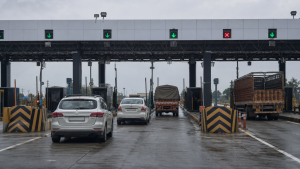
Toll collection on India’s national highways has shifted from manual cash payment to digital, barrier-free systems. FASTag remains the main ETC platform, while NHAI is also expanding local digital passes and testing next-generation tolling models.
Evolution of Toll Collection in India
National highway toll collection has moved from cash counters and paper receipts to automated electronic systems. The aim is to reduce congestion, save fuel, improve transparency, and support cashless infrastructure.
The FASTag Ecosystem
FASTag is India’s primary electronic toll collection system and works under the National Electronic Toll Collection (NETC) framework.
Core Technology and Operation
- Radio Frequency Identification (RFID): FASTag uses passive RFID technology. A small tag fixed on the vehicle’s front windscreen contains a chip and antenna.
- Automated Deduction: When a vehicle passes a toll reader, the toll amount is deducted automatically from the linked prepaid or bank account.
- Implementing Agencies: NPCI manages clearing operations, while NHAI and IHMCL handle implementation and rollout.
Timeline and Adoption
- Pilot Launch: NHAI launched the FASTag pilot on the Golden Quadrilateral in 2014.
- Mandatory Rule: FASTag has been mandatory for most four-wheelers at national highway toll plazas since 2021.
- Current Status: FASTag accounts for more than 98% of toll transactions on national highways.
| Parameter | Details |
| Technology | Passive RFID (Radio Frequency Identification) |
| Launch Year | 2014 (Pilot), 2021 (Mandatory) |
| Primary Clearing Agency | National Payments Corporation of India (NPCI) |
| Operational Base | Windscreen-mounted passive tags |
Digital Local Pass Facility
NHAI has expanded its digital FASTag Local Pass facility to make travel easier for residents living near toll plazas.
Features of the Digital Local Pass
- Coverage Expansion: The facility has been extended to 121 toll plazas across India.
- The 20-Kilometre Rule: Residents living within 20 kilometres of an eligible toll plaza can get a monthly pass for unlimited trips through that plaza.
- Platform Integration: Applications are submitted online through the Rajmargyatra mobile app.
- Verification Technologies: The system uses consent-based integration with DigiLocker and VAHAN for paperless verification, along with GIS mapping to confirm the 20-kilometre eligibility boundary.
Exam point: The digital local pass is valid for one month and allows unlimited trips through the designated toll plaza.
Multi-Lane Free Flow (MLFF) Tolling
MLFF is a barrier-free tolling model in which vehicles do not stop at toll plazas and are charged automatically at highway speed.
The Choryasi Toll Plaza Project
- First Deployment: NHAI operationalized India’s first barrierless MLFF tolling system.
- Location: It is being used at the Choryasi Toll Plaza on the Surat–Bharuch section of NH-48 in Gujarat.
- Operational Flow: Vehicles pass through without stopping, while overhead gantries record their movement.
Technical Components
- Automatic Number Plate Recognition (ANPR): High-speed cameras capture the vehicle number plate for identification.
- LiDAR and Radar: These systems classify vehicle size and track movement in real time.
- FASTag Integration: RFID readers detect FASTag at high speed and deduct the toll instantly.
Global Navigation Satellite System (GNSS) Tolling
GNSS-based tolling is being developed as a distance-based system that can replace barrier-dependent toll collection in the future.
How GNSS Tolling Operates
- Satellite Tracking: The system uses satellite navigation to track vehicle movement on national highways.
- On-Board Units (OBUs): Vehicles need a GNSS-enabled OBU that records entry and exit coordinates.
- Distance-Based Pricing: Users pay only for the exact distance travelled on the highway.
- Hybrid Model Transition: NHAI is introducing a hybrid model, with selected lanes for GNSS-equipped vehicles and other lanes for standard FASTag users.
Penalty rule: A non-GNSS vehicle entering a designated GNSS lane can be charged double the normal user fee.
Comparison of Toll Collection Technologies
| Feature | Manual Tolling | FASTag (RFID) | MLFF / GNSS Tolling |
| Primary Technology | Cash / Paper Receipts | Radio Frequency Identification | Satellites, OBUs, and ANPR Cameras |
| Physical Barriers | Yes, manual gates | Yes, automated boom barriers | No, barrier-free gantries |
| Vehicle Speed | Complete stop | 10 to 20 km/h at plaza | Full highway speed |
| Tolling Model | Fixed point rate | Fixed point rate | Distance-based (pay-as-you-use) |
| Hardware Required | Cash counters | Windscreen RFID tag | On-Board Unit (OBU) or high-speed plate reader |
Key Facts for Aspirants
- NHAI: Formed under the National Highways Authority of India Act, 1988, and functions under MoRTH.
- IHMCL: Incorporated in 2012 to implement electronic tolling in India.
- DigiLocker: A digital document wallet under the Ministry of Electronics and Information Technology.
- VAHAN: The national vehicle registry database maintained under MoRTH.
- SARATHI: The centralized database for driving licences in India, also under MoRTH.
- GIS Verification: Used to map whether a residence falls within the 20-kilometre eligibility boundary.
Recent Context
NHAI has expanded the digital FASTag Local Pass facility to 121 toll plazas. The service was first piloted in July 2026 at the Mundka–Bakkarwala Toll Plaza on UER-II in Delhi and is now being rolled out in phases.
Rare Facts for Prelims
- NETC framework: FASTag operates under the National Electronic Toll Collection system, which enables interoperability across participating banks and toll plazas.
- Passive RFID: FASTag tags do not need an internal battery; they are powered by the reader’s radio signal.
- ANPR role: In MLFF systems, number plate recognition acts as a backup identification layer if RFID reading fails.
- GIS use: GIS-based verification is not just for mapping; it helps automate eligibility checks without manual field inspection.
- Hybrid tolling: During the transition to GNSS, both satellite-based and FASTag-based systems may operate side by side.
- Local pass model: The monthly local pass is designed mainly for frequent short-distance commuters near toll plazas.
| Related | |
|---|---|