Types of Fifth-Generation Fighter Jets
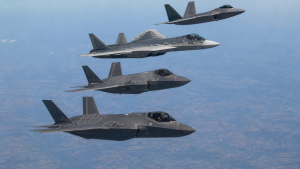
Fifth-generation fighter jets are the most advanced combat aircraft in service today. They combine stealth, sensor fusion, networked communications and high manoeuvrability to improve survivability, situational awareness and strike power in modern air warfare.
These fighters are designed to operate across air superiority, ground attack and reconnaissance roles while remaining difficult to detect and track. For Prelims, the focus should be on their defining features, operational models and major development programmes.
Characteristics of Fifth-Generation Fighters
- Stealth technology: These aircraft reduce radar cross-section through airframe shaping, radar-absorbent materials and internal weapon bays, making detection harder.
- Supercruise: They can sustain supersonic flight without afterburners, improving range, fuel efficiency and tactical flexibility.
- Sensor fusion: Data from onboard and offboard sensors is integrated into a single real-time picture, helping the pilot understand the battlefield faster.
- Advanced avionics and data links: Highly integrated computers and secure links support networked operations, command, control and communication capabilities, while reducing pilot workload.
- High manoeuvrability: Advanced airframes and, in some cases, thrust vectoring provide strong performance in close combat.
- Multirole capability: These fighters are built for air-to-air combat, air-to-ground strike and intelligence, surveillance and reconnaissance (ISR) missions.
Why They Matter in Modern Air Power
- Survivability: Stealth and electronic integration allow these aircraft to penetrate contested airspace more effectively than earlier generations.
- First-look, first-shot advantage: Better sensors and data fusion improve target detection and engagement before the enemy can respond.
- Force interoperability: Secure links and common mission systems help them operate with allied aircraft, ships and ground systems.
- Reduced pilot burden: Automation and integrated avionics allow pilots to focus more on mission execution than on raw aircraft handling.
- Flexible use: A single platform can support air dominance, precision strike and ISR, making it attractive for modern air forces.
Major Operational Fifth-Generation Fighter Jets
- Lockheed Martin F-22 Raptor (United States): The first operational fifth-generation air-dominance fighter, introduced in 2005. It is known for stealth, supercruise and advanced integrated avionics.
- Lockheed Martin F-35 Lightning II (United States): A multirole stealth fighter developed for air-to-air combat, air-to-ground strike and ISR missions. It entered service with the United States Marine Corps in 2015.
- Sukhoi Su-57 Felon (Russia): A twin-engine stealth multirole fighter developed under the PAK FA programme. It entered service with the Russian Air Force in 2020 and emphasises supermaneuverability, supercruise and integrated avionics.
- Chengdu J-20 Mighty Dragon (China): A twin-engine all-weather stealth fighter for the People’s Liberation Army Air Force (PLAAF), designed mainly for air superiority with precision-strike capability. It entered service in 2017.
- Shenyang J-35 (China): A twin-engine, single-seat aircraft introduced in 2025. It is primarily a navalised variant for aircraft carriers and is designed for air superiority and surface strike.
F-35 Lightning II Variants
- F-35A: Designed for Conventional Take-Off and Landing (CTOL) operations and is widely used by air forces.
- F-35B: Equipped for Short Take-Off and Vertical Landing (STOVL), making it suitable for amphibious assault ships and austere bases.
- F-35C: Built for aircraft carrier operations under CATOBAR conditions, with larger wings and stronger landing gear.
- Production and engine: The F-35 is produced by Lockheed Martin Aeronautics, while the F135 engine is made by Pratt & Whitney Military Engines.
Developmental and Future Programs
- HAL Advanced Medium Combat Aircraft (AMCA), India: India is independently developing a twin-engine fifth-generation supermaneuverable stealth multirole fighter. The Aeronautical Development Agency (ADA) is designing it, and Hindustan Aeronautics Limited (HAL) is expected to produce the initial prototypes.
- TAI TF-X KAAN, Turkey: Turkey is developing an indigenous fifth-generation stealth fighter and has aimed to become the fifth country to operate such an aircraft.
- KAI KF-21 Boramae, South Korea: Often treated as a 4.5 generation fighter, it incorporates stealth features and advanced avionics and is expected to move toward full fifth-generation capability in later blocks.
- Mitsubishi F-X, Japan: Japan’s next-generation fighter programme focuses on stealth and network-centric capabilities.
- Mikoyan MiG-41, Russia: This is a prospective sixth-generation interceptor, though it may incorporate some fifth-generation characteristics.
Key Prelims Takeaways
- Core features: Fifth-generation fighters are defined by stealth, supercruise, sensor fusion and advanced avionics.
- First operational model: The Lockheed Martin F-22 Raptor was the first operational fifth-generation fighter, introduced in 2005.
- Key variants of F-35: The F-35 family has the F-35A, F-35B and F-35C variants.
- F-35 producer: Lockheed Martin Aeronautics manufactures the F-35, while Pratt & Whitney Military Engines makes its F135 engine.
- Other operational fighters: Russia’s Su-57 and China’s J-20 and J-35 are major fifth-generation platforms.
- Indian programme: India’s AMCA is a fifth-generation fighter under development by ADA and HAL.
- Turkey’s programme: The KAAN project is Turkey’s push for indigenous fifth-generation fighter capability.
Recent Context
The United States State Department approved the potential sale of 48 F-35 Lightning II jets to Saudi Arabia on 17 September 2026. The proposed package, worth about USD 24.3 billion, includes F-35A aircraft, F135 engines, support equipment and training, and has entered a 30-day review period in the United States Congress.
| Related | |
|---|---|