NASA’s Moon Base Programme and India
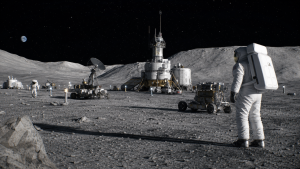
NASA has invited ISRO to join its Moon Base programme under the Artemis framework, strengthening India-U.S. cooperation in lunar exploration, human spaceflight, and long-term presence on the Moon.
NASA’s Moon Base Programme: The Artemis Framework
The Moon Base project is a core part of NASA’s Artemis programme. It aims to establish a permanent human outpost near the lunar South Pole, unlike the temporary landings of the Apollo era.
NASA has divided the programme into three phases:
| Phase | Timeline | Core Focus and Activities |
| Phase 1 | Through 2029 | Robotic exploration missions, small hopping robots, scouting of water ice, and landing site preparation. |
| Phase 2 | 2029–2032 | Initial operating capability and deployment of habitation modules and power systems. |
| Phase 3 | 2032 onward | Assembly of a permanent, city-like lunar outpost for long-duration human habitation and research. |
Strategic Choice of the Lunar South Pole
The lunar South Pole is the preferred site because permanently shadowed craters may contain water ice. This ice can be used to produce drinking water, oxygen, and hydrogen fuel for deeper space missions.
The habitat design uses hilltop locations for better sunlight exposure for solar arrays, while nuclear power systems are planned at a distance to reduce radiation risks.
India’s Strategic Path: The Artemis Accords
India joined the Artemis Accords in June 2023 and became the 27th signatory. The number of signatory nations has now reached 70.
Key Principles of the Artemis Accords
- Peaceful Exploration: Outer space activities must be conducted for peaceful purposes in accordance with international law.
- Transparency: Scientific data and operational plans should be openly shared.
- Interoperability: Space systems should follow common standards for joint operations and mutual assistance.
- Emergency Assistance: Signatories must help astronauts in distress.
- Registration of Space Objects: Space assets must be properly registered to reduce collision risks.
- Release of Scientific Data: Scientific findings should be made accessible to the global public.
- Protection of Heritage: Historic landing sites and artifacts in space should be preserved.
- Space Resources: Resources from the Moon, Mars, and asteroids may be used safely in line with the Outer Space Treaty of 1967.
India’s Domestic Lunar and Space Roadmap
The NASA invitation aligns with India’s own long-term space roadmap, which aims at self-reliance and global leadership in space exploration.
Key Stages in India’s Space Roadmap
- Gaganyaan (2026): India’s first crewed spaceflight mission to send astronauts to Low Earth Orbit (LEO).
- Chandrayaan-4 (2027/2028): A sample return mission to collect lunar soil from the South Pole and bring it back to Earth.
- Bharatiya Antariksha Station (2035): India’s indigenous space station in low Earth orbit.
- Indian Astronaut on the Moon (2040): Target year for landing an Indian astronaut on the lunar surface using indigenous technology.
- Lunar Space Station (2040): An Indian space station in lunar orbit to support surface operations.
- Permanent Indian Moon Base (2050): A permanent research base on the lunar surface.
Existing India-US Space Initiatives
The Moon Base invitation is supported by ongoing India-U.S. space cooperation.
NISAR (NASA-ISRO Synthetic Aperture Radar)
NISAR is a joint Earth-observation satellite mission designed to map the globe twice every 12 days. It uses dual-frequency synthetic aperture radar to study land surfaces, glaciers, ecosystems, and environmental hazards.
Axiom-4 Mission and Human Spaceflight
Under the U.S.-India Strategic Framework for Human Spaceflight Cooperation, Indian astronaut Group Captain Shubhanshu Shukla has been selected to fly to the International Space Station (ISS). This mission will help prepare Indian astronauts for long-duration deep-space travel.
Global Space Geopolitics: Competing Ecosystems
The Moon has become a major arena of geopolitical competition. Two major blocs are shaping lunar exploration:
- The Artemis Bloc: Led by the United States, with partners including Europe, Japan, Canada, and India.
- The ILRS Bloc: The International Lunar Research Station initiative, led by China and Russia, aiming to build a robotic and crewed base at the lunar South Pole.
For India, the U.S.-led Moon Base programme offers technical gains, training opportunities, and access to supply chains. At the same time, India continues to support strategic autonomy and open international standards.
Rare Facts for Prelims
- National Space Day: August 23 is observed as National Space Day in India after Chandrayaan-3’s lunar landing.
- First Indian on the Moon’s South Pole Region: India became the first country to reach the lunar South Pole region with Chandrayaan-3.
- LUPEX: The Lunar Polar Exploration mission is a joint ISRO-JAXA robotic mission focused on lunar water ice.
- First Indian in Space: Rakesh Sharma flew aboard Soyuz T-11 in 1984.
- Artemis Accords Origin: The Artemis Accords were launched by NASA and the U.S. State Department in 2020.
- Outer Space Treaty: The 1967 treaty remains the main international legal framework governing peaceful use of outer space.
| Related | |
|---|---|