Major Technical Textiles and Their Applications
Defining Technical Textiles
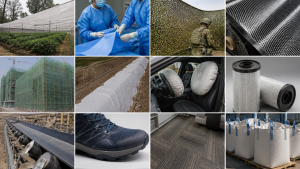
Technical textiles are materials and products manufactured primarily for their technical performance and functional properties rather than their aesthetic or decorative characteristics. They are used across sectors such as healthcare, defense, agriculture, construction, transportation, and footwear, where strength, protection, filtration, or durability is required.
The Twelve Segments of Technical Textiles
The international classification system divides technical textiles into twelve distinct segments based on end-use applications.
| Segment | Primary Focus | Key Applications | Key Materials Used |
| Agrotech | Agriculture, forestry, and aquaculture | Shade nets, mulch mats, crop covers, fishing nets | Polyethylene, polypropylene, nylon |
| Buildtech | Construction and architecture | Roofing membranes, concrete reinforcement, insulation | Glass fiber, polyester, PVC-coated fabrics |
| Clothtech | Clothing and footwear components | Interlinings, sewing threads, shoe linings, zip tapes | Polyester, nylon, cotton blends |
| Geotech | Geotechnical and civil engineering | Geotextiles, geogrids, road stabilization, erosion control | Polypropylene, polyester, polyethylene |
| Hometech | Household and furniture components | Fire-retardant upholstery, carpet backing, mattress covers | Polyester, aramid fibers, acrylic |
| Indutech | Industrial filtration and manufacturing | Conveyor belts, industrial filters, cleanroom wipes, ropes | Polyester, nylon, glass fiber, carbon fiber |
| Meditech | Medical, hygiene, and healthcare | Surgical gowns, bandages, diapers, implants, sutures | Nonwovens, polyester, cotton, biodegradable polymers |
| Mobiltech | Transportation and aerospace | Airbags, seatbelts, tire cords, aircraft insulation, carpets | High-tenacity nylon, polyester, carbon fiber |
| Oekotech | Environmental protection and ecology | Landfill liners, oil spill barriers, air purification filters | Polypropylene, polyester |
| Packtech | Packaging and storage | Bulk bags (FIBCs), protective wrapping, mesh bags | Polypropylene, polyethylene |
| Protech | Personal and property protection | Firefighter suits, bulletproof vests, spacesuits, chemical wear | Kevlar, Nomex, UHMWPE, glass fiber |
| Sportstech | Sports, leisure, and outdoor activities | Activewear, tents, parachutes, climbing ropes, sports turf | Nylon, polyester, elastane (Spandex) |
Core Segments and Applications
Agrotech
Agrotech textiles improve crop yield and shield plants from extreme weather conditions, pests, and weeds.
- Shade nets: Control sunlight exposure, temperature, and wind velocity in nurseries.
- Mulch mats: Prevent weed growth and conserve soil moisture.
- Crop covers: Shield crops from frost and harmful insects.
- Fishing nets: Heavy-duty synthetic nets assist in aquaculture and marine fishing.
Buildtech
Buildtech textiles enhance the durability and thermal efficiency of modern structures.
- Roofing membranes: Act as water barriers and thermal insulators on roofs.
- Fiber-reinforced concrete: Uses glass or polymer fibers to control structural cracking.
- Scaffolding nets: Protect construction sites from falling debris and reduce dust emissions.
Geotech
Geotech textiles are critical in infrastructure, road construction, and soil stabilization.
- Geogrids and geotextiles: Prevent soil erosion and distribute heavy loads on highways.
- Earth retaining structures: Use geotextiles to reinforce soil stability.
- Porous geotextiles: Filter soil particles while allowing water to pass through.
Meditech
Meditech fabrics focus on hygiene, patient care, and surgical procedures.
- Implantable materials: Include artificial arteries, vascular grafts, and surgical sutures.
- Non-implantable materials: Consist of bandages, wound dressings, and plasters.
- Extracorporeal devices: Use specialized hollow fibers for artificial kidneys and oxygenator membranes.
- Hygiene products: Baby diapers, sanitary napkins, and adult incontinence pads rely heavily on superabsorbent nonwovens.
Mobiltech
Mobiltech materials are integrated into passenger vehicles, trains, and aircraft to improve safety and comfort.
- Airbags and seatbelts: Require high-tensile-strength nylon and polyester fibers.
- Carbon fiber composites: Reduce the overall weight of aircraft and sports cars.
- Nylon tire cords: Reinforce rubber tires, providing heat resistance and stability under heavy loads.
Protech
Protech textiles shield humans from environmental hazards, chemicals, ballistics, and fire.
- Bulletproof vests and helmets: Use Ultra-High-Molecular-Weight Polyethylene (UHMWPE) and aramid fibers.
- Firefighter uniforms: Utilize specialized Nomex fibers to resist extreme heat.
- Barrier fabrics: Multi-layer fabrics shield military and medical personnel from hazardous biological and chemical agents.
Key Materials Used in Technical Textiles
The manufacturing of technical textiles relies on both synthetic and high-performance fibers.
Synthetic Fibers
- Polyester (PES): Offers high strength, low stretch, and resistance to chemicals. This makes it ideal for seatbelts, conveyor belts, and filtration.
- Nylon (Polyamide): Provides exceptional abrasion resistance and elasticity, which is useful for airbags, parachutes, and tire cords.
- Polypropylene (PP): Is lightweight, chemically inert, and hydrophobic. It is the dominant material in nonwoven hygiene products and geotextiles.
High-Performance Fibers
- Aramids: Kevlar offers high tensile strength and impact resistance, while Nomex provides high thermal stability and flame resistance.
- Carbon fiber: Features high stiffness, low weight, and high chemical resistance. It is essential for aerospace and automotive composites.
- Glass fiber: Is known for high strength and flame retardancy, making it useful in concrete reinforcement and insulation.
- UHMWPE: Features extreme impact strength and low density, which is suitable for body armor and industrial ropes.
Government Policy and Initiatives in India
The development and adoption of technical textiles are supported by several key policy initiatives.
- National Technical Textiles Mission (NTTM): Launched in 2020 with a budget of Rs 1,480 crore to position India as a global leader in technical textiles.
- Mission components: Research and Innovation, Promotion and Market Development, Export Promotion, and Skill Development.
- Production Linked Incentive (PLI) Scheme: Supports domestic manufacturing of man-made fibers (MMF) and technical textile products.
- PM MITRA Parks: Focus on developing integrated textile ecosystems, including technical textile manufacturing.
- HSN codes: The Ministry of Textiles has introduced dedicated Harmonized System of Nomenclature codes for technical textiles to streamline trade.
- Mandatory usage orders: Exist for specific technical textile products across multiple central ministries.
Exam point: Technical textiles are increasingly linked with value addition, innovation ecosystem development, and import substitution in India.
Footwear link: Technical textiles form over 90% of the material base in footwear manufacturing, especially in uppers, linings, reinforcements, and performance layers.
Current status: The 10th India International Footwear Fair (IIFF) 2026 was held at Bharat Mandapam, New Delhi, from August 6 to August 8, 2026.
Industry note: India’s footwear sector employs nearly 4.5 million people and contributes about 12% to 13% of global footwear production.
Policy note: India’s share in global footwear exports is around 2%, and the footwear-sector PLI scheme is linked to incremental production and sales.
Investment update: At the session titled “Bihar: The Next Frontier of Global Footwear Manufacturing,” Bihar secured investment proposals worth ₹125 crore, expected to generate 1,800 jobs.
Rare Facts for Prelims
- Technical textiles are not limited to clothing: They are also used in civil engineering, environmental protection, and aerospace.
- Geotextiles can be permeable: They allow water flow while retaining soil particles, which is why they are widely used in drainage systems.
- Nomex is flame-resistant: It is widely used in firefighter gear and other heat-protection applications.
- UHMWPE is extremely light: It offers high impact resistance at a very low density, making it useful in body armor.
- Nonwovens dominate hygiene products: They are central to diapers, sanitary napkins, and adult incontinence products.
- Technical textiles are often hidden inside products: Many are not visible to consumers but are essential for performance, safety, and durability.
| Related | |
|---|---|