Rice Procurement and Food-Security Support Schemes
Introduction
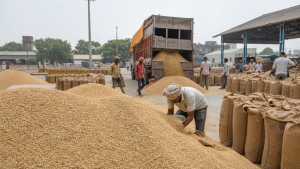
Rice procurement is a core part of India’s food-security system. By purchasing paddy at the Minimum Support Price (MSP), the government supports farmers, builds public stocks and supplies grain for welfare distribution.
The system is closely linked to the Targeted Public Distribution System (TPDS) and other food-security schemes, making procurement an important administrative and policy mechanism.
The Institutional Framework of Rice Procurement
Foodgrain procurement is managed through coordinated central and state action.
- Nodal ministry: The Department of Food and Public Distribution functions under the Ministry of Consumer Affairs, Food and Public Distribution.
- FCI role: The Food Corporation of India (FCI), established under the Food Corporations Act, 1964, is the principal central agency for purchase, storage and distribution.
- State agencies: State procuring agencies also participate in purchase operations and movement of stocks, depending on the procurement model adopted.
- Central pool: Procured rice and paddy are used to maintain central stocks for welfare distribution and buffer needs.
Centralised and Decentralised Procurement
India uses two broad procurement systems to improve grain management and distribution efficiency.
- Centralised procurement (Non-DCP): FCI or state agencies purchase paddy directly, and stocks are transferred to the central pool for storage and distribution.
- Decentralised procurement (DCP): Introduced in 1997–98, this model allows state governments to procure, store and distribute foodgrains locally under welfare schemes.
- Cost reimbursement: In the DCP system, the central government reimburses procurement and related costs.
- Surplus handling: Any surplus stocks under DCP are handed over to the central pool.
MSP and Procurement for Kharif Marketing Season 2026–27
The Minimum Support Price is recommended by the Commission for Agricultural Costs and Prices (CACP) and approved by the Cabinet Committee on Economic Affairs. For Kharif Marketing Season (KMS) 2026–27, starting 1 October 2026, the government has fixed revised MSP rates and procurement targets.
| Metric | Rate / Target | Previous Season Baseline |
| Paddy (Common) MSP | ₹2,441 per quintal | ₹2,369 per quintal (2025–26) |
| Paddy (Grade A) MSP | ₹2,461 per quintal | ₹2,389 per quintal (2025–26) |
| Paddy procurement target | 708.64 LMT | 720.74 LMT (kharif procurement achieved in the previous season) |
- Target trend: The 708.64 LMT target is slightly lower than the previous season’s achieved procurement of 720.74 LMT.
- Administrative lead: The procurement targets are being steered by the Department of Food and Public Distribution.
Quality Reforms in Rice Distribution
In July 2026, the Cabinet Committee on Economic Affairs approved a reform to improve the quality of rice distributed under welfare schemes and reduce storage-related losses.
- Raw rice standard: Permissible broken grain content has been reduced from 25% to 10%.
- Parboiled rice standard: Permissible broken grain content has been reduced from 16% to 5%.
- Improved Rice: Procurement under the revised standards will begin gradually in KMS 2026–27.
- Full rollout: The new standards are to be implemented across all procuring states by 2027–28.
- Estimated savings: The reform is projected to save about ₹2,161 crore annually.
- Industrial use: Broken rice can be diverted for industrial use, improving overall stock management.
Modernisation and Storage Initiatives
The procurement system is also being strengthened through digital tools, cooperative storage and direct-benefit innovations.
- AI-based validation: The Procurement Centre Smart-Assessment Portal will use AI-based image validation from KMS 2026–27.
- PACS godowns: Under the decentralised grain storage plan in the cooperative sector, godown construction was completed in 313 Primary Agricultural Credit Societies by July 2026.
- Storage capacity: These godowns created over 1.80 LMT of storage capacity.
- CBDC pilot: On 14 August 2026, a Central Bank Digital Currency-based Direct Benefit Transfer pilot was launched for the Pradhan Mantri Garib Kalyan Anna Yojana in Chandigarh and Dadra & Nagar Haveli.
- Transparency goal: The use of digital systems is meant to reduce transit losses and improve monitoring.
Key Prelims Takeaways
- Nodal department: The Department of Food and Public Distribution functions under the Ministry of Consumer Affairs, Food and Public Distribution.
- FCI: The Food Corporation of India was created under the Food Corporations Act, 1964, and began operations in 1965.
- DCP scheme: Decentralised procurement was introduced in 1997–98.
- MSP 2026–27: Paddy (Common) MSP is ₹2,441 per quintal and Paddy (Grade A) MSP is ₹2,461 per quintal.
- Paddy target: The procurement target for KMS 2026–27 is 708.64 LMT.
- Quality norms: Broken grain limits have been reduced to 10% for raw rice and 5% for parboiled rice.
- Storage and digital push: 313 PACS godowns created over 1.80 LMT capacity, and an AI-based validation system is being introduced.
| Related | |
|---|---|