Important Endangered Birds of India
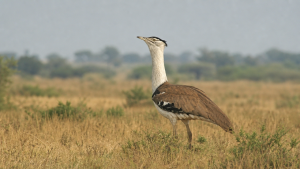
India’s bird diversity includes several species facing an extreme risk of extinction. For Prelims revision, the most important names are the Great Indian Bustard and other critically endangered birds linked to grasslands, forests, wetlands, and migration corridors.
Great Indian Bustard: flagship species of grasslands
The Great Indian Bustard (Ardeotis nigriceps) is one of the heaviest flying birds in the world and a major conservation symbol for India’s grassland ecosystems. It is a ground-dwelling species of the Indian subcontinent, mainly associated with arid and semi-arid open landscapes.
- Status: Critically Endangered on the IUCN Red List.
- Indian legal protection: Schedule I of the Wildlife (Protection) Act, 1972.
- State bird: Rajasthan.
- Core habitat: Arid and semi-arid grasslands of India and Pakistan.
- Important Indian habitat: Desert National Park, Jaisalmer, Rajasthan.
- Other Indian ranges: Parts of Gujarat, Maharashtra and Karnataka.
The species is closely tied to the protection of grassland habitat in western Rajasthan, especially the Thar Desert landscape. Its conservation is important not only for one bird, but also for the larger issue of protecting open natural ecosystems that are often overlooked in biodiversity planning.
Conservation breeding and recovery efforts
India has moved from protection to active species recovery for the Great Indian Bustard. The Integrated Great Indian Bustard Conservation Project was launched in 2016, followed by a large-scale conservation breeding programme in Rajasthan in 2019.
- Integrated Great Indian Bustard Conservation Project: Launched in 2016.
- Conservation breeding programme: Began in Rajasthan in 2019.
- Modern breeding centre: Located at Ramdevra in Rajasthan.
- First captive-bred chick: Born in March 2023 at the Ramdevra centre.
- Supervision: Wildlife Institute of India (WII).
- Rewilding training: Captive-bred birds are trained in specially designed tunnels to reduce human dependence and prepare them for open habitats.
WII, an autonomous premier research institution under the Ministry of Environment, Forest and Climate Change, plays a central role in technical supervision. The conservation effort also includes habitat management and reintroduction planning, because long-term recovery depends on safe grassland conditions, not captivity alone.
Other critically endangered birds in India
Several other bird species in India are also listed as Critically Endangered and require habitat-specific protection. Many of them are highly localised, migratory, or dependent on fragile ecosystems.
- Spoon-billed Sandpiper (Calidris pygmaea): A small migratory wader that breeds in northeastern Russia and winters in Southeast Asia, including parts of India. Habitat loss and degradation are major threats.
- Jerdon’s Courser (Rhinoptilus bitorquatus): Once believed extinct, it was rediscovered in 1986 in Andhra Pradesh. It is endemic to the Eastern Ghats and threatened by agricultural expansion and scrub jungle clearance.
- Forest Owlet (Athene blewitti): Endemic to the forests of central India and rediscovered in 1997 after more than a century. Deforestation and habitat fragmentation threaten its small population.
- Bengal Florican (Houbaropsis bengalensis): A large bustard of grasslands and open woodlands, found in fragmented populations in India, Nepal and Cambodia. Conversion of grasslands for agriculture is its major threat.
- Sociable Lapwing (Vanellus gregarius): A migratory bird breeding in Central Asia and wintering in parts of the Middle East, Pakistan and India. Habitat loss and hunting along migration routes threaten the species.
For Prelims, note that these birds reflect different conservation challenges: grassland degradation, forest loss, wetland pressure, migration-route threats and illegal hunting. Their protection is linked to wider biodiversity conservation and species recovery efforts.
Legal protection and conservation framework
India’s wildlife laws and international commitments provide the basic framework for protecting endangered birds. These instruments are important because they combine species protection with habitat conservation and regulation of trade.
- Wildlife (Protection) Act, 1972: Provides protection to wild animals, birds and plants.
- Schedule I: Gives the highest level of protection, with strict prohibition on hunting and severe penalties for violations.
- Examples under Schedule I: Great Indian Bustard, Bengal Florican and Jerdon’s Courser.
- CITES: The Convention on International Trade in Endangered Species of Wild Fauna and Flora regulates international trade in specimens of wild animals and plants.
- Integrated Development of Wildlife Habitats (IDWH): A centrally sponsored scheme that supports states and UTs for wildlife protection, habitat conservation and species recovery programmes.
These frameworks matter because endangered birds cannot be saved through legal protection alone. Their habitats, food sources, breeding sites and migration corridors must remain intact for populations to stabilise.
Major threats to avian biodiversity
Bird populations decline when natural habitats are altered faster than species can adapt. In India, the pressure comes from both direct human activity and ecological change.
- Habitat loss and degradation: Conversion of natural areas for agriculture, urbanisation, infrastructure and mining fragments bird habitats.
- Pesticide use: Chemical use can poison birds directly or reduce prey and food availability.
- Power lines and wind turbines: Collision risk is high for large birds such as bustards and raptors.
- Poaching and illegal trade: Some species are targeted for meat, feathers or the pet trade.
- Climate change: Changing rainfall, extreme weather and altered seasonality affect breeding, migration and food supply.
For exam purposes, the Great Indian Bustard is especially important because its survival is tied to open grasslands, which are among the most threatened and least protected ecosystems in India.
Key Prelims Takeaways
- Great Indian Bustard: Critically Endangered; Schedule I, Wildlife (Protection) Act, 1972; state bird of Rajasthan.
- Key habitat: Arid and semi-arid grasslands, especially Desert National Park, Jaisalmer.
- Conservation project: Integrated Great Indian Bustard Conservation Project launched in 2016.
- Breeding programme: Rajasthan conservation breeding began in 2019; first captive-bred chick born in March 2023.
- WII role: Technical supervision and rewilding support for captive-bred birds.
- Other Critically Endangered birds: Spoon-billed Sandpiper, Jerdon’s Courser, Forest Owlet, Bengal Florican and Sociable Lapwing.
- Protection tools: Wildlife (Protection) Act, 1972; CITES; Integrated Development of Wildlife Habitats.
Recent Context
In Jaisalmer district of Rajasthan, 10 captive-bred Great Indian Bustards are being released on October 3 and 4, 2026 at Ramdevra and Sudasari in the Desert National Park. The birds will be monitored for movement, habitat use, adaptation and survival, marking a significant step in species recovery.
| Related | |
|---|---|