Important Amphibian Species in India
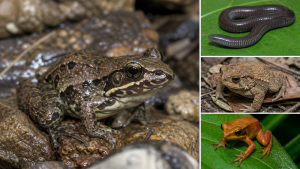
Amphibians are an important part of India’s biodiversity, linking aquatic and terrestrial ecosystems. From frogs and toads to caecilians, these vertebrates are useful indicators of environmental health because they depend on moist habitats and are sensitive to pollution, habitat change and climate stress. India’s varied landscapes, especially the Western Ghats, continue to reveal new species and fresh conservation concerns.
Understanding Amphibians
Amphibians belong to Class Amphibia under Kingdom Animalia. They are vertebrates that usually begin life in water as larvae and later undergo metamorphosis into terrestrial adults. Their skin is permeable, so they need moist surroundings to avoid desiccation. They are also ectothermic, meaning their body temperature depends on external sources.
Amphibians are not just biologically interesting; they also have ecological value. By feeding on insects and other small organisms, they help regulate food chains and act as sensitive bioindicators of ecosystem change.
Amphibian Diversity in India
India is home to a rich amphibian fauna, with 458 species recorded so far. This diversity reflects the country’s wide range of habitats, from rainforests and hill ranges to wetlands and stream ecosystems. Many species are narrowly distributed and remain poorly studied, which makes field documentation important for conservation planning.
A large share of Indian amphibians is concentrated in biodiversity-rich regions, especially the Western Ghats. New discoveries from such areas show that species inventories are still incomplete and that some local forms may remain undiscovered in fragmented or remote habitats.
Caecilians: The Limbless Amphibians
Caecilians belong to the order Gymnophiona and are among the least familiar amphibians. They are limbless, elongated and burrowing animals that are often mistaken for worms or snakes. Most species live underground or in moist soil, which makes them difficult to observe and survey.
- Distribution: Mostly found in tropical regions.
- Habitat: Burrow in soil and prefer damp microhabitats.
- Diet: Feed mainly on small invertebrates found in soil.
- India’s record: India has 42 caecilian species.
Because of their secretive lifestyle, caecilians are often underrepresented in biodiversity assessments. This makes taxonomic work and repeated field surveys especially important in regions with suitable habitats.
Western Ghats as an Amphibian Hotspot
The Western Ghats is a mountain chain running parallel to India’s western coast and is among the country’s most important centres of amphibian diversity. It is a UNESCO World Heritage Site, inscribed in 2012, and is also identified as one of the world’s eight “hottest hotspots” of biological diversity.
This region supports high levels of endemic species, meaning many amphibians occur nowhere else in the world. The Ghats are especially significant for caecilians, with 26 endemic caecilian species recorded from the region.
- Biodiversity value: High species richness and endemism.
- Conservation value: Many species are restricted to small habitats.
- Research value: Frequent new discoveries point to incomplete documentation.
- Ecological value: Streams, forests and moist soils support amphibian life cycles.
Important Genera and Endemism
Several amphibian genera show strong endemism in India, particularly in the Western Ghats. The caecilian genus Gegeneophis is a key example. India records 12 species of this genus, of which 11 are endemic to the Western Ghats. This pattern highlights how concentrated and localized amphibian diversity can be in India.
- Gegeneophis: Important caecilian genus with strong Western Ghats endemism.
- Indirana: Indian Dancing Frogs.
- Nyctibatrachus: Night Frogs.
- Micrixalus: Torrent Frogs.
- Raorchestes: Shrub Frogs.
These genera are of special interest because many of their species have restricted ranges and face pressure from habitat loss, fragmentation and changing climatic conditions. For prelims, the key point is that Indian amphibian endemism is strongly linked to the Western Ghats.
Conservation Status and Major Threats
Amphibians are among the most threatened vertebrate groups globally. About 41% of amphibian species are threatened with extinction. Their permeable skin, dependence on moisture and complex life cycles make them highly vulnerable to habitat disturbance, pollution and disease.
- Habitat loss: Forest clearing, land-use change and infrastructure development reduce suitable habitats.
- Fragmentation: Small, isolated populations become more vulnerable to decline.
- Pollution: Amphibians absorb contaminants easily through their skin.
- Disease: Chytridiomycosis has emerged as a major global threat.
- Climate stress: Changes in rainfall and temperature affect breeding and survival.
The Zoological Survey of India has stressed that species discovery is not only a scientific achievement but also a conservation tool. Documenting species early helps identify populations that may otherwise face silent extinctions in fragmented habitats.
Key Prelims Takeaways
- Amphibians are cold-blooded vertebrates that usually need moist habitats.
- India has 458 amphibian species recorded so far.
- Caecilians belong to the order Gymnophiona and are limbless burrowing amphibians.
- India has 42 caecilian species.
- The Western Ghats is a UNESCO World Heritage Site inscribed in 2012.
- The Western Ghats is one of the world’s eight “hottest hotspots” of biodiversity.
- The region hosts 26 endemic caecilian species.
- India records 12 species of Gegeneophis, of which 11 are endemic to the Western Ghats.
- Indirana, Nyctibatrachus, Micrixalus and Raorchestes are important Indian amphibian genera.
- Globally, 41% of amphibian species are threatened with extinction.
- Key threats include habitat loss, fragmentation, pollution, disease and climate stress.
- Amphibian surveys are important for species documentation and monitoring biodiversity loss.
Recent Context
The Northern Western Ghats in Maharashtra recently added a new subterranean amphibian, Gegeneophis chandgadi, from the Kolhapur region in September 2026. It was found in Buzawade village in Chandgad, and the name refers to the Chandgadi dialect of Marathi. Another species, Gegeneophis valmiki, was reported from the Valmiki Plateau in Satara district in January 2026.
| Related | |
|---|---|