Major Aircraft Engines and Propulsion Types
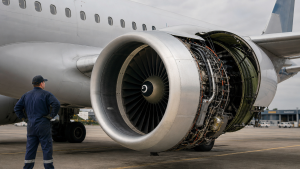
Aircraft propulsion systems create the thrust needed to overcome drag and move an aircraft forward. They are broadly classified by how they obtain oxygen for combustion, and by the speed regime in which they operate.
Principles of Aircraft Propulsion
Aircraft propulsion systems generate the thrust necessary to overcome aerodynamic drag and move an aircraft through the air. This process relies on Newton’s second and third laws of motion. Thrust is produced by accelerating a mass of air or gas in the direction opposite to flight. An engine can generate thrust either by accelerating a large mass of air to a low velocity, as seen in propeller systems, or by accelerating a small mass of gas to a very high velocity, as seen in jet engines.
Classification of Propulsion Systems
Aviation propulsion systems fall into two primary categories based on how they source oxygen for fuel combustion:
Air-Breathing Engines
These engines draw oxygen directly from the surrounding atmosphere to burn fuel. They cannot operate in space where there is no atmosphere. This category includes reciprocating piston engines, gas turbine engines, ramjets, and scramjets.
Non-Air-Breathing Engines
These engines carry both fuel and an oxidizer on board. This design allows them to operate in the vacuum of space. Rocket engines are the primary example of this category.
Reciprocating Piston Engines
Reciprocating engines represent the oldest form of aircraft propulsion, dating back to the early flight era. They utilize pistons moving back and forth within cylinders to turn a crankshaft, which drives a propeller.
- Fuel Type: These engines typically run on aviation gasoline (Avgas) or diesel.
- Configurations: Common cylinder arrangements include radial, inline, V-type, and horizontally opposed.
- Operating Range: Piston engines are highly efficient at low altitudes and low speeds, typically below 250 knots.
- Applications: They are widely used in light general aviation aircraft, flight training airplanes like the Cessna 172, and small utility aircraft.
Gas Turbine Engines
Gas turbine engines operate on the Brayton thermodynamic cycle. The cycle involves four continuous stages: intake, compression, combustion, and exhaust. High-pressure gases spin a turbine, which drives the compressor.
Turbojet Engines
The turbojet is the simplest gas turbine engine. All the air entering the intake passes through the engine core—consisting of the compressor, combustor, and turbine—before exiting as a high-velocity jet through the nozzle.
- Characteristics: Turbojets provide high thrust at high speeds but are loud and inefficient at subsonic speeds.
- Applications: They powered early commercial transports like the Concorde and early-generation fighter jets. Today, they are mostly limited to unmanned aerial vehicles (UAVs) and cruise missiles.
Turbofan Engines
Turbofan engines feature a large fan at the front of the engine. This fan splits the incoming air into two paths. Part of the air enters the engine core for combustion, while the rest bypasses the core.
- Bypass Ratio (BPR): The ratio of bypassed air to air entering the core is the bypass ratio. High-bypass engines are fuel-efficient and quiet, making them ideal for commercial aviation. Low-bypass engines are narrower, produce higher exhaust speeds, and are used in military supersonic aircraft.
- Applications: Modern commercial airliners utilize high-bypass turbofans.
Turboprop Engines
In a turboprop, a gas turbine core drives a conventional propeller through a reduction gearbox. The gearbox reduces the high rotational speed of the turbine shaft to a speed suitable for the propeller.
- Thrust Mechanism: Most of the total thrust comes from the propeller, while the remaining thrust comes from the exhaust gases.
- Performance: Turboprops are highly efficient at medium altitudes and speeds between 250 and 400 knots. They lose efficiency at higher speeds due to aerodynamic drag on the propeller tips.
- Applications: Regional turboprop airliners and military transport aircraft rely on this system.
Turboshaft Engines
A turboshaft engine is structurally similar to a turboprop, but the turbine drives a shaft that delivers power to something other than a propeller. The exhaust gases produce virtually no thrust.
- Transmission: The shaft connects to a transmission system, which powers a rotor or auxiliary equipment.
- Applications: Turboshafts power helicopters and serve as Auxiliary Power Units (APUs) on large transport aircraft.
High-Speed Propulsion: Ramjets and Scramjets
At high speeds, the mechanical compressors and turbines of traditional gas turbine engines are unnecessary and cannot withstand the extreme heat. High-speed flight allows the physical shape of the engine inlet to compress the incoming air naturally.
Ramjets
Ramjets have no moving parts. The forward speed of the vehicle rams incoming air into the duct, compressing it. Fuel is injected, ignited, and the expanding gases exhaust through a nozzle.
- Operational Envelope: Ramjets require a minimum speed of around Mach 2 to compress the air effectively. They cannot produce static thrust and must be launched using a booster rocket.
- Combustion Speed: Air passing through the combustor is slowed down to subsonic speeds.
- Applications: Used in missiles such as the MBDA Meteor.
Scramjets
A Scramjet (Supersonic Combustion Ramjet) is an evolution of the ramjet. It maintains supersonic airflow throughout the entire engine, including the combustion chamber.
- Operational Envelope: Scramjets operate at hypersonic speeds, typically starting from Mach 5 up to Mach 10 and beyond.
- Technical Challenges: Maintaining stable combustion in supersonic airflow is extremely difficult.
- Applications: Hypersonic cruise missiles and experimental research vehicles.
Rocket Propulsion
Rocket engines do not rely on atmospheric oxygen. They carry both fuel and an oxidizer on board. They operate via high-pressure combustion that expels exhaust gas through a nozzle to produce thrust.
- Solid Propellant Rockets: Fuel and oxidizer are mixed into a solid chemical compound. Once ignited, they burn continuously until exhausted. They produce massive thrust but cannot be throttled or restarted.
- Liquid Propellant Rockets: Liquid fuel and liquid oxidizer are pumped into a combustion chamber. These systems can be throttled, shut down, and restarted in flight.
- Specific Impulse (Isp): This parameter measures the efficiency of a rocket engine, representing thrust produced per unit of propellant consumed per second.
Key Parameters and Comparison of Propulsion Types
| Propulsion Type | Compressor Mechanism | Typical Speed Range | Fuel Efficiency | Primary Applications |
| Reciprocating Piston | Reciprocating Pistons | < 250 knots (Mach 0.3) | High at low speed | General aviation, trainer aircraft |
| Turboprop | Axial/Centrifugal Compressor | Mach 0.3 – 0.6 | Very High (medium speed) | Regional airliners, cargo aircraft |
| Turbofan | Fan and Axial Compressor | Mach 0.5 – 0.9 | High (subsonic/transonic) | Commercial transport, business jets |
| Turbojet | Axial Compressor | Mach 0.8 – 2.0 | Medium to Low | Military fighters, cruise missiles |
| Ramjet | Ram Compression (Inlet geometry) | Mach 2.0 – 5.0 | Low at low speed; High at Mach 3+ | Supersonic missiles, target drones |
| Scramjet | Ram Compression (Supersonic) | Mach 5.0 – 15.0 | High at hypersonic speeds | Hypersonic missiles, space planes |
| Rocket | None (Pressurized tanks/pumps) | Unlimited (vacuum capable) | Low (consumes propellant rapidly) | Space launch vehicles, ICBMs |
Future Trends in Aircraft Propulsion
Aviation technology continues to adapt to meet environmental and efficiency goals.
- Electric Propulsion: Small aircraft and electric Vertical Takeoff and Landing (eVTOL) vehicles use electric motors powered by batteries. They produce zero direct emissions and operate quietly.
- Hybrid-Electric Systems: These configurations pair conventional gas turbines with electric motors. The gas turbine acts as a generator to power electric motors or assist during high-thrust flight phases like takeoff.
- Hydrogen Fuel Systems: Hydrogen can either be burned directly in modified gas turbine engines or used in fuel cells to generate electricity. This process produces water vapor as the primary byproduct.
- Open Rotor Engines: This design features unducted fan blades outside the engine cowl. This setup combines the speed of a turbofan with the high fuel efficiency of a turboprop.
Recent Context
HAL and Safran Helicopter Engines signed a contract through SAFHAL for the Aravalli turboshaft engine, aimed at the 3,500-4,000 shp class. It is selected for HAL’s IMRH and DBMRH helicopters, supporting indigenous aerospace capability and reduced import dependence.
Rare Facts for Prelims
- The first practical jet engine was independently developed by Frank Whittle and Hans von Ohain in the 1930s.
- Bypass ratio is one of the biggest reasons modern airliners are quieter than older turbojets.
- Turboprops are often more efficient than turbofans on short regional routes because propellers work well at lower speeds.
- Ramjets cannot operate from standstill because they need forward motion to compress incoming air.
- Specific impulse is usually expressed in seconds and is a key measure of rocket performance.
- Scramjets keep airflow supersonic inside the combustor, unlike ramjets that slow it to subsonic speed.
| Related | |
|---|---|