Robotics, AI and Automation Policies in India
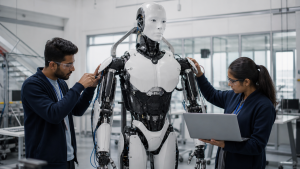
India is building a policy framework for robotics, artificial intelligence and automation across sectors such as banking, courts, education and national security. The focus is on safe use, ethical deployment, accountability and support for domestic innovation.
Draft National Strategy on Robotics
The Ministry of Electronics and Information Technology (MeitY) released the Draft National Strategy on Robotics on September 4, 2023, and later issued a revised draft in February 2024. The strategy aims to position India as a global robotics hub by 2030.
- Priority sectors: Manufacturing, healthcare, agriculture and national security.
- National Robotics Mission (NRM): Proposed as the nodal mechanism to manage and implement the strategy.
- Robotics Innovation Unit (RIU): Recommended under MeitY to coordinate research and local supply chain development.
- Policy goal: To promote automation while building domestic capability in robotics hardware, software and integration.
India AI Governance Guidelines
MeitY released the India AI Governance Guidelines on November 6, 2025, based on a drafting committee constituted in July 2025. The document sets out a non-binding, techno-legal framework for safe and ethical AI deployment.
- Voluntary approach: The framework relies on self-certification and voluntary compliance by developers and organisations.
- Existing law continues: Legal liability remains enforceable under the Information Technology Act, 2000, the Digital Personal Data Protection Act, 2023, and relevant IT Rules.
- Seven ethical Sutras: Trust, People First, Innovation over Restraint, Fairness & Equity, Accountability, Understandable by Design, and Safety, Resilience & Sustainability.
- Regulatory intent: Encourage responsible innovation without creating a rigid licensing regime for all AI use cases.
AI in Financial Sector: RBI’s FREE-AI Report
The Reserve Bank of India published the Framework for Responsible and Ethical Enablement of Artificial Intelligence (FREE-AI) report on August 13, 2025. The framework was prepared by an expert committee chaired by Dr. Pushpak Bhattacharyya.
- 26 recommendations: Designed to guide the use of AI in banking and financial technologies.
- Six pillars: Infrastructure, Policy, Capacity, Governance, Protection and Assurance.
- Purpose: To support responsible adoption of AI in the financial sector while addressing risks related to transparency, security and consumer protection.
Judicial AI Regulations: 2026 Draft
The Supreme Court of India’s Artificial Intelligence Committee released the preliminary draft Regulations for Use of Artificial Intelligence in Courts, 2026 on June 3, 2026. Public feedback remained open until June 20, 2026.
- Permitted uses: Legal research, translation and case management.
- Prohibited uses: Deciding cases, passing sentences or determining bail.
- Disclosure requirement: Litigants and legal representatives must disclose AI use in pleadings and related documents when filing.
- Responsibility: Users remain legally accountable for errors, including hallucinations, in AI-assisted filings.
Funding, Budgets and National Schemes
Several schemes and allocations support deep-tech development, robotics and AI in India. These include central funding mechanisms and education-focused initiatives.
- RDI Scheme: Launched on November 3, 2025, with an outlay of ₹1 lakh crore over six years to incentivise private investment in deep tech, robotics, quantum computing and AI.
- RDI Fund allocation: The Union Budget 2026-27 provided ₹20,000 crore for the fund.
- IndiaAI Mission: Received ₹1,000 crore in the Union Budget 2026-27, down from ₹2,000 crore in the previous year due to underutilised funds.
- AI for Education: The Union Budget 2025-26 provided ₹500 crore for a Centre of Excellence in AI for Education.
- Skilling push: The same budget proposed five National Centres of Excellence for Skilling.
- School integration: The Union Budget 2026-27 set up a High-Powered Education to Employment and Enterprise Committee to integrate AI into school-level curricula.
- Bharat-Gen: A DST initiative under the National Mission on Interdisciplinary Cyber-Physical Systems (NM-ICPS) to build multimodal and multilingual generative AI models.
Key Prelims Takeaways
- National Robotics Mission (NRM): Proposed under MeitY to coordinate robotics development across four priority sectors.
- Draft Robotics Strategy: Aims to make India a global robotics hub by 2030.
- India AI Governance Guidelines: Based on voluntary compliance, self-certification and seven ethical Sutras.
- Legal liability in AI: Remains governed by existing laws, including the IT Act, 2000 and DPDP Act, 2023.
- FREE-AI report: RBI’s 26-recommendation framework for responsible AI use in banking and finance.
- Judicial AI draft: Allows support functions but bars AI from adjudicatory roles such as deciding cases or bail.
- Bharat-Gen: DST-led initiative for multilingual generative AI under NM-ICPS.
| Related | |
|---|---|